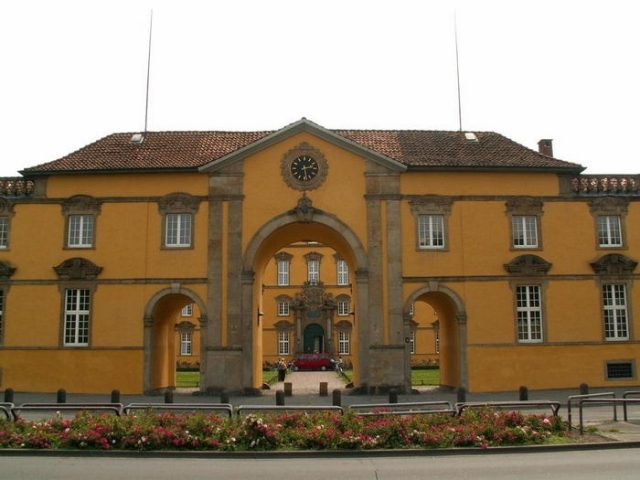
CastleOsnabrück

Osnabrück Castle

Osnabrück Castle

University of Osnabrück

Osnabrück Castle was the residence of the Protestant Prince-Bishop Ernst August I of Braunschweig-Lüneburg and his wife Sophie of the Palatinate. Since 1974, it has been the seat of the administration of the University of Osnabrück. The building and its garden, including the sculptures in the castle garden and the Lyra Monument, are listed as historical monuments.

In 1662, Ernst August became Bishop of Osnabrück. Like his predecessors since the 11th century, he resided in Iburg Castle, located south of the city. This soon no longer met his representational demands. Furthermore, he intended to limit the independence of the city. In Osnabrück, there was no building suitable for his purposes. The Petersburg, built by his Catholic predecessor Franz Wilhelm von Wartenberg and only temporarily inhabited, had already been razed by the citizens of Osnabrück in 1648.

Ernst August bought a plot of land in the new town. In 1667, construction began on the four-winged Baroque-style castle. Various architects were commissioned with the construction. The four-story residential building, the Corps de Logis, housed living and guest rooms, utility rooms, the stables, a chapel, and on the third floor, a 25-meter-long ballroom. Sophie of the Palatinate also contributed ideas after visiting castles and gardens in France with her daughter Sophie Charlotte. She particularly took on the task of designing the castle park.

By 1673, the castle was ready for occupancy. The couple's youngest son, Ernst August II of Hanover, was born in Osnabrück Castle in 1674. The bishop's family left Osnabrück after Ernst August's older brother, Johann Friedrich, died in 1679 and Ernst August succeeded him in the Principality of Calenberg. The family henceforth resided in Hanover, but Sophie mourned the Osnabrück residence: "I will miss the garden and the castle in Osnabrück my whole life. My garden, my flowers, my house, my furniture: I find myself suddenly deprived of these joys."

Osnabrück Castle mostly stood empty, with the exception of the years when Ernst August and Sophie's son Ernst August II succeeded the Catholic Bishop Karl Joseph of Lorraine in 1715 and resided in Osnabrück. Ernst August II's older brother, Georg Ludwig, became King George I of Great Britain and Ireland. He died on June 11, 1727, in Osnabrück Castle while on his way from England to Hanover. Ernst August II died on August 14, 1728, in Osnabrück Castle. He was succeeded by Clemens August I of Bavaria, again a Catholic, as bishop. The castle was neglected and threatened to fall into disrepair.

From 1803, the castle served as an administrative building. During World War II, it was destroyed by bombing; only the outer walls remained. After the war, it was rebuilt; the interiors were remodeled several times.

Gestapo Cellar+

During the National Socialist era, the Secret State Police (Gestapo) was housed from 1938 onwards in the former riding hall in the western wing of the castle. In the cellar, they set up five detention and torture cells. Jewish residents of Osnabrück were imprisoned there during the November Pogroms in 1938 before being taken to Buchenwald concentration camp. Later inmates of the penal camp for foreign forced laborers at Augustaschacht Ohrbeck were also initially held here, as were political prisoners and Jews who continued to be persecuted. Since 1995, a memorial plaque on the west wing of the castle commemorates the Gestapo victims in Osnabrück. After the end of the war, the rooms were temporarily used as storage. In 2001, the association "Memorial Gestapo Cellar in Osnabrück Castle," with the support of the University of Osnabrück, opened the Gestapo Cellar Memorial with permanent and temporary exhibitions.

College of Education and University+

In 1953, the Adolf-Reichwein-Hochschule, a College of Education, was moved from Celle to Osnabrück. It took up residence in Osnabrück Castle. In 1969, all eight Colleges of Education in the state of Lower Saxony were merged as the College of Education Lower Saxony. The Vechta and Osnabrück departments were integrated into the new University of Osnabrück on December 5, with the law on the organization of the Universities of Oldenburg and Osnabrück proclaimed on December 3, 1973. It began teaching in the summer semester of 1974. The university administration has since been located in the castle. In addition, the subject units Music/Musicology and Protestant Theology are housed in the main castle building. The castle auditorium is used for larger events, concerts, and conferences.

Castle Garden+

The castle garden, with an area of more than three hectares, was planned in 1674 by the French garden architect Martin Charbonnier. He was also involved in the further development of the Great Garden in Herrenhausen. Sophie of the Palatinate reported on the work in the castle garden: "I get up every morning at six o'clock. Then I watch the soldiers enlarging our garden and surrounding it with a canal. It is not yet very beautiful, but I am pleased to see it progressing. I hope to end my days here; I will never be more comfortable." A water basin was created in the center of the symmetrical park with a central axis; a forest formed the southern end.

The castle garden was destroyed in World War II. In the 1940s and 1950s, the British armed forces had erected Nissen huts here for their soldiers; even their own cinema was present. In the 1960s, after their removal, the garden was redesigned by Werner Lendholt. In the castle garden stand four sculptures, presumably made around 1740 by a student of the Baroque master builder Johann Conrad Schlaun. They are allegories of the continents Europe, Asia, Africa, and America. They were brought from the former manor in Eggermühlen to Osnabrück in 1965, after having been thoroughly restored. In 1976, the sculptures were overhauled again. The Europe allegory had been knocked off its pedestal in the mid-1980s and was repaired in 1986. By 1996, the damage from pollution and vandalism had become so extensive that the sculptures were restored again.

Take Mobile History with you

You are reading this text for free. Premium adds what matters on the road: descriptions read aloud, sites found through your camera, whole regions taken offline.

  • Every description, including the ~17,700 Premium sites
  • Audio guide: have descriptions read to you on location
  • AR finder: see sites through your camera, with distance and bearing
  • Unlimited saved sites

14 days free, then from €2.99 a month. Cancel anytime.

Source: Wikipedia · Licence: CC BY-SA 4.0 · Image: http://www.wehrbauten.de/thread.php?threadid=590

This description draws on the facts documented in the linked Wikipedia article; Wikipedia content is licensed under CC BY-SA 4.0. Wording and editing: Mobile History.

Location: 52.2713, 8.0441