To be privately owned
Parz Castle

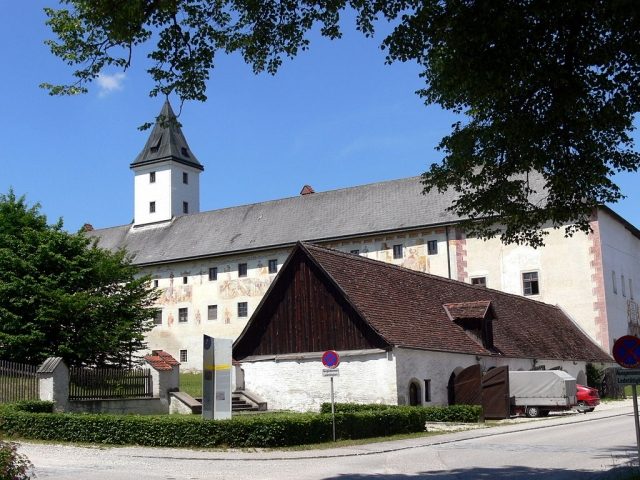
Parz Castle in the Upper Austrian town of Grieskirchen is a country castle built around 1515. It is located immediately south of the much smaller moated castle Parz and was the center of the Upper Austrian State Exhibition in 2010.
After the Pollheimers had already acquired Tegernbach Castle and lordship as well as the market town of Grieskirchen in 1398, Sigmund Ludwig von Pollheim bought the lordship of Parz from Han(n)s Pürchinger in 1514 and incorporated it with the lordship of Tegernbach, located about two kilometers northeast. Subsequently, Sigmund Ludwig von Pollheim, with the permission of Emperor Maximilian I, had the old castle in Tegernbach demolished and, partly with its demolition material, erected a three-story Renaissance castle with extensive outbuildings next to the small moated castle Parz, which was initially also called Neu-Tegernbach and was only later named after the village of Parz. Sigmund Ludwig von Pollheim's namesake son (1531–1598) expanded the castle to its present form and established an intellectual center of Protestantism in Upper Austria.
After the death of Gundacker von Polheim (1575–1644), the founder of Grieskirchen (1613) and imperial chamberlain and Aulic Council, Parz Castle was sold. Subsequently, there were brief possessions by the Pálffy, Harrach, and Verdenberg families. In 1651, the castle and lordship were bought by David Ungnad Graf von Weißenwolf (1604–1672), a Knight of the Order of the Golden Fleece. After the extinction of this noble family in 1961, the castle complex came into the possession of Georg Spiegelfeld-Schneeburg in 1985 via Antoinette Altgräfin von Salm-Reifferscheidt (1908–1962) and Karl Friedrich Maria Johann Mensdorff-Pouilly (1894–1981), who restored and revitalized it. Currently (2010), the castle is owned by the Willy Messerschmitt Foundation.
Description+
The castle consists of a three-story main wing with a tower and two side wings. In 1987, large-scale Renaissance frescoes were discovered on the approximately 100 m long south facade. They were commissioned by the Protestant Sigmund von Pollheim and depict the superiority of Protestantism over Catholicism. They were uncovered with the support of the Messerschmitt Foundation.
Take Mobile History with you
You are reading this text for free. Premium adds what matters on the road: descriptions read aloud, sites found through your camera, whole regions taken offline.
- Every description, including the ~17,700 Premium sites
- Audio guide: have descriptions read to you on location
- AR finder: see sites through your camera, with distance and bearing
- Unlimited saved sites
14 days free, then from €2.99 a month. Cancel anytime.
Source: Wikipedia · Licence: CC BY-SA 4.0 · Image: http://commons.wikimedia.org/wiki/File:Parz_-_Schloss_1.jpg
This description draws on the facts documented in the linked Wikipedia article; Wikipedia content is licensed under CC BY-SA 4.0. Wording and editing: Mobile History.
Location: 48.2340, 13.8449