To be privately owned
Perolles Castle (Fribourg)

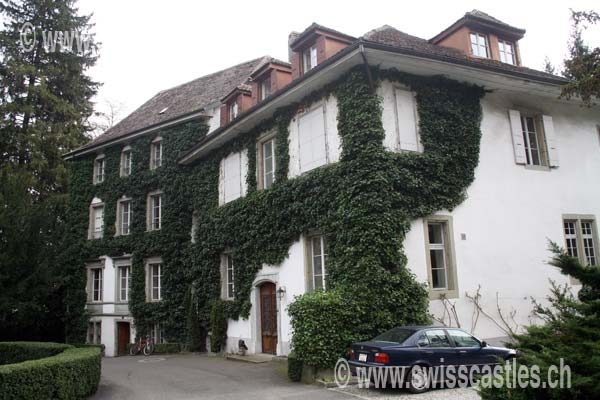
From a large estate to a small plot of land: How many Fribourgers know that one of the boldest urban planning ventures of the "Belle Époque", the Boulevard de Pérolles, owes its name to a large patrician estate? The castle and chapel are now hidden between an industrial area and a villa district.
The first house, already mentioned in 1259, was owned by the Mossu family in the 15th century. In 1508, it was part of the dowry when Elisabeth Mossu - the last of that name - married Christophe de Diesbach, who had become a citizen in 1500. Hardly married, he already demanded 36 trees from the government on July 4th for the reconstruction of the house and chapel. He commissioned an associate of Hans Felder the Younger from Zurich, who had been called to Fribourg for the construction of the town hall, for this significant building.
The late Gothic chapel - the most beautiful in the canton - is adorned with a series of Renaissance windows unique in Switzerland. They are the work of the best workshops of the time, notably that of Lukas Schwarz in Bern. In 1516, Christophe de Diesbach sold his house in Herrengasse (Grand'Rue) and moved into his new residence in Pérolles, where he died in 1522. His daughter had to leave the house to the creditors, who had new work carried out in 1528. The fragmentation of the estate, now named de Reynold, began around 1834 with the demolition of the farmhouse, which was originally connected to the manor house by a surrounding wall. The house itself suffered serious alterations in 1860. In the first quarter of the 20th century, it was restored under the direction of the Bernese architect Henry Berchtold von Fischer.
Today, the castle is isolated in a green zone. It is the remaining part of the large Pérolles d'En-Haut estate, which was successively fragmented to promote the development of the city to the south from 1900 onwards through the sale of plots. Particularly noteworthy parts of the castle are the large and small salons on the first floor with their richly decorated reveals from 1528 and their cabinet panes. Both salons have coffered ceilings from the Renaissance period with portrait medallions. These medallions - as a sign of power - have their origin in the Roman imago clipeata. They alternately depict late Roman emperors, heroes of antiquity, and female faces. This type of ceiling decoration was still common at the beginning of the 17th century, as evidenced by the papier-mâché medallions made for Pierre de Fégely and Dorothea de Diesbach at rue des Alpes 10.
Take Mobile History with you
You are reading this text for free. Premium adds what matters on the road: descriptions read aloud, sites found through your camera, whole regions taken offline.
- Every description, including the ~17,700 Premium sites
- Audio guide: have descriptions read to you on location
- AR finder: see sites through your camera, with distance and bearing
- Unlimited saved sites
14 days free, then from €2.99 a month. Cancel anytime.
Source: Wikipedia · Licence: CC BY-SA 4.0
This description draws on the facts documented in the linked Wikipedia article; Wikipedia content is licensed under CC BY-SA 4.0. Wording and editing: Mobile History.
Location: 46.7978, 7.1459