To be privately owned
Pesch Castle

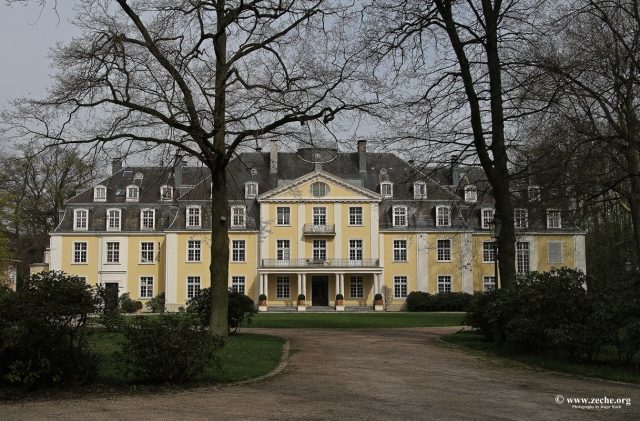
Schloss Pesch is a three-winged hunting lodge in Meerbusch, halfway between the districts of Strümp and Ossum-Bösinghoven. Despite its location in formerly Electoral Cologne territory, the castle was always an independent estate without feudal obligations to the Elector-Archbishop of Cologne.
Structure of the Castle Grounds+
The main house, a two-story, plastered building with 13 window axes, is situated in an extensive castle park surrounded by three outbuildings:
- the former rent office, also a plastered, two-story building with 7 window axes and a clock tower on the north side,
- the three-winged manor farm, a brick building from 1795, on the south side, and
- the castle chapel between the rent office and the main house on the northeast side.
Origins
The estate was first mentioned in 1311 as Peschhof and appears in a document from 1368, when Knight Godert Knop transferred "Haus Pesch" and other estates to his wife. In the immediate vicinity of the castle, there are traces of Roman settlement. In 1863, between the neighboring Haus Gripswald and the castle, the Gripswalder Matronen- und Mercuriussteine, six votive stones in honor of the "blessed Matronae" and Mercurius Arvernus, were found. Older sources also suggest the remains of a Roman field chapel there. The military road connecting the Roman cities or legionary camps Colonia Claudia Ara Agrippinensium (Cologne), Novaesium (Neuss), Gellep-Stratum (Gelduba), and Colonia Ulpia Traiana (Xanten) ran not far east of the estate. Traces of the route were still visible until the mid-19th century.
16th to 18th Century
The old Pesch Castle was plundered and burned down in 1583 during the Truchsessian War. The ruins remained in the park of the present castle. The manor house was rebuilt further west. In 1595, Emmerich Hurth von Schöneck inherited the house along with estates in Ossum and Ilverich.
After Emmerich Hurth (now von Schöneck zu Pesch) and his wife Magdalena, née von Merode, remained childless, their property in the Amt Linn fell to Edmund von Metternich (after 1605, probably around 1615). In the following years, between 1616 and 1669, several families disputed "Haus Pesch samt Zubehör, einen Hof zu Ossum (Oßem) und ein Gut zu Ilverich (Eiluerich)" with a total value of 6,000 gold guilders for almost two generations. Involved on the plaintiff's side were members of the noble houses Merode (Rhineland), Lützerode zu Klyff and Uettingen, Landschad von und zu Steinach and Uettingen (both from southern Germany), Wolfskeel von Reichenberg, Greck von und zu Kochendorf, Bawyr von Frankenberg, as well as the Cologne citizen families Thoer and Bengeraths (who had bought into the property). Opposing them were two daughters from the house of Metternich, who had inherited the property through their brother Edmund and were now married into the families von Landschad and von Galen.
In a map of the Archdiocese of Cologne from the Atlas Maior by the Dutch cartographers Willem Blaeu and Joan Blaeu from 1645, a Peschoff is marked approximately at the current location.
In 1689, Schloss Pesch became a scene of the War of the Palatine Succession. A battle took place directly at the estate between Prussian and French troops, who had occupied the left bank of the Rhine at that time. On the Prussian side, the first battalion Dönhoff of the Royal Prussian First Infantry Regiment under Field Marshal Lieutenant Hans Adam von Schöning was involved. The regiment consisted of 26,036 men and carried 79 cannons. The French troops were commanded by General Sourdy. On March 13, Bösinghoven and Ossum, then Strümp, and later Büderich became the scene of the fighting. The fighting around Ossum was particularly fierce, with 300 French grenadiers falling there alone. After the corps of Lieutenant General Hans Albrecht von Barfus had taken Ossum, the French were pushed back via Strümp and Büderich to occupied Neuss. They lost around 1000 men. They had to abandon their position in Linn. In the later course of the fighting, the Prussians also besieged Kaiserswerth, occupied by the French, which had to capitulate on June 27, 1689.
In 1758, 47,000 French soldiers were encamped slightly northwest of Schloss Pesch in and around the town of Fischeln. These were involved in the famous Battle of Krefeld on June 23, 1758, as part of the Seven Years' War. On the evening after the battle, the French retreated to Osterath, also a place in the vicinity of the estate and today, together with Schloss Pesch, part of the Meerbusch urban area. Around this time, the castle was already owned by Baron Matthias Gerhard von Hoesch, who received a seat in the Landtag from it. In the neighborhood, he had acquired further property some years earlier, the small "Gerversgut zu Ossum" from the Ahren/Herbertz families.
In the autumn of 1789, the then 20-year-old Alexander von Humboldt and the Dutch physician and botanist Steven Jan van Geuns (1767–1795) traveled together along the Lower Rhine. Near Düsseldorf, they briefly separated, and van Geuns walked via Schloss Pesch to Krefeld. Two works emerged from their joint journey: van Geuns' diary in the style of contemporary travel literature and Humboldt's first major scientific publication, Mineralogische Beobachtungen über einige Basalte am Rhein.
Schloss Pesch under the Lords of Hallberg
Through the marriage of Heinrich Theodor von Hallberg († 1792) to Henriette Helene von Hoesch († 1807/1808), daughter of Matthias Gerhard von Hoesch (1698–1784), Schloss Pesch passed from the possession of the Hoesch family to the Hallberg family.
In 1794, the estate was plundered again and burned down in 1795, this time by soldiers of the French revolutionary troops during the First Coalition War. Around this time, Schloss Pesch belonged to the Counts of Hallberg and was the ancestral seat of the Hallberg-Pesch line.
In 1797, the later founder of the spa town of Bad Gleichenberg (near Graz) and later Minister for Trade and National Economy of Austria-Hungary, Mathias Constantin Capello Reichsgraf von Wickenburg called Stechinelli, was born at Schloss Pesch. His mother was a Countess Hallberg by birth.
In 1828, Schloss Pesch had 20 permanent residents according to official statistics. The neighboring village of Ossum had 89 inhabitants, the surrounding estates Haus Hamm 12 and Haus Gripswald 10. The village and the three estates belonged to the mayoralty of Strümp, which had a total of 831 Catholic inhabitants (1816: 716 inhabitants). It is noteworthy that the estate was listed in the statistics as a manor and not as a castle. At that time, an extensive forest area still stretched between Strümp, Ossum, Linn, Bockum, Oppum, and Krefeld. Only later in the 19th century were large areas cleared and cultivated as farmland. A wide heathland extended from Bösinghoven to Fischeln, Willich, Anrath, and Neersen. To the east was an old arm of the Rhine; during floods, the Rhine then still reached close to the Herrenbusch between Strümp and Latum.
According to Duncker, a Henrietta Freiin von Hoesch, wife of the Count of Hallberg, rebuilt the house in the style of a castle with a generous garden from 1840 onwards. It is probably meant to be 1804, as Henrietta died in 1808.
Schloss Pesch under the Lords of Schweppenburg and von Arenberg
Schloss Pesch around 1857 (west side) Schloss Pesch around 1898 (west side) Schloss Pesch before the renovation by Breuhaus
In 1848, the Hallberg family died out in the male line with Mathias Anselm. Haus Pesch was bequeathed to Matthea Agnes Lucia Henriette Maria Hubertina Walburgis Reichsfreiin Geyr von Schweppenburg und Lathum (* 1830), who brought the house into her marriage with Felix Edmundt Carl Ghislain Freiherr von T'Serclaes (* 1818, from 1851 Count T'Serclaes-Hallberg) in 1849.
Even in 1850, the estate was still referred to as the manor Haus Pesch. It belonged to the municipality of Ossum, then the mayoralty of Lank in the district of Krefeld (justice of the peace district Uerdingen, mortgage office Krefeld).
In 1885, the castle came into the possession of the Dukes of Arenberg. Between 1906 and 1912, Johann von Arenberg had the castle extended and rebuilt into its current form as a hunting lodge by the architect Fritz August Breuhaus de Groot. This renovation is considered an important part of Breuhaus' early work. The Herrenbusch forest, adjacent to the castle in the northeast, was used for hunting.
Some prominent members of the Arenberg family who lived at Schloss Pesch:
- In 1895, Robert-Prosper Prince and Duke of Arenberg, the father-in-law of Felix Archduke of Austria (the current number 12 in the line of succession (Habsburg Monarchy)), was born at Schloss Pesch. This very Robert-Prosper was intended in 1943 by Department I of the Abwehr (intelligence service) as a secret agent in the Vatican to spy on the Curia and especially Pope Pius XII for Nazi Germany. However, this mission was prevented by the then Vatican ambassador Ernst von Weizsäcker, the father of Richard von Weizsäcker.
- In 1907, shortly after the so-called Hottentot Election, the Reichstag election of 1907, Prince Franz von Arenberg died at Schloss Pesch. As a long-standing member of the presidium of the German Colonial Society, he was one of the most famous figures of the German colonial movement of his time.
- In 1922, Rose-Sophie Princess von Arenberg, the grandmother of the former German Minister of Defense Karl-Theodor Freiherr von und zu Guttenberg, was born at Schloss Pesch. She married the later Bundestag member Karl Theodor Freiherr von und zu Guttenberg in 1943, after whom her grandson was named.
Schloss Pesch was always also an agriculturally operated estate, for example, a "Geflügelhof Schloss Pesch" (Schloss Pesch Poultry Farm) is documented for the year 1928.
After the Second World War, the Congregation of the Sisters of St. Elisabeth operated an old people's home in the adjacent farmyard of the castle from 1946 to 1953.
Current Use+
Around 1977, the artist Kurt Link, a close friend of Joseph Beuys, inhabited part of the castle and had his studio there. There were plans to create an artists' colony and international academy Ossum at Schloss Pesch. In the early 1980s, the listed property was renovated and converted into luxury condominiums. Only in 2000 was the last building of the ensemble saved from decay: the former castle chapel was also repurposed for residential use.
The castle and park are now in private ownership and are not publicly accessible. Viewings are not provided.
Overview: Lords of Schloss Pesch+
- around 1368 Godert Knop (followed by his wife)
- before 1595 Emmerich Hurth von Schöneck (inherited)
- before 1615 Edmund von Metternich (inherited from uncle)
- 1616 von Landschad, von Galen (inherited from brother)
- 1669 von Landschad, von Galen
- 1783 Matthias Gerhard (since 1744 von) Hoesch
- 1792 Henriette Helene von Hoesch (inherited from father)
- 1792 Heinrich Theodor von Hallberg (by marriage)
- 1848 Mathias Anselm von Hallberg (inherited from father)
- 1848 Matthea Agnes Lucia Henriette Maria Hubertina Walburgis Reichsfreiin Geyr von Schweppenburg und Lathum (inherited from uncle)
- 1849 Felix Edmundt Carl Ghislain Freiherr von T'Serclaes (by marriage)
- 1885 Dukes of Arenberg (by purchase)
- before 1981 Dr. Hans Schaefer (by purchase)
- 1986 Division as WEG (by purchase)
Take Mobile History with you
You are reading this text for free. Premium adds what matters on the road: descriptions read aloud, sites found through your camera, whole regions taken offline.
- Every description, including the ~17,700 Premium sites
- Audio guide: have descriptions read to you on location
- AR finder: see sites through your camera, with distance and bearing
- Unlimited saved sites
14 days free, then from €2.99 a month. Cancel anytime.
Source: Wikipedia · Licence: CC BY-SA 4.0 · Image: http://www.zeche.org/
This description draws on the facts documented in the linked Wikipedia article; Wikipedia content is licensed under CC BY-SA 4.0. Wording and editing: Mobile History.
Location: 51.2964, 6.6455