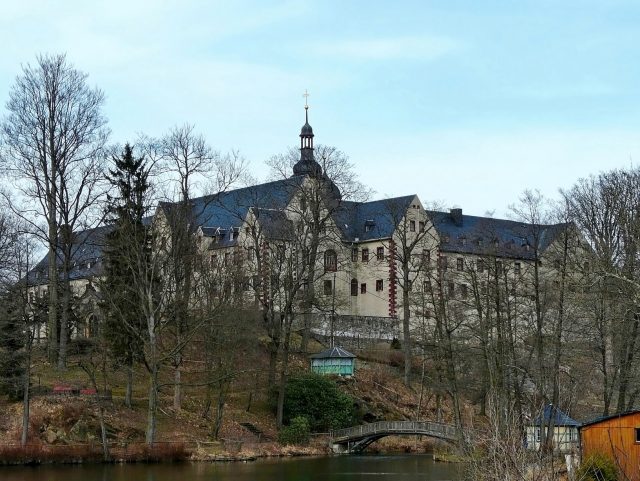
CastlePfaffroda

Pfaffroda Castle

Pfaffroda Castle

Home for the elderly

First mentioned in 1512 as a knight's estate, Pfaffroda Castle is located on a rocky outcrop in the municipality of the same name. It was partially destroyed during the Thirty Years' War. After 1650, it was rebuilt and expanded.

At the beginning of the 13th century, secular clerics from Ossegg Monastery established the Pfaffroda estate. The first documented mention as a knight's estate dates from 1512. Between 1352 and 1389, Peter v. Schönberg acquired the Lordship of Sayda, including Purschenstein and Pfaffroda, as a fief from the Burgraves of Meissen. With the death of the last Burgrave near Aussig in 1426, the Margraves of Meissen assumed the position of feudal lords. The Schönbergs remained owners of the Lordship of Purschenstein. Like many other possessions of the v. Schönberg family, this lordship thus also became a fief of the Wettins.

In 1480, Caspar von Schönberg zu Frauenstein and Pfaffroda traveled to Rome and pledged to rebuild the church destroyed by a fire. Thereupon, Pope Sixtus IV issued him an indulgence letter.

Caspar married Barbara, née von Bünau, in his second marriage, and they built the castle from 1575 to 1578. The Renaissance portal with the alliance coat of arms on the southwest gable of the castle has been preserved since 1578. Caspar was an electoral chamberlain, chief mining captain, and district administrator. During the Thirty Years' War, the castle, church, and village were severely affected.

Caspar-Heinrich, probably still the best-known owner of Pfaffroda today, granted a new home to Bohemian exiles in his Lordship of Purschenstein during the Thirty Years' War. But the consequences of the war were devastating for the von Schönberg family as well. From Caspar Heinrich's son August, the Electoral Saxon Chief Mining Captain Georg Friedrich v. Schönberg, from the Sachsenburg main branch, acquired Pfaffroda shortly before his death in 1650. The knight's estate of Pfaffroda probably became allodial, i.e., free property, at that time. Georg Friedrich's son Caspar, also his successor in the office of Chief Mining Captain, also bought Dörnthal.

During the passage of Napoleon's troops in August 1813, King Murat of Naples stayed overnight at Pfaffroda Castle. Carl Alexander von Schönberg (1857–1928) bequeathed Pfaffroda to his adopted son Alfons Diener von Schönberg, son of his sister Sara, the renowned expert on Schönberg history in the 20th century. The expropriation of Pfaffroda Castle affected Hubertus Diener von Schönberg in 1945.

Present+

Today, the castle is partly used as a retirement home. In addition to the castle, a riding stable in the Neoclassical style has also been preserved. The castle park and the nearby ponds are visited primarily in summer by those seeking relaxation and tourists.

Take Mobile History with you

You are reading this text for free. Premium adds what matters on the road: descriptions read aloud, sites found through your camera, whole regions taken offline.

  • Every description, including the ~17,700 Premium sites
  • Audio guide: have descriptions read to you on location
  • AR finder: see sites through your camera, with distance and bearing
  • Unlimited saved sites

14 days free, then from €2.99 a month. Cancel anytime.

Source: Wikipedia · Licence: CC BY-SA 4.0 · Image: Thomas Eichler

This description draws on the facts documented in the linked Wikipedia article; Wikipedia content is licensed under CC BY-SA 4.0. Wording and editing: Mobile History.

Location: 50.6963, 13.3533