To be privately owned
Pfaffstätt Castle

Pfaffstätt Castle is located in the municipality of Pfaffstätt in the district of Braunau in Upper Austria.
An early medieval fortified complex of Pfaffstätt was located on the Siedelberg, of which the field names Burgstall and Schatzgruben still bear witness today. Until the 1830s, ruins and remnants of moats and a forecourt were still present. The complex is a protected monument.
The first documented mention occurs with Herrant de phaphesteti in 1150. These Pfaffenstätter were followed by the Rewtter in 1222. In 1422, a Georg Rewtter is mentioned, in 1500 a Martin Rewtter, in 1505 a Rudeprecht Rewtter. Under these, the moated castle in the valley must have been built. The character of a moated castle is clearly visible on Michael Wening's copper engraving, as is the double hipped roof. Thereafter, the Walch (1503 to 1617) are documented as owners. In 1617, Wolf Walch sold Pfaffstätt to Hans Sigwart von Schwabpach. After the Schwabpachers, the Barons of Vieregg resided here from 1630 to 1721.
In this year, the property passed to Countess Maria von Wartenberg, née Princess of Melun and Epinoi. They transformed the former moated castle into a country estate, allegedly according to plans by Johann Bernhard Fischer von Erlach, whereby the former moat was also filled in. From the heirs, Pfaffstätt first came to the Lerchenfeld and from 1764 to 1800 to the Counts of Taufkirchen. From 1800 to 1805, Martin and Walpurga Sehkührer were the owners, and from 1805 to 1811, Martin Wührer. Then the castle passed to the Barons of Peckenzell until 1868. In 1868, Heinrich Klinkosch followed, and in 1895, Count Edmond Lippe-Weissenfeld bought the property. In 1909, Count Adolf von Peckenzell bought back his birthplace and had it renovated. From 1917 to 1920, Margrave Pallavicini was the owner, followed by Adolf Baron von Stift, who sold it in 1923 to Prince Albrecht zu Schaumburg-Lippe. After 1942, Prince Max zu Schaumburg-Lippe was the owner of the castle (died 1974). After his death, his wife Princess Helga Claire Lee, née Roderbourg, was the owner. From 1978, Heinrich Lohberger, a manufacturer from Mattighofen, was the owner of the castle. From September 2001, the new castle owners are Robert and Barbara Jakob.
The castle chapel, which is also visible on Michael Wening's copper engraving, no longer exists.
Pfaffstätt Castle today+
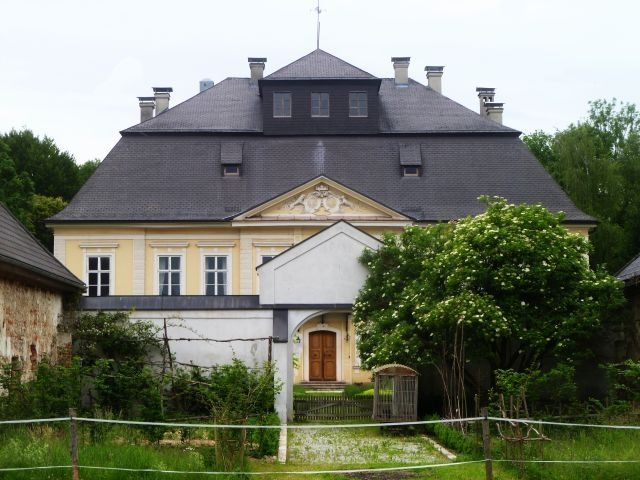
The castle is two-story with a hipped mansard roof. On the park-side front, there is a flat triangular gable, which has a coat of arms with lateral escutcheons (lion and ram). The alliance coat of arms on the garden side contains the coats of arms of the Wartenburgs and the Melum d’Epinois, that on the south side that of the Taufkirchener and that of the Huber von Mauer. In the middle, a three-axis belvedere with a pyramid roof is placed.
The castle opens into a courtyard with outbuildings that are used as a riding stable. These parts of the building are clearly in need of renovation. The new owners are striving for a revitalization of the castle in several ways.
Take Mobile History with you
You are reading this text for free. Premium adds what matters on the road: descriptions read aloud, sites found through your camera, whole regions taken offline.
- Every description, including the ~17,700 Premium sites
- Audio guide: have descriptions read to you on location
- AR finder: see sites through your camera, with distance and bearing
- Unlimited saved sites
14 days free, then from €2.99 a month. Cancel anytime.
Source: Wikipedia · Licence: CC BY-SA 4.0 · Image: http://commons.wikimedia.org/wiki/File:Schloss_Pfaffst%C3%A4tt-1.jpg
This description draws on the facts documented in the linked Wikipedia article; Wikipedia content is licensed under CC BY-SA 4.0. Wording and editing: Mobile History.
Location: 48.0759, 13.1447