CastleBerlin-Zehlendorf

Pfaueninsel Castle
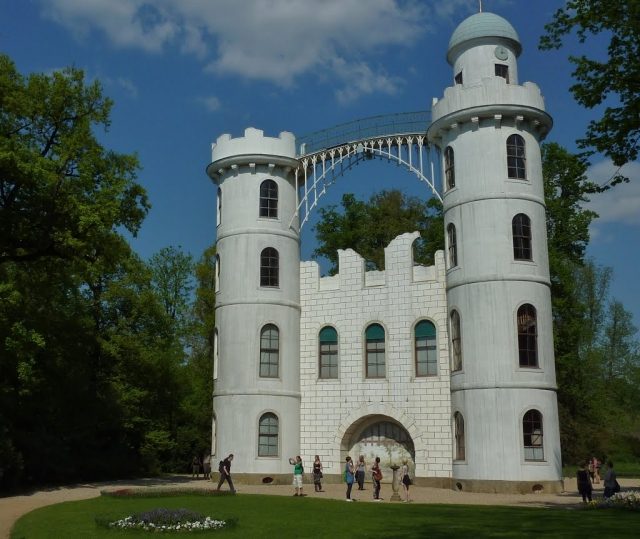
Pfaueninsel Castle

The Castle can be visited

Pfaueninsel Palace on the island of the same name in the Havel near Berlin is a pleasure palace built for the Prussian King Frederick William II at the end of the 18th century.

The Planning of the Palace+

From 1787 to 1792, Frederick William II had a summer palace, the Marble Palace, built for himself on Heiliger See in Potsdam, whose further surroundings he incorporated into the park landscape in the following years. From the Marble Palace, a visual axis was created towards the neighboring Pfaueninsel – which was then still called Kaninchenwerder – which was to be crowned with a focal point as its conclusion. Since Pfaueninsel was within rowing distance of the Marble Palace and could also be passed by boat from the more distant Charlottenburg Palace, a small palace was to be built here where one could rest after a boat trip and also spend the night. Frederick William, who maintained a long-standing relationship with Wilhelmine Encke and never separated from her during his lifetime, certainly also intended to be able to stay here undisturbed with his confidante and lover. His affection went so far that he ennobled Wilhelmine as Countess Lichtenau in 1796. Wilhelmine, occasionally referred to as the "Prussian Pompadour," was involved in the planning of the palace and was largely allowed to determine the interior design, furnishings, and decorations herself. However, the Countess could not truly enjoy the work; in the year the small palace was completed, her patron Frederick William II died, and she was sent into exile. The palace was subsequently used by Frederick William's successor.

Architecture+

The palace was to be executed as romantic ruin architecture, and one of the king's stipulations was that the building had to be constructed from Prussian timbers. Court master carpenter Johann Gottlieb Brendel took over the construction management, and the work lasted from 1794 to 1797. Brendel essentially designed the white palace as a two-story cube – a third story is only hinted at with window rudiments – to which he fronted the main facade and adorned it with two round towers connected by a bridge. The building structure thereby takes up the picturesque design of a gondola house originally planned – but never realized – for the Charlottenburg Palace Garden. The bridge connecting the towers was originally made of wood but was replaced by one of wrought iron as early as 1807. In the middle of the building, a painted archway with a view of an "Italian landscape" is depicted here. This side of the building is precisely aligned with the Marble Palace; the palace was very freely interpreted as a "ruined Roman country house." Behind the windows of the upper floor of the main facade is the ballroom.

The interiors are simple but of extremely high quality. The furnishings are almost completely preserved in their original state to this day, although some damage, especially to the wallpaper, is evident due to age. In addition to the silver chamber in the basement, the small palace houses several cabinets, two bedrooms, and the dining and ballroom on the second floor, adorned with various valuable types of wood. One of the towers is designed as a staircase and laid out with noble marble; in the other, there are small, round salons, of which the so-called "Otaheite Cabinet" deserves special attention. This room is designed from the inside like a bamboo hut, which, in addition to the real windows, offers a view of an exotic painted landscape in which the buildings of Pfaueninsel can be found. The upper floors of the towers were used as servants' quarters. The palace kitchen was unobtrusively integrated into a slope a few meters next to the building.

The Palace and its Surroundings+

The garden-like landscape of Pfaueninsel is adorned with other buildings; among them are the Luisentempel, a hunting lodge – the "Borkenhäuschen" –, the neo-Gothic Kavaliershaus, and the dairy, also conceived as a ruin. The royal refuge was made accessible to visitors as early as 1821, albeit only three days a week, as the small palace was occasionally still inhabited by the Prussian royal family. Thus, Frederick William III used the building as his summer residence and had the island, which until then had hardly been horticulturally structured, transformed into a large landscape park by Peter Joseph Lenné from 1816 onwards. Only after the king's death did the Hohenzollerns lose interest in the palace.

Today, it belongs to the Prussian Palaces and Gardens Foundation Berlin-Brandenburg and is open to visitors.

Take Mobile History with you

You are reading this text for free. Premium adds what matters on the road: descriptions read aloud, sites found through your camera, whole regions taken offline.

  • Every description, including the ~17,700 Premium sites
  • Audio guide: have descriptions read to you on location
  • AR finder: see sites through your camera, with distance and bearing
  • Unlimited saved sites

14 days free, then from €2.99 a month. Cancel anytime.

Source: Wikipedia · Licence: CC BY-SA 4.0 · Image: Joachim Schneeleopard

This description draws on the facts documented in the linked Wikipedia article; Wikipedia content is licensed under CC BY-SA 4.0. Wording and editing: Mobile History.

Location: 52.4309, 13.1199