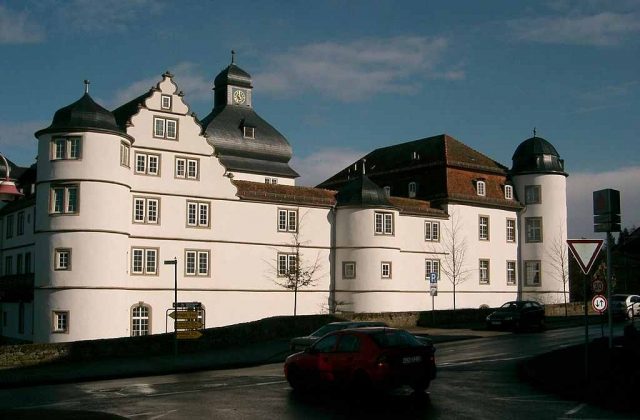
The Castle can be visited
Pfedelbach Castle

Pfedelbach Castle is located in the center of the municipality of Pfedelbach in the Hohenlohe district. Today, the castle houses the community hall, the former castle chapel, and numerous apartments. The inner courtyard is used as a parking lot for tenants. During the Hohenlohe Cultural Summer, concerts take place both in the castle courtyard and in the former castle chapel. The municipality of Pfedelbach uses the former castle chapel as a ceremonial wedding venue.
Like many other Hohenlohe residential castles, the building was constructed in the Renaissance style around a square courtyard. The castle is almost exactly north-south oriented. It has a rectangular footprint with a ratio of 1:2 (23.75 m × 47.50 m). The narrow sides to the north and south are occupied by rectangular houses, again almost exactly with a floor area of 1:2 and 2 round corner towers, whose diameter measures half the building width. In the middle of their courtyard sides, protruding by one-third, they have octagonal stair towers, whose diameter measures half the building width. In the middle of their courtyard sides, protruding by one-third, they have octagonal stair towers, measuring one-third of the building width. Thus, half of the total length remains for the castle courtyard between the houses, forming a square when including its outer walls. The center of the western long side is occupied by another round tower of the same diameter as the corner towers. Their centers lie in the corners of the rectangle and its wall alignment. Thus, only the semicircle protrudes, the corner towers as three-quarter circles. Correspondingly, the rectangular gatehouse protrudes from the center of the east side by the radius of the towers, whose originally planned length was three-quarters of the width of the residential houses and its footprint initially had a ratio of again almost exactly 1:2.
In the inner courtyard of the castle, one can recognize echoes of Tuscan castle buildings with arcades. On the eastern wing, there are two superimposed arcades in the inner courtyard. Elaborate tendril and floral paintings adorn the compartments of the castle. During the Baroque period, in the late 17th and 18th centuries, all Renaissance windows in both houses, excluding the towers, were uniformly converted into tall, basket-arched windows with profiled frames, keystone agraffes, and profiled sills. The castle is surrounded by a moat of equal width on all sides. Pfedelbach Castle was built by the stonemason and master builder Sebastian Mayer from Heilbronn.
Because the climate in Pfedelbach was milder than up in his castle in Waldenburg, Count Eberhard von Waldenburg built the moated castle in Pfedelbach as his winter residence on the walls of a previous ministerial castle, also a moated castle, from 1568 to 1572. The characteristic corner towers clearly identify the complex as a construction from the mid-16th century. Due to the tragic events of the Waldenburg Carnival on February 7, 1570, Eberhard died on March 10, 1570, when construction was in full swing. His wife Agathe completed the castle and took up residence there.
The magnificent castle chapel, occasionally used for weddings and concert events, was established in 1732 by Count Ferdinand von Hohenlohe-Bartenstein on the site of the old bakehouse. From 1811 to 1888, the castle chapel served as a Catholic parish church.
Above the coat of arms portal on the entrance side of the castle hangs an alliance coat of arms of Hohenlohe-Tübingen. It dates back to the builder of the castle, married to Agathe, Countess of Tübingen. The couple's tombstone is located in the collegiate church of Öhringen.
Pfedelbach Castle was for a long time the official seat and widow's residence of the House of Hohenlohe. From 1806 to 1840, the Württemberg district court was housed in the castle. In the post-war years, numerous displaced persons were accommodated in the castle. In 1951, 18 families lived in the premises. Negotiations with the youth social welfare organization for the use of the castle failed.
The municipality of Pfedelbach acquired the dilapidated castle in 1962 for 40,000 Mark from Princess Clara zu Hohenlohe-Bartenstein and renovated it in several construction phases. On January 17, 1972, the completed north building was inaugurated. The completion of the renovation was celebrated on July 19, 1979, with a ceremony in the castle courtyard. During the renovation work, the original Renaissance style was largely restored. In 1989, access to the castle moat was improved. In 2005 and 2006, the castle was again fundamentally renovated. The community hall is now used as a meeting room and event venue. In the community hall, among other paintings, there is a ceiling painting by Joachim Georg Creutzfelder and a copy of the Öhringen foundation charter from 1037. Numerous private apartments are also located in the castle. The Pfedelbach Castle Festival, which takes place every three years, finds its fitting ambiance in the castle.
Widow's Residence+
Gasthaus Sonne, former princely widow's residence. Year 1662 at the cellar entrance. Acquired in 1746 by Princess Anna Felicitas, the widow of Prince Ferdinand von Hohenlohe-Bartenstein. She had the house rebuilt and lived there until her death in 1751. Sold in 1769 to head hunter Carl von Tettenborn. In 1781, the barrel painter Johann Michael Probst acquired the property and established the Gasthaus Sonne. Subsequently, several changes of ownership until 1990. Acquired by the municipality of Pfedelbach in 1990. Renovated from 1992 to 1995. The salon has been preserved in all its individual elements. From the rocaille stucco of the ceiling to the parquet flooring. The greatest peculiarity are the preserved baroque landscape wallpapers.
Court Garden+
At the time of the construction of Pfedelbach Castle, in addition to utility gardens behind the stable building, there was also the pleasure garden beyond the moat in front of the north building. A respectable garden also belonged to the later Baroque stately home, and thus its creation, west of the castle and main road, can probably be attributed to Count Gottfried. Since a Renaissance castle, due to the design principles of its time, was self-contained and without far-reaching connections to its surroundings, there was no possibility in Pfedelbach to meaningfully connect a larger garden. The main road running west past the castle was only loosely built on its outer side. Behind it was a flat area, suitable for a reasonably regular garden in the Baroque sense. Even the original map of 1833 shows a garden here with a central square, surrounded by paths. A gardener's house and an orangery must have existed.
Charlottenberg+
In the years 1712 and 1713, Count Ludwig Gottfried built a belvedere, called Charlottenberg Castle, for his wife Luise Charlotte, née Countess von Hohenlohe-Langenburg, on the Heuberg high above Pfedelbach with a wide view north into the Hohenlohe region. The small castle was sold to farmers in 1782. Temporarily repurchased by the Princes of Hohenlohe-Bartenstein, it was severely damaged by artillery fire in 1945 and then rebuilt as a residential house with a barn in 1947. Today, its last remains survive as a six-axis, rectangular building with a hip roof. In popular parlance, the property is called Charlottenschlössle. In the Panorama 2 development area in Heuberg, a street was named Am Charlottenschlössle.
Take Mobile History with you
You are reading this text for free. Premium adds what matters on the road: descriptions read aloud, sites found through your camera, whole regions taken offline.
- Every description, including the ~17,700 Premium sites
- Audio guide: have descriptions read to you on location
- AR finder: see sites through your camera, with distance and bearing
- Unlimited saved sites
14 days free, then from €2.99 a month. Cancel anytime.
Source: Wikipedia · Licence: CC BY-SA 4.0 · Image: https://commons.wikimedia.org/wiki/File:Pfedelbach-Schloss.jpg
This description draws on the facts documented in the linked Wikipedia article; Wikipedia content is licensed under CC BY-SA 4.0. Wording and editing: Mobile History.
Location: 49.1769, 9.5045