Educational Institution
Pitzelstätten Castle

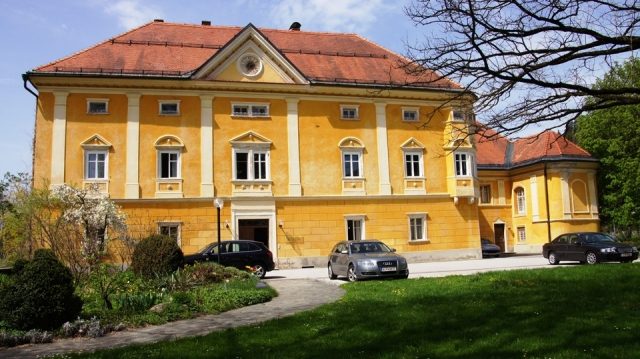
Pitzelstätten Castle is a former castle complex in the Wölfnitz district of Klagenfurt, converted into a castle in the 16th century. Pitzelstätten was acquired by the Austrian state in 1950 and has since been used as an agricultural training center. Today, the castle, supplemented by several school buildings, is the seat of the state Higher School for Agriculture and Forestry (HLFS).
Pitzelstätten was originally a castle, its name likely deriving from the name of its builder. After its construction, it was a knightly fief of the Duke of Carinthia, as indicated by the oldest known documentary mention from 1311, in which Henry of Carinthia granted his revenues from Petzelsteten to a Walter von Gutenstein.
In the 16th century, this castle was converted into a palace. The farm building is marked with the year 1529, while the manor house was built in the second half of the 16th century. The branch of the noble Dietrichsteiner family, based in Carniola, had the noble seat "magnificently adorned and built" according to the chronicler Gothard Christalnick. Soon after, Pitzelstätten was pledged to the mining family Putz von Kirchheimeck. From the mid-17th century, Pitzelstätten frequently changed owners until it was acquired by the Austrian state in 1950.
The manor house received its current late Baroque facade around 1740. It was restored in 1955 and 1978.
The estate is currently used as an agricultural training center. Initially as a training center for Austrian farm women, which was renamed "Higher Federal Institute for Agricultural Women's Professions" twelve years later, from 1988 "Higher Federal Institute for Agriculture and Home Economics" and since 1995/96 as "Higher Federal Institute for Agriculture and Nutrition Economics". Due to its use as a school, several additional buildings were constructed around the castle complex between 1952 and 1955.
Architectural Description+
The castle is situated on a gently south-sloping terrace on Glantalstrasse north of Klagenfurt. Of the original castle complex, which is still clearly visible in Valvasor's depiction from 1680, only remnants of a tower remain today.
Next to the entrance is the two-and-a-half-story farm building of the castle, built on a square plan in 1529 according to an inscription on the outer wall. On the outer wall of the plainly designed building, there are remnants of early modern period painting, it has only small windows and some loopholes, which indicate the threat from the Turks existing in the Eastern Alps at that time. The vaulted pillar hall on the ground floor, originally used as a stable, was converted in 1965 and decorated with mosaics by Max Spielmann. It is integrated into the school operations as a chapel. The storage floor above has flat wooden ceilings and has served as a library since a redesign in 1997.
The actual manor house is a rectangular, two-story building with a typical transverse loggia on the ground floor, corresponding to a now divided hall on the main floor. Around 1740, the current facade of the building was created with a rusticated plinth, pilasters, and a triangular gable with a clock. At the same time, two formerly stately rooms inside were decorated with stucco ceilings. A polygonal oriel is attached diagonally on the north side. The Renaissance-style frieze originally placed above the basket-arch portal was embedded in the facade of the former chapel attached to the north side.
Take Mobile History with you
You are reading this text for free. Premium adds what matters on the road: descriptions read aloud, sites found through your camera, whole regions taken offline.
- Every description, including the ~17,700 Premium sites
- Audio guide: have descriptions read to you on location
- AR finder: see sites through your camera, with distance and bearing
- Unlimited saved sites
14 days free, then from €2.99 a month. Cancel anytime.
Source: Wikipedia · Licence: CC BY-SA 4.0 · Image: http://www.wehrbauten.at/ktn/kaernten.html
This description draws on the facts documented in the linked Wikipedia article; Wikipedia content is licensed under CC BY-SA 4.0. Wording and editing: Mobile History.
Location: 46.6710, 14.2660