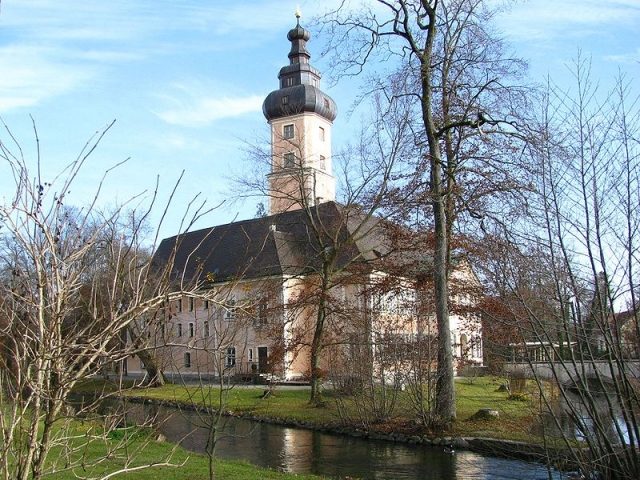
CastlePlanegg

Planegg Castle

Planegg Castle

To be privately owned

Planegg Castle is the seat of the lords of the former Hofmark Planegg, a few kilometers southwest of Munich. The former moated castle is still owned by the von Hirsch family, the last lords of the Hofmark.

Planegg was first mentioned in 1409 when Duke Wilhelm III of Bavaria, the then owner of the estate, acquired further properties and united them with Planegg.

Wilhelm III elevated the estate to a Hofmark and gifted it to his son Konrad von Egenhofen in 1425. When the last male descendant of the Egenhofen family died in 1472, Planegg passed to Christoph Lung through marriage. The noble family Lung, whose original name was Dietoch, came from the area of Rottenburg an der Laaber. The "Lungs" were owners for several generations until 1613, after which Planegg belonged for three years to Karl von Villinger from the baronial family of Villinger von Schönenberg.

In 1616, Hans Georg von Hörwarth the Elder became the lord of Planegg Castle through purchase. The fourth generation, Johann Josef Anton Franz von Hörwarth, had to sell the property in 1732 due to debt to Johann Baptist von Ruffin, who came from South Tyrol and already owned the neighboring Hofmark Krailling.

Together with other Hofmarks, the third of the Ruffini family sold Planegg to the Bavarian Minister of the Interior, Count Friedrich Karl von Thürheim. He owned it for only eight years before selling it in 1815 to the Bavarian court banker Jakob von Hirsch.

Castle Complex+

Presumably around 1415-1420, Planegg was expanded into a fortress. In 1617, the complex was significantly expanded, and the castle chapel St. Magdalena has been documented since then. A copper engraving by Michael Wening from around 1701 shows a multi-structured building with an onion dome. The tower's core likely dates back to the Middle Ages and is today, in Rococo style, the landmark of Planegg.

In 1737, Planegg Castle was extended and received its current Baroque appearance. On the north side, the existing wooden tower was replaced in 1818 by a new one by Gabriel von Seidl; however, this tower no longer exists today.

The castle park is traversed by the Würm river and was initially laid out in the French style. After 1800, it was largely redesigned into an English landscape park. The park is not publicly accessible.

During the Reichskristallnacht from November 9 to 10, 1938, the castle of the Jewish-descended lord Rudolf von Hirsch was set on fire by SS men in civilian clothes. Since the arriving fire brigade was prevented from extinguishing the fire at gunpoint, several rooms burned out.

Castle Brewery+

Immediately adjacent to the park is the former castle brewery from 1835. Jakob von Hirsch renewed a brewery in 1850 that had existed since the 16th century. The brewery changed owners and names several times: in 1886, Brauerei Josef von Hirsch; in 1908, Freiherrl.von Hirschsche Bierbrauerei; in 1922, Schloßbrauerei Planegg Emil Freiherr von Hirsch; in 1928, Schloßbrauerei Planegg AG; in 1931, Pschorrbräu AG Abt.Schloßbrauerei Planegg, and was finally leased to the Munich Paulaner brewery. Today, the building serves as a magazine for the Bavarian State Library.

Take Mobile History with you

You are reading this text for free. Premium adds what matters on the road: descriptions read aloud, sites found through your camera, whole regions taken offline.

  • Every description, including the ~17,700 Premium sites
  • Audio guide: have descriptions read to you on location
  • AR finder: see sites through your camera, with distance and bearing
  • Unlimited saved sites

14 days free, then from €2.99 a month. Cancel anytime.

Source: Wikipedia · Licence: CC BY-SA 4.0

This description draws on the facts documented in the linked Wikipedia article; Wikipedia content is licensed under CC BY-SA 4.0. Wording and editing: Mobile History.

Location: 48.1019, 11.4222