Local Authorities
School
Residential and commercial building
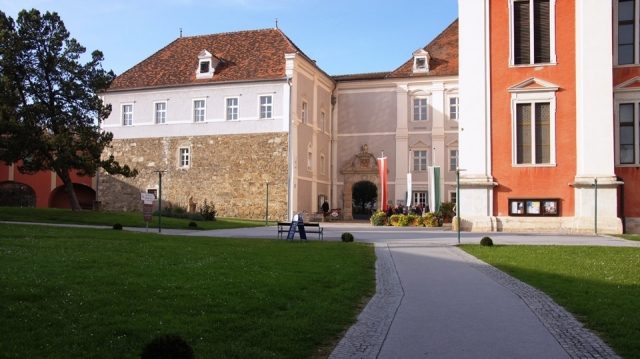
Pöllau Castle

The first mention of a Heinrich von Pöllau in 1163 likely already implies a noble residence. Heinrich was probably a knightly vassal of the Stubenbergs. Pöllau is the oldest foundation of the Stubenbergs in the vast forest area that was granted to them around 1125 by Margrave Leopold III. The castle served as the administrative and economic center of the newly settled area.
Until 1419, there were several divisions of inheritance, with Pöllau eventually passing to Otto von Stubenberg. In 1459, Hans von Stubenberg sold the castle and lordship to Heinrich von Neuberg. His son Hans stipulated in his will that both should fall to the newly founded Augustinian Canons' Monastery of Pöllau.
However, this could not be carried out initially, as the Neubergs sided with Matthias Corvinus in the Hungarian Wars, and Pöllau was confiscated by Emperor Frederick III. In 1488, Wilhelm Baumkircher had taken Pöllau and likely partially destroyed the castle and church in the process. Only when Emperor Maximilian I returned the confiscated lordship to the Neubergs in 1502 could Countess Elisabeth von Pösing-St. Georgen carry out the founding of the monastery. Since she died in 1503, her husband, Count Christof, drew up the foundation charter the following year. He reserved the Vogtship over the monastery for himself and reserved a building as his residence. In 1532, the Turks devastated the market and the monastery.
The old Pöllau Castle now served as a monastery building until the end of the 17th century. Afterwards, Provost Michael Maister had the old moated castle demolished and, around 1670, had plans drawn up for a new building for the monastery and church. When Provost Maister died in 1696, the entire north wing, as well as parts of the east and west wings, were already completed. Under his successor, Provost Johann Ernst von Ortenhofen, the construction was completed. In 1720, the new sacristy was added in place of St. Veit's Church, which had been demolished in 1705. When the Canons' Monastery was dissolved in 1785, Pöllau fell to the state religious fund, which initially leased the lordship. At the turn of the 19th century, the abandoned monastery building served as a barracks. When the castle and lordship were publicly offered for sale in 1827, Karl Freiherr von Kulmer was awarded the bid. In 1834, the buildings passed to Anton Raimund Graf Lamberg, who had them thoroughly renovated.
Count Lamberg began selling off parts in 1935 and transferred the castle to the market town of Pöllau in 1938. Today, in addition to rental apartments, a music school and various offices are housed in the individual wings. Between 1984 and 1990, the church and castle underwent a thorough total restoration.
Take Mobile History with you
You are reading this text for free. Premium adds what matters on the road: descriptions read aloud, sites found through your camera, whole regions taken offline.
- Every description, including the ~17,700 Premium sites
- Audio guide: have descriptions read to you on location
- AR finder: see sites through your camera, with distance and bearing
- Unlimited saved sites
14 days free, then from €2.99 a month. Cancel anytime.
Source: Wikipedia · Licence: CC BY-SA 4.0 · Image: http://www.wehrbauten.at
This description draws on the facts documented in the linked Wikipedia article; Wikipedia content is licensed under CC BY-SA 4.0. Wording and editing: Mobile History.
Location: 47.3029, 15.8337