To be privately owned
CastlePossenhofen
Possenhofen Castle
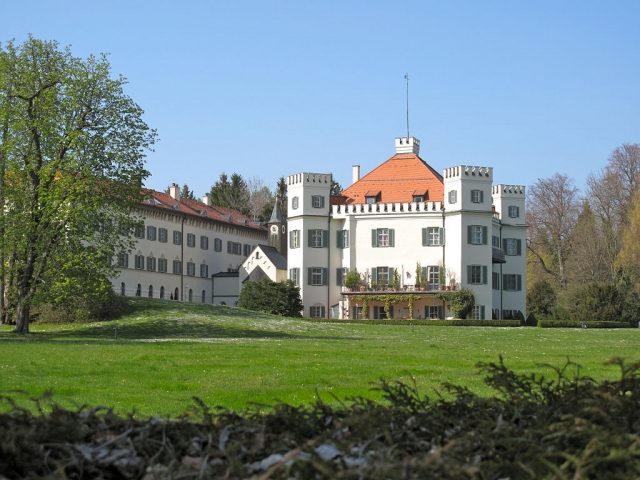
Possenhofen Castle is a castle complex consisting of the Old Castle, a cubic hip-roofed building with four corner towers set crosswise, the New Castle, also known as the Horseshoe Building, and the castle chapel, which lies between the two buildings and connects them via a corridor. The castle is located in the Possenhofen district of the municipality of Pöcking in the district of Starnberg, Upper Bavaria. Princess Elisabeth in Bavaria (also known as Sisi), the later Empress of Austria and Queen of Hungary, spent her childhood here, which would later bring the castle widespread fame.
In 1536, the landscape chancellor Jakob Rosenbusch built the castle named after the place, having previously had a wooden manor house erected on this site. Shortly thereafter, he received noble freedom from the Bavarian dukes, and Possenhofen was elevated to a Hofmark. In 1548, Rosenbusch received the village of Feldafing, acquired some estates in Pöcking, and in 1545, the island of Wörth. When he died, the property passed to his son Christoph Rosenbusch, who sold the Hofmark in 1582 to Captain Mathias von Schöll.
After several other owners, most recently the Imperial Count Basselet von la Rosée, the castle and the two Hofmarks of Possenhofen and Garatshausen finally came into the possession of Duke Max Joseph in Bavaria in 1834. His daughter Elisabeth (Sisi) and her numerous siblings reportedly spent a happy childhood here. However, these youthful years were filmed at Fuschl Castle on Lake Fuschl in the Salzkammergut in the 1955 film Sissi.
The initially two-story, three-winged Horseshoe Building was erected before 1840; a second upper floor was added around 1900. Around 1860, the facades were redesigned according to the taste of the time. The castle chapel was built around 1854 according to plans by Daniel Ohlmüller.
The ducal Bavarian family used the castle less and less after the First World War. Finally, in 1940, it was sold by them to the National Socialist People's Welfare Organization, which handed it over to the Luftwaffe for medical training. Afterwards, the castle was used, among other things, as a military hospital, a supply hospital, and a factory for bicycle auxiliary engines. These uses, and not least a sheepfold in the castle, led to the almost complete loss of the original interior design and room layout. After the end of the Second World War, the castle and the complex increasingly deteriorated.
Source: Wikipedia · Licence: CC BY-SA 4.0
This description draws on the facts documented in the linked Wikipedia article; Wikipedia content is licensed under CC BY-SA 4.0. Wording and editing: Mobile History.
Location: 47.9588, 11.3127