Center for sustainable agriculture
Quetz Castle

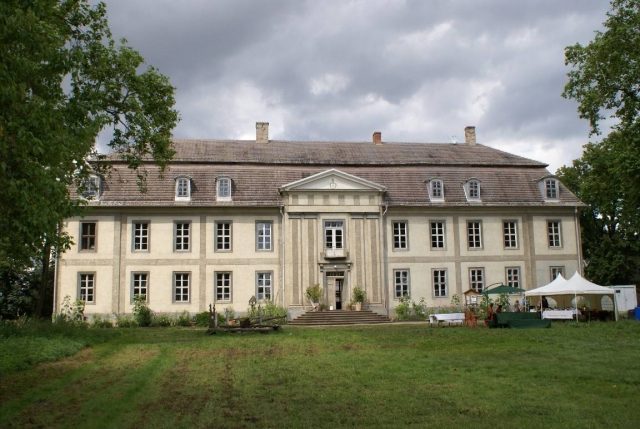
Quetzer Castle, built in the Neoclassical style by Hellmut Moritz Erdmann von Graevenitz in 1788/1790. Its unity with the park and pond often attracts visitors of all kinds.
A description by Dr. Holger Brülls (State Office for Archaeology and Monument Preservation, Halle/Saale) outlines the castle as follows: "Quetz Manor, located halfway between Halle and Bitterfeld, with its late Baroque core, is one of the numerous stately noble residences in this region. However, due to the redesign carried out in the early Neoclassical style in the late 18th century by the architect Friedrich Wilhelm von Erdmannsdorff (1736-1800), the manor house claims a significance that extends far beyond local art history."
In 1779, the Quetz estate came into the possession of the von Graevenitz family through the marriage of Luise Ernestine von Möllendorf to Helmut Moritz von Graevenitz. On April 14, 1788, the foundation stone for Quetzer Castle was laid. A plaque on the west side of the castle commemorates this: "Blessed is he who, far from the city full of falsehood, rests freely under trees he has planted." (Hellmut Moritz Erdmann von Grävenitz) The castle is an 11-axis building and comparable to Mosigkau Castle and Palais Dietrich in Dessau. The rear facade – the so-called "Ehrenhof" (Court of Honor) is comparable to Margarethenhof in Oranienbaum and Oranienbaum Castle; a three-axis, gable-crowned central risalit is visible, where the outer windows are narrower than the central one. This suggests that C.F. Damm took over the construction management at Quetz Castle. The interior architecture was created in the Neoclassical style by Friedrich Wilhelm von Erdmannsdorf. He is known for the Dessau-Wörlitz Garden Realm he created. For six generations, the castle and the estate property could be passed down within the von Graevenitz family. In 1939, the form of inheritance in the family fideicommiss was abolished by National Socialist legislation. In September 1945, the von Graevenitz family was forcibly dispossessed by the Communists.
In the 1950s, the building served as a kindergarten, doctor's office, and administrative building for the Agricultural Production Cooperative (LPG). In 1997, Quetzer Castle, along with 360 hectares of arable land, the castle park, and Quetzer Berg, was acquired by Georg Riedmeier from the Treuhand-Liegenschaftsgesellschaft. Since then, the owner has undertaken extensive measures against the decay of the castle and has restored and thus preserved a large part of the manor house in accordance with monument protection regulations. Since October 2005, the association Land.Leben.Kunst.Werk e.V. has been based in Quetzer Castle. With the help of European funding, a high ropes course was built in the eastern part of the park. The goal of the association members is to restore the historic park according to its old model and to cultivate long-forgotten vegetable and grain varieties in the garden. The latter has already been implemented in recent years.
Take Mobile History with you
You are reading this text for free. Premium adds what matters on the road: descriptions read aloud, sites found through your camera, whole regions taken offline.
- Every description, including the ~17,700 Premium sites
- Audio guide: have descriptions read to you on location
- AR finder: see sites through your camera, with distance and bearing
- Unlimited saved sites
14 days free, then from €2.99 a month. Cancel anytime.
Source: Wikipedia · Licence: CC BY-SA 4.0 · Image: Roland Neubert, Halle (Saale)
This description draws on the facts documented in the linked Wikipedia article; Wikipedia content is licensed under CC BY-SA 4.0. Wording and editing: Mobile History.
Location: 51.5823, 12.1381