CastleMatzen-Raggendorf

Raggendorf Castle
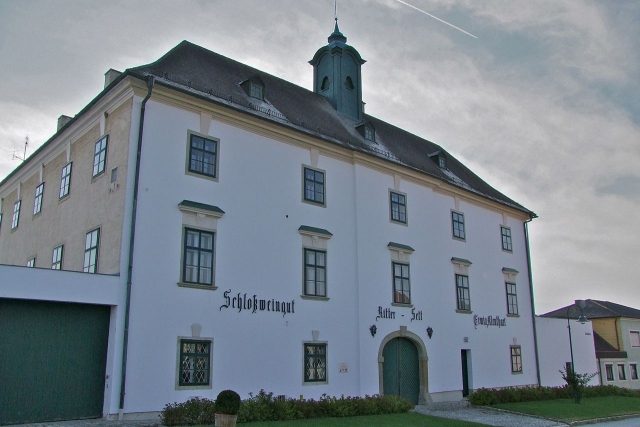
Raggendorf Castle

To be privately owned

Within a wide surrounding wall, the castle today is a perfectly regular building, a three-story, four-wing structure that completely encloses the square courtyard. A central portal is located in the street (N) and one in the garden (S) wing. In the 5-axis front facade, there is a string course above the round arch portal. Above the steep roof, a roof turret with a clock rises; otherwise, the castle has no tower. The side facades have 8 window axes. In a 4.5 m deep cellar, which extends underground to the east beyond the main front, there is a foundation stone of Knight Zoppl von Haus with the date 1559. On the ground floor to the right of the entrance hall, a staircase with a counter-running ascent and an intermediate landing leads to the upper floors. The chapel, which extends through two floors, with a stucco ceiling and an altarpiece from the school of Kremser-Schmidt, is located in the NW corner of the castle. It was built around 1733 by Ehrenreich Graf Sonnau.

Vischer's engraving from 1672 shows the main facade as it is today: 5 window axes and a clock tower as a roof turret. However, the castle entrance was then on the current garden side to the south. This facade ended at two rectangular towers, 4 stories high with full hip roofs. Since then, the towers and the rear facade have been removed, the side facades extended, and a new rear wing built in accordance with the current front facade. The original symmetry and regularity of the Renaissance building were thus subsequently reinforced.

The following is documented about the castle's ownership history:

  • 1369 - In a deed of purchase from 1369, concerning rents in Reyersdorf, Weichart der Reckchendorfer and Wernhart der Reckchendorfer appear as seal witnesses.
  • 1378 - Niklas Behaimb von Regelsbrunn assured his wife Cathrain, who was a von Haßlau, of 90 pounds of morning gift on half a farm in Rackendorf and 20 acres of fields in Köllerstorf in his will.
  • 1382 - Dorothea von Lichtenstein, the daughter of Burgrave Albrecht von Gars, donates 17 full fiefs and 2 farmsteads in Rackendorf to the castle chaplaincy in Gmünd. The rest of the village, at this time 7 full fiefs and 1 half fief, is in ecclesiastical possession and later comes to the Diocese of Passau together with a rich tithe.
  • 1392 - In a deed of purchase of the two communities Proteß and Rust, Wernhart der Reckchendorfer appears as a seal witness.
  • 1396 - In a deed of renunciation concerning a vineyard in Schweinbart, Wernhart der Reckchendorfer appears as a witness.
  • 1401 - Master Georg, Dean and Pastor of Pillichsdorf, purchased in 1401 from Ulrich von Dachsberg, Land Marshal in Austria, for 340 pounds of Viennese pfennigs, the subjects in Rackendorf and with them the annual income of 10 pounds of pfennigs from inhabited property and overlanders. He then also acquired 40 buckets of wine from mountain rights attached to vineyards.
  • 1434 - In the Austrian Fief Book, for the year 1434, a Bernhard der Aichenstauder appears, who, as the elder, held for himself and his brothers Georg and Lorenz a farm in Rackendorf near Schweinbart, the large and small tithe on one and a half fiefs and 4 farmsteads, the entire Preuslaholz near Matzen, and the hunting rights in Rackendorf.
  • 1455 - According to the Fief Book of King Ladislaus P. for Austria, the previously mentioned fief is transferred to Matthäus Grasser for himself and his cousin Hans Grasser.
  • 1466 - Johann Galler, Knight, was granted the castle, estate, and village of Rackendorf as a fief by Albrecht, Lord of Eberstorf, in the year 1466.
  • 1494 - Between the years 1494 and 1497, the estates of Oberweiden and Rackendorf came through the marriage of Volkard, Lord of Auersberg, the husband of Elisabeth, Lady of Sinzendorf, the daughter of Tiburtius von Sinzendorf.
  • 1514 - Georg Galler was enfeoffed in 1514 by Wolfgang, Lord of Eberstorf, with the castle and estate of Rackendorf, an Eberstorf fief. This Georg Galler was still endowed with Raggendorf and Gallbrunn in Lower Austria in 1524, married Margaretha von Beymann zu Gallspach, and left sons Sigmund and Peter with several daughters.
  • 1544 - The Puchheimer von Göllersdorf pledges rents to Christoph von Eizing: 53 pounds 3 shillings 7 denarii in Rackendorf.
  • 1554 - According to Kirchl.Top, Christoph von Zoppl already appears as the owner of the estate of Rackendorf, because Dean Ott von Pillichsdorf leased the wine and grain tithe in Rackendorf to the local estate owner Christoph von Zoppl.
  • 1556 - According to his son's statement, Christoph von Zoppl von Haus buys the estate of Rackendorf from the Holzer heirs.

Christoph Zoppl von Haus

During the Reformation, the property of the castle chaplaincy in Gmünd, and thus also the Rackendorf estate, came into secular hands, changed owners frequently, and was purchased in 1556 by Christoph Zoppl von Haus, who settled in Rackendorf. Whether he already found the castle there, of which Vischer provides a view in his Topography of Lower Austria (1672), or whether it originated from him or from a later period, cannot be determined from the information available so far.

Christoph Zoppl von Haus was an archducal seneschal. In Rackendorf, he possessed jurisdiction over 31 subjects. Mrs. Zoppl von Haus recorded 12 subject houses in Kl. Harras and 4 in Auersthal. At the church in Raggendorff, the marble high-relief tombstone of Zoppl can still be seen. It shows the almost life-size figure of the deceased in knight's armor, with the inscription below: "Here lies buried and has fallen asleep in God the Lord the noble and steadfast Christoph von Haus zu Raggendorff. Who was a councilor to three Roman Emperors and Archduke Ferdinand of Austria, may God be gracious and merciful to him. And grant a joyful resurrection. Amen. Died on the 27th day of January, after Christ in the year 1582." In the meantime, however, the independent parish of Rackendorf had become a filial church of Pillichsdorf.

Pillichsdorf had the right to appoint the pastor of Rackendorf when the position became vacant. Until a new pastor arrived, Pillichsdorf could appropriate the considerable income of this parish, especially the rich tithe. It is therefore not surprising that the parish of Rackendorf was often vacant and the vacancies became longer and longer, with the shortage of priests during the Reformation contributing. Over time, Pillichsdorf regarded Rackendorf as its filial church, with which it could deal as it pleased. From a petition by the community, it is evident that Rackendorf was once without a pastor for longer than 15 years. This embittered the community so much that - Christoph Zoppl was probably also behind it - around 1570 they completely converted to Protestantism. From 1575 to 1586, the Protestant preacher Johann Burchard Hasenzahl was there, who received his income from the castle and the community. But Christoph Zoppl returned to Catholicism before his death in 1582, and with him the community.

  • 1593 - His son Ulrich Christoph Zoppl appears as the owner of the estate, by inheritance from his mother.
  • 1616 - Baltasar Prack is the owner of the fortress Raggendorff.
  • 1626 - Hans Baltasar Graf von Hoyos by purchase from Hans Christoph Oremen.
  • 1628 - Alexander Pestaluz by purchase from the previous owner.
  • 1641 - Johann Bapt. Candido by purchase from Mrs. Regina Pestaluz.
  • 1661 - Adam Quintin Graf von Herberstein from his mother Regina, née Baroness von Althann, as a gift. Adam dies in 1665.
  • 1684 - Hans Anton Graf von Herberstein from his mother Regina Katharina Baroness von Rattmannstorf. Hans dies in 1701.
  • 1701 - Carl Quintin Graf von Herberstein by inheritance from his brother Hans Anton. Carl dies in 1719.
  • 1719 - Ehrenreich Graf von Sonnau by inheritance from his mother, née Countess Herberstein.
  • 1747 - Philipp Ferdinand Graf von Sonnau by inheritance from his half-brother Ehrenreich. Philipp dies in 1749.
  • 1749 - Alois Graf von Sonnau by inheritance from his brother, the previous one. Alois dies in 1763.
  • 1766 - Carolina Gräfin von Sonnau from her husband Alois.
  • 1769 - Anton Graf von Lamberg-Spinzenstein by purchase from the previous owner.
  • 1771 - Joh.Bapt. von Lichtenstein.
  • 1799 - The guardianship of his children, Joseph Gotthardt von Schwandtner.
  • 1827 - Archduke Rainer, a son of Emperor Leopold II, unites the estate of Raggendorf with the estate of Schönkirchen.
  • 1853 - Both estates fall by inheritance to Archduke Ernst.
  • 1871 - Gustav Freiherr von Heine-Geldern buys both estates.
  • 1886 - Count Sizzo and Gustav Freiherr von Heine jun. become the owners.
  • 1907 - The estate of Raggendorf is bought by a consortium of Polish noble families, parcelled out and resold in the same year. The largest part is acquired by the farmers of Raggendorf.
  • 1908 - Matthias Klenkhart, born 1882, mayor of Raggendorf from 1919-1938, buys the economic and administrative buildings. In 1745, the Klenkhart family, coming from Matzen, is first mentioned in Raggendorf through marriage.
  • 1910 - The Association of Gardeners and Garden Friends in Vienna – Hietzing buys the castle and has it converted into a home for invalid gardeners. The costs for this adaptation amounted to 33,681 gold crowns and 62 heller.
  • 1913 - The commemorative plaque in the castle chapel has the following wording: "The 'Association of Gardeners and Garden Friends in Vienna-Hietzing', under the highest patronage of His Imperial and Royal Highness, the Archduke Franz Ferdinand, has dedicated this home to invalid gardeners. MCMXIII." The castle garden is redesigned.
  • 1956 - The castle passes by purchase into the possession of the honorary citizen and mayor of Raggendorf, Erwin Klenkhart (born 1914) and his wife Magdalena, née Nikendei. Erwin Klenkhart begins to set up a sparkling wine production facility in the castle, which he constantly expands. He is the founder of the Klenkhart sparkling wine dynasty. After his death,
  • 1970 - his son inherits the castle. The young castle owner pushes for the qualitative expansion of the sparkling wine cellar. With the right feeling for sparkling wine culture, coupled with modern cellar methods, he has created the outstanding standard of the Klenkhart sparkling wine cellar.

Take Mobile History with you

You are reading this text for free. Premium adds what matters on the road: descriptions read aloud, sites found through your camera, whole regions taken offline.

  • Every description, including the ~17,700 Premium sites
  • Audio guide: have descriptions read to you on location
  • AR finder: see sites through your camera, with distance and bearing
  • Unlimited saved sites

14 days free, then from €2.99 a month. Cancel anytime.

Source: Wikipedia · Licence: CC BY-SA 4.0 · Image: http://commons.wikimedia.org/wiki/File:Raggendorf_Schlo%C3%9F_3.jpg?uselang=de

This description draws on the facts documented in the linked Wikipedia article; Wikipedia content is licensed under CC BY-SA 4.0. Wording and editing: Mobile History.

Location: 48.3945, 16.6571