CastleMagdeburg-Randau-Calenberge

Randau Castle
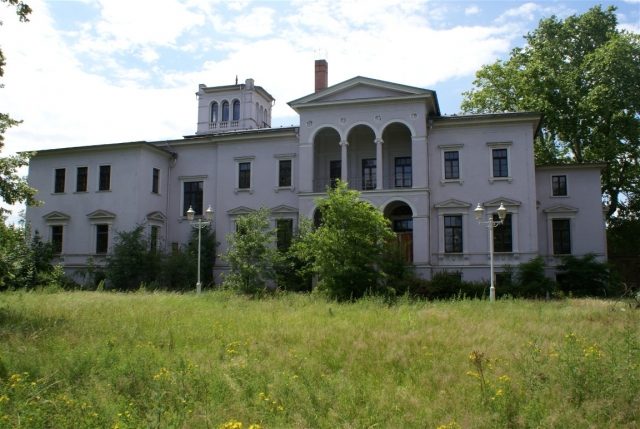
Randau Castle

Uninhabited

Randau Castle is a castle-like manor house in the Randau-Calenberge district of Magdeburg.

Already in the Middle Stone Age, around 5000–4000 BC, the valley sand island north of Randau was settled. Finds on the "Göbs" from around 600 to 800 AD could originate from a Slavic settlement around a ringfort.

After its destruction, Emperor Frederick Barbarossa settled the "Elbenauer Werder" around 1160 with Dutch colonists. On this large island between the Elbe river and the Old Elbe in the southeast of Magdeburg was the strategically important Randau Castle, which is first mentioned in a settlement dated May 28, 1236, between the Monastery of Our Lady and Iwan von Dornburg. Thegenardus von Randowe is named as a witness there, who was probably one of the first owners of Randau Castle on the Göbs. How long this castle had existed and whether it emerged from the Slavic settlement or the ringfort is not traceable.

In the late 13th century, during a feud between the Magdeburg nobility and the powerful bishop and sovereign of Magdeburg, the Lords of Randau undertook raids and plunderings in the surrounding area from here and also threatened Elbe shipping. In 1297, the troops of the nearby Hanseatic city of Magdeburg conquered and destroyed the castle. The Magdeburg Schöppenchronik mentions the destruction with only one sentence: "bi sinen tiden wunnen dusse borger dat hus to Randauwe und breken dat und vorstordent" [= in his (Archbishop Burchard II's) time, these citizens conquered the house at Randau and destroyed it]. There is also the vivid legend of the ancestress of the old Randau Castle, which is one of the most beautiful local legends of the Magdeburg area.

Even in the 18th century, traces of the castle with a triple moat system, a large church with a cloister, and several buildings were allegedly visible in Randau. Remains of the castle are still preserved today as an archaeological monument "on the Göbs". (For a current view of the traces of the Randau castle ruins in the field on the "Göbs", see weblinks)

Randau under Alvensleben Rule (1391–1850)+

In 1391, Randau Castle and Estate were acquired by the Alvensleben family from Rogätz as an archiepiscopal fief. When the Rogätz line of the Alvensleben family died out in 1553, the castle fell to Andreas von Alvensleben in the inheritance settlement, who introduced the Reformation in Randau. His great-nephew Kuno von Alvensleben, canon of Magdeburg Cathedral, envoy of the archdiocese, and member of the learned Fruitbearing Society, decided after 1609 to build a new castle, which, along with the house chapel, the Magdeburg Cathedral Canon's Curie, and a valuable library, fell victim to the flames in 1631 during the destruction of the city by Tilly.

It was not until "Minister Alvensleben in London," Johann Friedrich Karl von Alvensleben (1714–1795), that the manor farm was moved further south (to the area of today's Randau Castle), a beautiful new residence was built on a hill facing the Elbe, and it was surrounded – still adhering to the Baroque style – with geometric garden layouts. His successor, Gebhard Johann Achaz von Alvensleben, created the classical central risalit and added the side buildings. The other utility buildings, dairy farm, windmill, colonist houses, factory housing, and the preacher's widow's house, dated back to the Minister. He gave the complex its basic present form. A wide avenue on the central axis was aligned with Magdeburg Cathedral. Interrupted by woodlands, the view swept over the Elbe arms all around. In the next generation, the economy declined: in 1850, Randau was put up for sale, and around 1880, the manor house was demolished. Large parts of the property were sold by two subsequent owners, and large forest stands were cleared.

Randau in the Possession of the Hennige Family (1863–1928)+

In 1863, the complex, referred to as a knight's estate, was sold to the Magdeburg entrepreneur and commercial councilor Paul Hennige. Hennige attempted to repurchase the lost property and thus restore the original scope of the operation. In 1885, "Randau Castle" was built on the foundations of the old manor house. The building has a classical form. It features a grand staircase and column-supported round arches. In addition to various farm buildings, a spacious castle park adjoins the castle. The park originally contained typical structures for such park facilities, such as an obelisk, a rotunda, a bridge, an aviary, a greenhouse, an earth grave, and also an observation tower.

Around 1890, further farm buildings were constructed on Schloßstraße, some of which are still preserved today.

Randau Castle Today+

From 1968–1984, the castle was used as a primary school, after which it became a "station for young tourists." Partial restorations of the building took place in 1985 and 1992. Initially, the establishment of an educational center was planned. Due to the insolvency of the investor Wyborski, who died suddenly and unexpectedly on April 30, 2001, the project failed. Today, the castle still stands empty.

Personalities who worked on site+
  • Andreas I von Alvensleben (1495-1565) was lord of Calvörde Castle, Eichenbarleben Castle, and Randau Castle; he was a supporter of the Reformation.

Take Mobile History with you

You are reading this text for free. Premium adds what matters on the road: descriptions read aloud, sites found through your camera, whole regions taken offline.

  • Every description, including the ~17,700 Premium sites
  • Audio guide: have descriptions read to you on location
  • AR finder: see sites through your camera, with distance and bearing
  • Unlimited saved sites

14 days free, then from €2.99 a month. Cancel anytime.

Source: Wikipedia · Licence: CC BY-SA 4.0 · Image: Roland Neubert, Halle (Saale)

This description draws on the facts documented in the linked Wikipedia article; Wikipedia content is licensed under CC BY-SA 4.0. Wording and editing: Mobile History.

Location: 52.0584, 11.7279