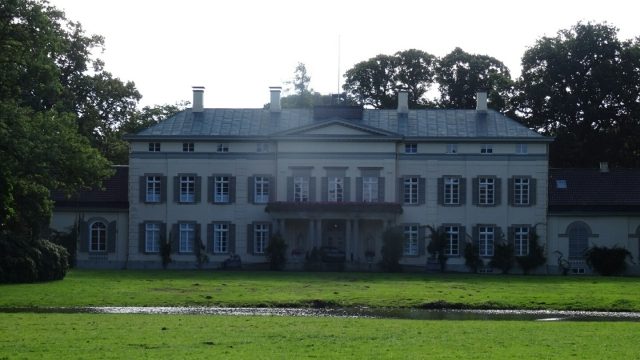
CastleRastede

Rastede Castle

Rastede Castle

To be privately owned

Rastede Castle is a country house in Rastede, Ammerland, near Oldenburg.

Rastede Castle was for a long time the residence of the Counts and Grand Dukes of the House of Oldenburg and is still in family ownership today. The building is exemplary of Oldenburg Classicism, which was brought to Oldenburg by Duke Peter Friedrich Ludwig, and is also the most important secular building in Ammerland. The castle, which is not accessible to the public, is situated amidst an English-style park landscape. Opposite the castle is the municipal Erbprinzenpalais, which is now used for cultural events and houses the municipal archive.

From Monastery to Castle

In the course of the Reformation, Rastede Monastery lost its spiritual foundation. Through annuity payments to the monks, Count Christoph von Oldenburg, canon in Cologne and brother of the reigning Count Anton I, managed to become provisor (administrator) of the dying order. After the last monk left the monastery in 1529, Christopher reached an agreement with his brothers and built a 'comfortable dwelling' near the monastery. With the death of the former canon in 1566, the building also lost its last semblance of ecclesiastical function.

The horse lover Count Anton Günther (1583–1667) had a large stable built at the monastery in 1612. In 1643, the old abbot's house was demolished, and the Count had a hunting lodge built in its place, which he gladly used as a summer residence. With a central stair tower topped by an onion dome and two-story side wings, right and left, each with 4 window axes, the castle had the typical form of baroque regents' seats in the 17th century. In 1657, the former monks' courtyard was transformed into a 'pleasure garden'.

The Danish Period

With the death of Count Anton Günther in 1667, the County of Oldenburg and thus also Rastede Castle fell to the royal Danish line of the House of Oldenburg. The Danes were not particularly interested in Oldenburg, and so the castle served for over four decades from 1701 to 1744, by order of the Danish King Frederick IV, merely as a place of exile for the disgraced Princess Sophie Eleonore of Schleswig-Holstein-Sonderburg-Beck.

In 1750, the Danish governor Rochus Friedrich Count von Lynar sold the castle to the judicial councilor Christoph Römer, thus passing into bourgeois ownership. He had the castle rebuilt by the Dutch architect Cornelis Redelykheid in the Dutch style into a three-winged building complex with many baroque-typical entablatures and risalits. He had the garden laid out in the French style.

Peter Friedrich Ludwig

In 1777, the later Grand Duke Peter Friedrich Ludwig acquired the castle and had it modernized from 1780 to 1791. Initially, the rural building inspector Heinrich Gottlieb Becker and later his successor Joseph Bernhard Winck, who also supervised the classicist redesign of the Lamberti Church in Oldenburg, directed the renovation measures, which, however, did not yet free the castle from its baroque character. The castle park was laid out by Carl Ferdinand Bosse, who was appointed garden architect in 1784. Bosse also brought the rhododendron to Ammerland, which later became the emblem of the district.

After the occupation of Oldenburg by Napoleon Bonaparte's troops and Peter Friedrich Ludwig's return from Russian exile in 1813, plans for the castle's current classicist style matured. In 1816, the north wing was redesigned under the direction of Carl Heinrich Slevogt and Georg Sigmund Otto Lasius, and the attic was altered. The sculptor Eduard Demitrius Högl adorned the castle's hall with stucco work. The central building of the residence burned out in 1968 after just completed renovations and was immediately restored to its original state.

The Cavalier House+

The Cavalier House is located to the right in front of the castle. It was used by the ducal family as a guesthouse. After the death of Friedrich August II in 1931, his second wife Elisabeth Alexandrine Princess of Mecklenburg-Schwerin lived in the Cavalier House.

The Deer Gate+

The stately entrance to Rastede Castle Park was erected in 1870 under Grand Duke Nikolaus Friedrich Peter. The replicated deer on the gate represent the red deer (and later, due to the forest damage caused, fallow deer) that were then found in the fenced area of the castle park.

After the Second World War, the original deer were dismantled in 1945 and disappeared without a trace. The gate complex fell into disrepair in the following decades. In 1983, a support group for the Deer Gate was founded, and in 1988, after the municipality of Rastede agreed to cover the costs, restoration of the damaged and dilapidated parts could begin. The balustrades and end pillars had to be completely replaced. The pair of deer was only added to the gate in 1995 and financed by private donations. In 1996, the vases were placed on the end pillars, and a year later, the ornate wrought-iron gate could be installed.

Personalities+

Born in the castle:

  • Grand Duke Paul Friedrich August (1783)

Died in the castle:

  • Count Anton Günther (1667)
  • Grand Duke Nikolaus Friedrich Peter (1900) (Palais)
  • Friedrich August II.

On the night of February 24, 1931, the castle administrator Theodor Beenken heard the bell in the service apartment, which was activated from the Grand Duke's bedroom. Friedrich August II, the last Grand Duke to reign until 1918, died in his arms, even before the doctor summoned from Oldenburg arrived. His son, Hereditary Grand Duke Nikolaus Friedrich Wilhelm von Oldenburg, later primarily used the castle as a summer residence.

Take Mobile History with you

You are reading this text for free. Premium adds what matters on the road: descriptions read aloud, sites found through your camera, whole regions taken offline.

  • Every description, including the ~17,700 Premium sites
  • Audio guide: have descriptions read to you on location
  • AR finder: see sites through your camera, with distance and bearing
  • Unlimited saved sites

14 days free, then from €2.99 a month. Cancel anytime.

Source: Wikipedia · Licence: CC BY-SA 4.0 · Image: Jörg Heldt

This description draws on the facts documented in the linked Wikipedia article; Wikipedia content is licensed under CC BY-SA 4.0. Wording and editing: Mobile History.

Location: 53.2424, 8.2019