To be privately owned
CastleMölbling-Rastenfeld
Rastenfeld Castle
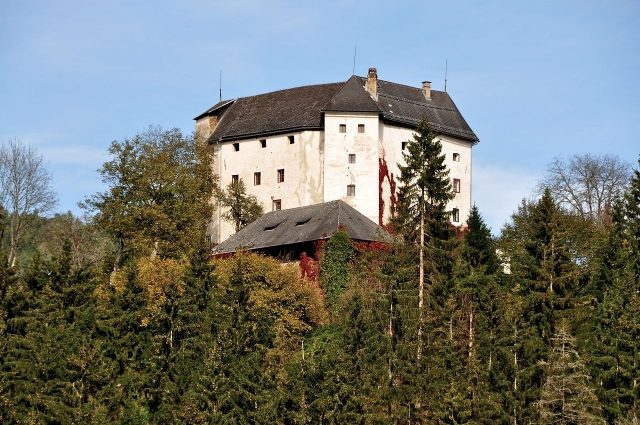
Rastenfeld Castle, a late medieval structure in Carinthia, was originally a castle and later transformed into a palace.
History+
The origins of Rastenfeld Castle date back to the 13th century, when the Raspo family from Friesach erected a castle on this site. The complex was first mentioned in a document in 1432 as “Raspenveld”. In 1469, Wilhelm von Perneck sold the castle to the Diocese of Gurk. Emperor Frederick III renounced his feudal sovereignty in 1478, granting Rastenfeld the status of a free property with a castle precinct. It remained in the possession of the diocese until 1530, during which time it was converted from a castle into a palace. Later owners included the Feistritz family and the Counts of Herberstein. In the 18th century, the Barons of Schluga were the proprietors. In the 19th century, the palace frequently changed hands until it was sold in 1893 by the singer Marie Geistinger to the industrialist Carl Freiherr Auer von Welsbach, the inventor of the incandescent light. To this day, the palace remains in the possession of his descendants.
Location+
Rastenfeld Castle is located southwest of Meiselding, a district of the municipality of Mölbling in the St. Veit an der Glan district of Carinthia, Austria. It sits on a mountain ridge sloping to the east, an offshoot of the forested Gunzenberg, at an altitude of approximately 699 m above sea level.
Source: Wikipedia · Licence: CC BY-SA 4.0 · Image: http://commons.wikimedia.org/wiki/File:Moelbling_Rastenfeld_Schloss_Rastenfeld_2012-10-18_CXI.jpg
This description draws on the facts documented in the linked Wikipedia article; Wikipedia content is licensed under CC BY-SA 4.0. Wording and editing: Mobile History.
Location: 46.8512, 14.3945