Support Foundation for Children and Youth Foundation of the Castle Regensberg
Regensberg Castle
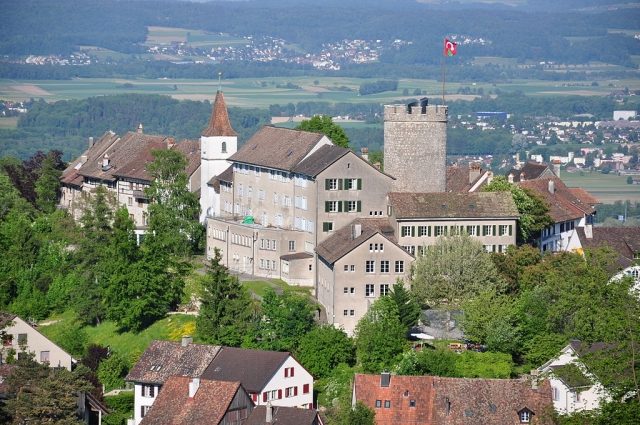
Regensberg Castle is located in Regensberg in the canton of Zurich on the eastern Lägern ridge, an offshoot of the Swiss Jura mountains.
Middle Ages
Presumably around 1040, Baron Lütold von Affoltern built the Altburg on a moraine hill near Regensdorf, on the current border between the city of Zurich and Regensdorf, not far from Lake Katzensee. His descendants later called themselves Barons of Regensberg. The Regensbergers experienced their heyday at the beginning of the 13th century in northeastern Switzerland, in what was then the Zurichgau. They consolidated their position of power through intensive castle building, town foundations, and the establishment of the monasteries of Fahr and Rüti.
It is not definitively clear whether Lütold V or his son Ulrich founded the town of Neu-Regensberg, today Regensberg, around 1240/45. What is certain is that after the death of Lütold V (around 1250), his two sons, Lütold VI and Ulrich von Regensberg, divided the inheritance. Ulrich secured, among other things, the ancestral seat of Neu-Regensberg. The Regensberg Feud of 1267/68, which is only fragmentarily documented, falls within his time and ended with the economic decline of the Regensbergers and the sale of their possessions to Habsburg feudal lords. Ulrich von Regensberg died around 1280 and was buried in the Barfüsserkloster. His very well-preserved tomb slab, depicting an idealized knightly figure, can be seen in the Swiss National Museum; a replica is located at the fountain at the entrance to the town of Regensberg. Ulrich's son Lütold VIII also had to sell Neu-Regensberg to Habsburg-Austria in 1302, and the Regensbergers retreated to their old ancestral castle.
The Habsburgs pledged the castle and town several times until they were acquired by the city of Zurich in 1409 and, from 1417, became the seat of the bailiff of the Regensberg bailiwick ("Outer Bailiwick") of the city of Zurich. On Pentecost 1443, Regensberg was conquered by the Confederates in the Old Zurich War (1436–50), but not destroyed. The only known victim is said to have been the bailiff of Regensberg, as was the bailiff of Grüningen a few months later. Zurich reoccupied Regensberg with troops as early as 1444.
Early Modern Period
In 1540, the town was destroyed by a major fire; only the castle remained largely unscathed. The palas was demolished in 1583/85 and replaced by a new building. From 1689, a 'modern' fortification surrounded the castle and old town. In the spring of 1798, French revolutionary troops marched into the Old Swiss Confederacy. On March 13, 1798, the Zurich council resigned: the bailiwicks were abolished. With the "Helvetic Revolution," the last bailiff left his official residence in the castle, and Regensberg was incorporated into the Bülach district. After the end of the Helvetic Republic, Regensberg became the district capital in 1803, but lost this function to Dielsdorf in 1871, which had gained importance due to railway construction.
Until 1865, the castle remained the seat of authorities, and the district prison was located in the main building.
In 1883, on the initiative of the Charitable Society of the Canton of Zurich, the current "Förder-Stiftung für Kinder und Jugendliche der Stiftung Schloss Regensberg" (Support Foundation for Children and Young People of the Regensberg Castle Foundation) was founded.
Layout+
Regensberg was conceived as a castle with an adjoining town and was developed 'modernly' according to the criteria of the time. In the so-called Oberburg, two rows of houses enclosed the generously laid out main square, where Switzerland's deepest well, 57 meters deep, was hewn into the limestone. Similarities in the conception and planning of the castle town with Grüningen, also a foundation of the Barons of Regensberg, are unmistakable.
The Unterburg (Lower Town), which nestles into the western hollow against the castle hill, was probably only built in the 14th century. It was not surrounded by a ring wall and was not included in the modernization (1689) of the fortifications of Oberburg and the bailiff's seat.
Untypical for northeastern Switzerland is the round, five-story keep, built of local limestone, with a wall thickness of three meters. The nine-meter-diameter tower originally had a high entrance instead of the current ground-level entrance and a pointed helmet roof, which was destroyed by lightning in 1766.
Presumably, Lütold V took his wife Berta von Neuenburg into consideration with this architectural style, as round towers were common in her Western Swiss homeland at the time.
Adjoining the round tower to the north was a palas, which had largely survived the devastating fire of 1540. In 1583 and 1585, Bailiff Vogel had the palas demolished down to its foundations and a three-story building erected in its place, which largely corresponds to today's northern castle wing. The entire complex, together with the outbuildings – washhouse, stables, garden, chapel – was surrounded by a ring wall, and a gate led into the upper town.
In 1890, the main building was widened and converted into a schoolhouse. New buildings were constructed in the west, and the "lower house" was repurposed as living quarters and a basket weaving workshop.
Take Mobile History with you
You are reading this text for free. Premium adds what matters on the road: descriptions read aloud, sites found through your camera, whole regions taken offline.
- Every description, including the ~17,700 Premium sites
- Audio guide: have descriptions read to you on location
- AR finder: see sites through your camera, with distance and bearing
- Unlimited saved sites
14 days free, then from €2.99 a month. Cancel anytime.
Source: Wikipedia · Licence: CC BY-SA 4.0
This description draws on the facts documented in the linked Wikipedia article; Wikipedia content is licensed under CC BY-SA 4.0. Wording and editing: Mobile History.
Location: 47.4828, 8.4381