To be privately owned
CastleReichenschwand
Reichenschwand Castle
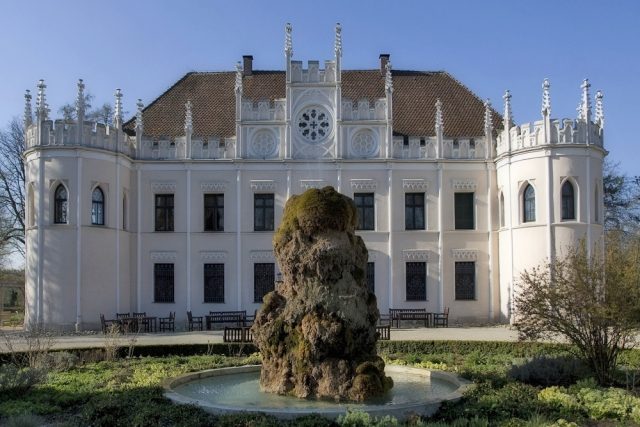
The moated castle of Reichenschwand dates back to a fortified seat, which the ministerial family of Strahlenfels presumably built around the year 1300. Evidently, the family had tried to gain a foothold here on the Pegnitz and in the immediate vicinity of Henfenfeld, after being pressured on the Strahlenfels by the neighboring lords of Wildenstein. The Wildensteiners, counting among the most important followers of the Bavarian dukes, took massive action against the comital environment in their lords' war against the Count of Hirschberg from 1290 onwards, especially against the former imperial ministerials of Henfenfeld, who in turn had close, also familial, ties to the Strahlenfels family.
Konrad von Strahlenfels appears for the first time in 1310 as the holder of manorial rights in Oberndorf near Reichenschwand and in 1312 in Sendelbach. The Sendelbach rights confirm the close relations with the Henfenfelders, who once held all the tenants there. In 1331, Adam von Strahlenfels resided in Reichenschwand, which was apparently claimed as a free allodial property. It was not until Georg von Strahlenfels in 1366 that it was enfeoffed to Emperor Charles IV as a Bohemian fief. Georg and Peter von Strahlenfels were among the 20 castle guardians of the now Bohemian Rothenberg Castle. In 1399, Peter, in 1424 Leonhard, and in 1440 Thomas von Strahlenfels were enfeoffed with Reichenschwand by the Bohemian crown.
At the latest by 1464, the family's time in Reichenschwand came to an end, when Ulrich Ratz von Eismannsberg acquired the moated castle and the associated rights, perhaps through a marriage. After his death, it presumably passed to Bertold Ratz around 1480. Shortly after 1500, Bertold died and left the seat to his widow Amalie, who in 1504, as a result of the Landshut War of Succession, had to recognize the territorial sovereignty of the Imperial City of Nuremberg. For years, an administrator, Hans von Seckendorff, managed the manor until it was sold in 1531 to Bonaventura Furtenbach. He came from a family based in Feldkirch, which had made a fortune in long-distance trade and through daring transactions. Furtenbach, who had settled in Nuremberg in 1522, married a daughter of Anton Derrer and, after partly dubious financial dealings with various princes, including the Emperor and other Habsburgs, achieved fabulous wealth. Bonaventura Furtenbach's dealings with the imperial court earned him an imperial letter of nobility and a coat of arms in 1548, and in 1555 even the privilege of jurisdiction for his lordship of Reichenschwand, which, however, was not recognized by Nuremberg.
The entrepreneur also shaped his new property architecturally. The old Strahlenfels residence was largely renewed and significantly expanded in the 1530s. A map of the Pegnitz river course created around 1538 explicitly noted "newly built house or castle". However, Furtenbach's splendor was not destined to last long. In the Second Margrave War, the margravial troops first captured the moated castle on May 18, 1552, which the Nuremberg forces under Niklas Nöttelein, however, recaptured. In the second year of the war, on May 12, 1553, the castle was surrendered to the enemy without resistance and burned down by them.
Even before his death on June 24, 1564, Bonaventura von Furtenbach had designated the already rebuilt seat as a fideicommissum to prevent a sale or fragmentation of the estate among his heirs. The foundation remained in existence until its legal abolition by the Kingdom of Bavaria in 1808. Hans IV von Furtenbach was the first administrator; he revived the dispute with the Imperial City over the jurisdiction of Reichenschwand, which, however, ended in 1566 with a recognition of the Imperial City's territorial sovereignty and high jurisdiction.
Under Hans V von Furtenbach, the new castle was ruined a second time, namely in 1632 by the Imperial forces, who occupied, plundered, and partly set it on fire. A second capture of the damaged castle by Bavarian electoral troops was, however, violently ended by the Imperial City in September 1634. Under Johann Bartholomäus von Furtenbach, at most a provisional repair began in 1636. The actual restoration only followed in the years 1660 to 1664 by the brothers Johann Sigmund and Johann Wilhelm von Furtenbach. In 1692, Johann Wilhelm's widow, Ursula Philippina, had the so-called large new room expanded and redecorated with paintings. Under her stepson Wilhelm August, born in 1663, not only was the castle further modernized between 1694 and 1718, but the castle garden was also redesigned, which included filling in the inner moat, erecting a pleasure house, and building a fountain system in 1712.
After the legal abolition of the fideicommissa, about half of the property was sold in December 1812 to the royal legation councilor and chief postmaster Ernst Gottlieb Heinrich Ritter von Axthelm. In 1813 and 1814, the remaining shares were finally sold to him by the guardians of Jobst Wilhelm von Furtenbach, who was afflicted by strokes. In April 1828, the chief postmaster sold the castle estate for 57,500 guilders to Dr. Franz Otto Ritter von Stransky, a medical councilor from Bohemia. He immediately began initial renovation work, which lasted until 1831. According to the preserved building accounts, a master mason Schmidt from Lauf directed the work, and the building contractor Gößel from Mögeldorf was also involved.
Source: Wikipedia · Licence: CC BY-SA 4.0 · Image: http://de.wikipedia.org/wiki/Datei:01_Schloss_Reichenschwand_klein.jpg
This description draws on the facts documented in the linked Wikipedia article; Wikipedia content is licensed under CC BY-SA 4.0. Wording and editing: Mobile History.
Location: 49.5102, 11.3767