School
CastleReichersbeuern
Reichersbeuern Castle
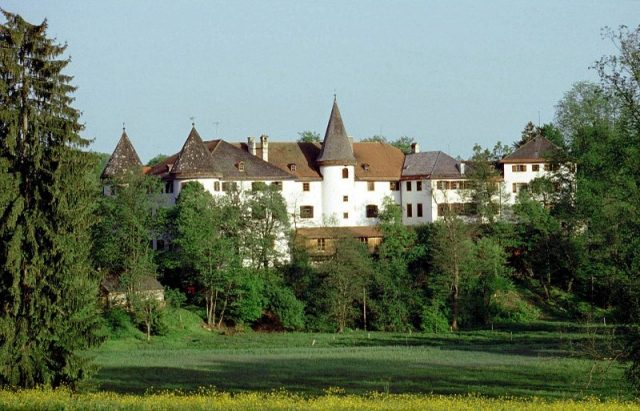
Reichersbeuern Castle, also known as Sigriz Castle, in the municipality of Reichersbeuern, stands at the foot of the foothills of the Bavarian Alps, six kilometers east of Bad Tölz.
Since 1829, it has been owned by the von Sigriz family. Today, it houses a reform-pedagogical artistic gymnasium with a full-day school and boarding school, the Max-Rill-Schule.
Around 920, the early country estate of Tegernsee Monastery was called "Puron" or "Piura," which was probably granted as a fief to the noble Bavarian family Richer. These lords "de Richerspiuren" held a key office of the monastery until 1380: the office of seneschal. Around 920, a fortified castle was also built in Puron against the Hungarian invasions – a moated castle, almost hidden between the hills.
From 1384, Reichersbeuern was a Hofmark with its own jurisdiction. Veit Jacob Tänzl zu Trazberg, who became rich from silver mining in the Inn Valley and thus an important financier in the empire of Maximilian I, converted Reichersbeuern Castle into a Renaissance castle in 1520, representative, comfortable, and artfully designed, including wood sculptures by Erasmus Grasser and G. Bockschütz.
Christoph II von Pienzenau doubled the property. The Hofmark Sachsenkam was added. There, in 1606, his daughter Anna von Pienzenau-Closen founded a "Loreto" pilgrimage chapel on the Reutberg, rebuilt after the original in Ancona, Italy. Anna's scandal-ridden Italian husband, Jakob Papafaba Count zu Carrara and Aquilara, the cupbearer of the Duke of Bavaria, is said to have tried to rob, abduct, or even murder his wife; in vain – he himself had to flee to Italy.
Source: Wikipedia · Licence: CC BY-SA 4.0
This description draws on the facts documented in the linked Wikipedia article; Wikipedia content is licensed under CC BY-SA 4.0. Wording and editing: Mobile History.
Location: 47.7675, 11.6255