Research center
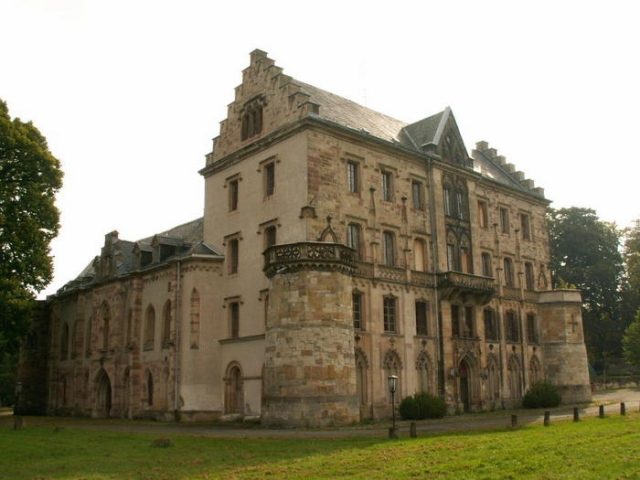
Reinhardsbrunn Castle

Reinhardsbrunn is a district of the small Thuringian town of Friedrichroda in the Gotha district. Reinhardsbrunn was home to the house monastery of the Landgraves of Thuringia. Reinhardsbrunn Castle was built on its ruins in 1827.
Monastery
The Benedictine monastery was founded in 1085 by the Thuringian Count Ludwig the Springer near his ancestral castle, the Schauenburg near Friedrichroda. A convent from Hirsau moved into Reinhardsbrunn, which was fraternized with Hirsau and Cluny and had been under papal protection since 1092.
The monastery gained importance as a center of the Hirsau reforms within Thuringia, but also as the house monastery and burial place of the Ludowingians, who had risen to become Landgraves of Thuringia. Between 1156 and 1168, the Reinhardsbrunn librarian Sindold compiled a collection of letters. These include 12th-century letters from the monastery's operations and from correspondence with the Landgraves' family, as well as samples, style exercises, and theoretical material on the art of letter writing. The Reinhardsbrunn Chronicle, compiled around 1340 to 1349, provides information from the 6th century to 1338. It includes the history of the monastery itself, from its foundation, of the Ludowingian family, of the Landgraviate of Thuringia and its transition to the Wettins, but also of the German Empire. Some of the sources used as templates are now considered lost.
In the early 13th century, the decline of Reinhardsbrunn Monastery gradually began, intensified by the extinction of the Ludowingians in 1247 and by a fire in the monastery in 1292. However, even under the Wettins, who succeeded the Ludowingians as Landgraves, Reinhardsbrunn still served as a burial place several times.
In 1525, during the Peasants' War, the monastery was plundered and destroyed. The monks fled to Gotha, and the monastery's property was sold to the Elector of Saxony. The Reinhardsbrunn district was formed from the monastery's property. Zella St. Blasii, which previously belonged to the monastery, became part of the Schwarzwald district. Five years later, in January 1530, nine Anabaptists were held at Reinhardsbrunn and interrogated by the Gotha superintendent Friedrich Myconius. Six of them were unwilling to recant their reformational-Anabaptist views and were subsequently executed. They were the first Anabaptists to be killed solely for their faith under a Lutheran government. Philipp Melanchthon later defended these executions in a letter to Myconius.
The monastery buildings fell into disrepair during the following decades; in 1952, the gravestones of the Landgraves were moved to the Georgenkirche in Eisenach.
Castle
After the monastery fell into disrepair, Duke Friedrich Wilhelm I of Weimar built an official residence for the Reinhardsbrunn district in 1601. His brother Johann III planned the reconstruction of Reinhardsbrunn; by the time construction began, he had already died. Under his widow Dorothea Maria, the floor plan with the main buildings was created between 1607 and 1616. In the following years, connecting buildings were erected, into which remnants of the monastery buildings were probably incorporated. Parts of the buildings were constructed under Duke Friedrich II of Gotha-Altenburg around 1706. The western building was the main building, called "the high house" or "castle", on whose foundations, using the corner towers, a pleasure palace was built under Duke Ernst I of Coburg and Gotha in 1826/1827. Building councilor Eberhardt (1805-1880) from Gotha and Heideloff from Nuremberg were responsible for the construction. To the northeast, the hall building adjoins the main building as a short wing; to the south, and thus almost parallel to the main building, runs the "Hirschgalerie" (Deer Gallery). This was created from the former official building. From this, to the east, runs "the new building" or "Long Building", which contains parts of the 15th century and later served as a church gallery.
The church closes the octagon to the east with three sides and replaces the church demolished in 1855. It lies slightly south of the former monastery church and within the area of the former cloister wings. This former church was a large, very elaborately designed building, whose size was reflected in an altarpiece, depicting "Jacob's Dream", executed as a family memorial plaque. In 1850, the painting by Christian Richter, father of the court painter Christian Friedrich Richter (1587-1667), was moved to the Augustinian Church in Gotha. The tomb slabs were incorporated into the new church building in 1874, after having been moved several times before. The gravestones of Frederick the Bitten and his wife Elisabeth had already been removed from the burial site in the Katharinenkloster Eisenach in 1552 and moved to the castle chapel of the newly built Grimmenstein Castle, as were the tomb slabs from the then already dissolved Reinhardsbrunn Monastery. When the castle was destroyed in 1567, the stones were moved to the former foundry in front of Grimmenstein; in 1613, Dorothea Maria had them repaired and in 1614 placed on the southern outer front under a protective roof. In 1874, they were placed inside the church's porch or in the connecting room from the church gallery, but partly with incorrect dates. Today the slabs are in the Georgenkirche in Eisenach.
Around 1850, a landscape park was created around the castle. Here, Queen Victoria of Britain and Albert of Saxe-Coburg and Gotha met several times.
In 1891, the complex was included in the "Inventory of Art Monuments of the Duchy of Saxe-Coburg and Gotha". In 1945, the House of Saxe-Coburg and Gotha was expropriated without compensation by the Soviet occupation forces. Thus, the ducal house also lost Reinhardsbrunn Castle, including its furnishings and park. Afterwards, the state of Thuringia took over the properties and temporarily used them for training firefighters and police. In 1953, the castle became a hotel of the VEB Reisebüro der DDR, primarily as a foreign exchange earner for guests from West Germany and other Western countries. Accordingly, an Intershop was also located on the castle grounds until 1990. The castle developed into a cultural and educational center, with concerts and congresses. Since 1980, it has been listed as a "monument of national importance" in the GDR monument list. In the ducal outer park, the VEB Kali Werra built and maintained the pioneer holiday camp "Georgi Dimitroff" during GDR times.
In 1992, Reinhardsbrunn Castle was entered into the monument register of the Free State of Thuringia. After the reunification, the hotel was sold by the Treuhandanstalt to two Western hotel groups. However, the plan to develop it into a five-star hotel was abandoned. A retransfer to the former owners did not materialize. Then came English, Ukrainian, and Russian buyers. The decay of the complex continues. Since 2011, there has been a "Friends of Reinhardsbrunn Castle and Park" association, which has developed positive activities.
Regarding the condition of the castle in June 2013, the Frankfurter Allgemeine Zeitung published a detailed report on June 20, 2013. Expropriation of the complex is currently being considered in order to preserve the monument.
Tomb Slabs
The stones that stand in the Georgenkirche today are reproductions of the originals, which were probably destroyed in a fire in 1292. Three of the stones were created by the same sculptor around 1320, the rest seem to have been worked around the middle of the 14th century. After the restoration of the stones under Duchess Dorothea Maria, another was carried out by the sculptor Wolfgang from Gotha in 1864. The eight stones were placed on the west wall of the Reinhardsbrunn castle chapel; on the north wall, on a pedestal with the year 1301, was a memorial plaque for an unknown deceased person, as the inscription was only fragmentarily recognizable. On the east wall stood the tomb slabs of Frederick I, the Bitten or the Free († 1323), in front of them in a box his bones, next to them the slab of his wife Elisabeth von Arnshaugk († 1359). Tomb slabs on the south wall were probably those of Abbot Hermann († 1168) and a Diether von Isenburg († around 1406?). There was a crypt in the church itself.
The following tomb slabs are found in the choir of the Georgenkirche:
- Figural tomb slab for Ludwig the Springer (Ludowingian) († 1123), founder of Reinhardsbrunn Monastery
- Figural tomb slab for Adelheid († 1110), wife of Ludwig the Springer
- Figural tomb slab for Landgrave Ludwig I († 1140), son of the founder
- Figural tomb slab for Landgrave Ludwig II, the Iron († 1172), son of Ludwig I
- Figural tomb slab for Landgravine Jutta († 1191), wife of Ludwig II, sister of Emperor Frederick Barbarossa
- Figural tomb slab for Landgrave Ludwig III, the Pious († 1190), son of Ludwig II
- Figural tomb slab for Landgrave Ludwig IV, the Saint († 1227), nephew of Ludwig III
- Figural tomb slab for Landgrave Hermann II († 1241), son of Ludwig IV
St. John's Chapel in the Castle Park+
In the area of the medieval monastery complex, the Evangelical Church of Thuringia found a place for the Reinhardsbrunn Foundation, creating training and conference rooms, a meeting place, and St. John's Chapel, consecrated in 2001. This church, also known as the "Cyclist's Chapel," stands in the castle park and is occasionally used for sacred purposes, e.g., on church holidays.
It is a replica of St. John's Church of St. Boniface from 724. It is said to have been the baptismal church of Landgrave Ludwig IV (husband of St. Elisabeth). At that time, Boniface was evangelizing near Altenbergen and had a chapel built at the present candelabra monument, which was expanded several times until the mid-18th century. In the replica of the chapel in the castle park, there is a cast of the figural tomb slab of Ludwig IV; the original is in the Georgenkirche in Eisenach. Ludwig is buried in Reinhardsbrunn Monastery.
Take Mobile History with you
You are reading this text for free. Premium adds what matters on the road: descriptions read aloud, sites found through your camera, whole regions taken offline.
- Every description, including the ~17,700 Premium sites
- Audio guide: have descriptions read to you on location
- AR finder: see sites through your camera, with distance and bearing
- Unlimited saved sites
14 days free, then from €2.99 a month. Cancel anytime.
Source: Wikipedia · Licence: CC BY-SA 4.0 · Image: http://www.wehrbauten.de/thread.php?threadid=589&sid=9b2b210ff3d27b7a80b9c70dbb4777c0
This description draws on the facts documented in the linked Wikipedia article; Wikipedia content is licensed under CC BY-SA 4.0. Wording and editing: Mobile History.
Location: 50.8664, 10.5577