CastleRöthenbach an der Pegnitz-Renzenhof

Renzenhof Castle
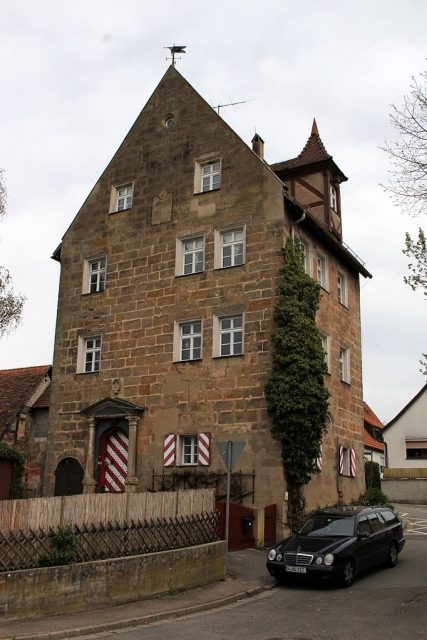
Renzenhof Castle

To be privately owned

In Renzenhof, a reichslehnbare (imperial fief) forest hub has been documented since the 14th century. Konrad Peßler is mentioned as the owner of Renzenhof in 1362, followed by Konrad Hutt, judge of Lauf, who sold it in 1374 for 300 Gulden to the Nuremberg citizen Hans Maier. In 1401, King Ruprecht enfeoffed Maier with Renzenhof ("a forest hub") and granted him permission to appoint another person to perform the forest service in his stead. In 1402, the prominent merchant and mining entrepreneur Herdegen Valzner and Hans Maier jointly purchased the Haimendorf forest hub from Ulrich Strobel, agreeing that this estate should be connected with the Renzenhof forest hub. In the same year, King Ruprecht granted the Haimendorf forest hub to Hans Maier and confirmed that it "belonged to Renzenhof." Later, the estates passed to Albrecht von Egloffstein, who allegedly opened Renzenhof to the Nuremberg Council in 1416, meaning he allowed it to be garrisoned with soldiers in case of war. No evidence for this has yet been found; moreover, Egloffstein and his son Wolfram sold both forest hubs to the Nuremberg citizen Peter Eyttenholzer in 1415/16. In 1417, King Sigismund enfeoffed him with the imperial forest fiefs of Renzenhof and Haimendorf.

In 1426, Eyttenholzer sold the Renzenhof forest hub to Hans Hallertauer, from whom it passed to Kunz Wagner in 1453. The remarkably low purchase price of 25 Gulden suggests significant war damage, especially since the area around Moritzberg suffered heavily in the First Margrave War in 1449. Later, the forest hub passed to Nikolaus Paumgartner, who sold it to Thomas Zingel in 1480. The Zingel family had immigrated from Nördlingen to Nuremberg at the end of the 14th century and had become wealthy through long-distance trade and iron production. Thomas Zingel died in 1482 and bequeathed Renzenhof to his nephews, the brothers Dr. Johann and Paul Zingel. They sold the property in 1484 for what was now 440 Gulden to Jörg Schedel, which suggests that renovations had taken place in the meantime.

In the espionage report compiled in 1504 before the outbreak of the Landshut War of Succession, the "seat" at Renzenhof is explicitly attested for the first time. After Jörg Schedel's death the following year, it passed to his brother Dr. Hartmann Schedel, the famous physician and humanist, best known for the Schedel's World Chronicle printed by Koberger in 1493. After his death in 1514, his son, also named Hartmann, granted the imperial city the right of opening in 1517. The heirs of the famous scholar sold the seat on July 20, 1544, to Christoph II. Fürer von Haimendorf, thereby establishing a centuries-long tradition of ownership.

The tower-like, massive manor house apparently survived the Landshut War of Succession as well as the Second Margrave War without major damage. August Gebessler's dating ("existing building late 15th/early 16th century over presumably older foundations") with reference to a building inscription of 1485 allegedly previously above the portal, nevertheless appears to require re-examination. Building measures around 1600 are likely indicated by the addition of a now demolished stair tower to the northwestern eaves side (the bricked-up passages are still visible today) and the creation of the Renaissance portal, which has since been framed with Tuscan columns and a flat triangular pediment. Perhaps the weathered Fürer coat of arms above the portal and four corner turrets, which have also disappeared, also resulted from this measure.

In 1573, permission was granted for a stable "on new ground" as an extension to the Voithaus. This new construction thus concerned the farmyard, which was located west of the manor house. Another inscription "Renovirt 1784" above an oval window on the ground floor proves a more recent building measure. The stair tower and corner turrets are still visible on F. A. Annert's copper engraving from 1791; the latter had already disappeared by 1894. Iron bands, which had once served to fasten the corner turrets, were still present at the eaves corners in 1961. The former ground-floor hall with a beam supported by a column was later divided by the installation of interior walls.

The Fürer von Haimendorf family only sold the manor house with all its appurtenances to private individuals in 1847 for 9,785 Gulden. Later, it came into the possession of the industrial family Conradty, who, under Conrad Conradty, had founded a pencil factory in the Röthenbach paper mill in 1880, which developed into one of the world's most important production sites for lighting carbons in the 19th century. Unfortunately, the largely early modern economic buildings fell into other hands and today show the traces of years of neglect. Hopefully, the historically very valuable building stock can be saved.

Take Mobile History with you

You are reading this text for free. Premium adds what matters on the road: descriptions read aloud, sites found through your camera, whole regions taken offline.

  • Every description, including the ~17,700 Premium sites
  • Audio guide: have descriptions read to you on location
  • AR finder: see sites through your camera, with distance and bearing
  • Unlimited saved sites

14 days free, then from €2.99 a month. Cancel anytime.

Source: Wikipedia · Licence: CC BY-SA 4.0 · Image: http://de.wikipedia.org/wiki/Datei:Renzenhof_06.jpg

This description draws on the facts documented in the linked Wikipedia article; Wikipedia content is licensed under CC BY-SA 4.0. Wording and editing: Mobile History.

Location: 49.4719, 11.2678