CastleBrakel - Rheder

Rheder Castle

Rheder Castle

Museum

Rheder Castle is a small castle complex on the Nethe in the Brakel district of Rheder, Höxter district. It emerged from a manor that was a fief of the Prince-Bishopric of Paderborn. The complex is privately owned and surrounded by an eight-hectare English landscape garden. This has been designated as a nature reserve since 1949 and is accessible to the public.

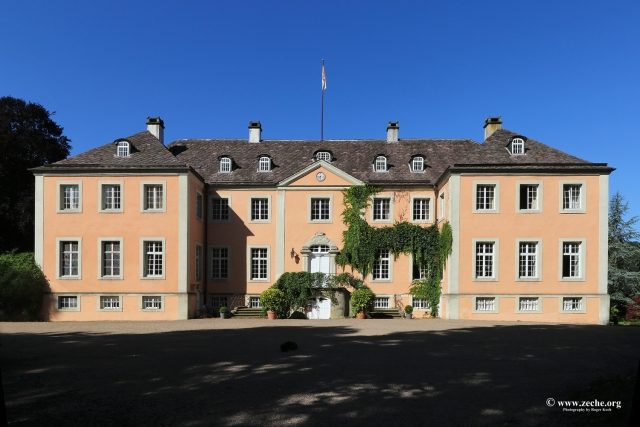
The castle complex consists of a pink manor house and a horseshoe-shaped outer bailey to the east with a yellow facade. Its approximately 120-meter wide front features two octagonal corner pavilions and a large, centrally located gate passage with sculptural gable decoration.

The two-story, late Baroque manor house with its short, only hinted-at side wings appears very simple externally. On its east side, it has a central risalit with an unadorned triangular gable. A two-flight open staircase leads to the portal located there. The building has an interior in the Rococo style. Particularly noteworthy, in addition to the so-called Chinese Room with hand-painted fabric wallpaper from around 1770, is the richly stuccoed garden hall with an octagonal floor plan. Its furnishings come from the same Italian artists who also decorated Schwarzenraben Castle. In the southern part of the manor house, there is also a castle chapel with Rococo decoration.

The castle park, in the style of an English landscape garden, is mostly located east of the buildings. Particularly striking is its wide visual axis, called Pückler-Schlag, which leads straight from the garden hall of the manor house to the Sieseberg to the east. Also belonging to the park are a 19th-century tower ruin, called Idaturm, located north of the manor house, and the castle's former kitchen garden.

In the 14th century, Rheder was owned by the Knights of Brakel. After their extinction in 1384, their possessions fell to the Prince-Bishopric of Paderborn, whose bishop subsequently enfeoffed the family of the Barons von Mengersen with them. They built a castle there and moved to Rheder around 1400.

The castle complex was destroyed during the Thirty Years' War, so Christian von Mengersen subsequently had several fortified houses built along the Nethe to manage his possessions from there. His successor Christian Falcko von Mengersen received the privilege from Paderborn Prince-Bishop Simon von Sternberg on July 2, 1686, to brew and serve beer in Rheder. This laid the foundation for the still existing castle brewery.

Christian Falcko's successor Bruno Burchard von Mengersen commissioned the Westphalian master builder Lambert Friedrich Corfey in 1716, together with the two Pictorius brothers, to build an outer bailey surrounded by a moat, which was ultimately realized by the then still young Johann Conrad Schlaun by 1727. The outer bailey was followed in 1750, under Franz Joseph von Mengersen and his wife Sophie-Antoinette, née Baroness von Spiegel zu Desenberg, by the construction of the present manor house according to plans by the architect Johann Matthias Kitz.

Also during the 18th century, a representative Baroque garden was laid out, which, however, was probably only partially realized in terms of the original planning. The garden was completely surrounded by a wall, which is still preserved today in the south and north of the castle area.

In 1800, Friedrich Wilhelm Bruno von Mengersen inherited Rheder Castle and was elevated to the hereditary countship in 1814 for special services.

The present landscape garden was probably created in two phases. The first dates to the end of the 18th century and resulted in a romantic, playful design of the area. The park then had a Chinese garden house, a bark house, a temple of friendship, and a hermitage. However, none of these buildings are preserved today, nor are the former avenue with oriental poplars, the rose island, or the burial island planted with fir trees. The second design phase of the park goes back to Josef Bruno von Mengersen, who later became known as the "Poet Count of the Nethegau" through literary publications. Inspired by the landscape gardening ideas of Prince Hermann von Pückler-Muskau, he transformed the park from 1838 into a "classical" landscape garden with native trees and shrubs, expanding it to about 70 hectares.

With Josef Bruno von Mengersen, the Rheder line of the von Mengersen family died out in the male line in 1873, and Rheder Castle passed by inheritance to the family of the Barons Spiegel von und zu Peckelsheim, who are still the owners of the complex today.

Current Use+

In the outbuildings of the outer bailey, the more than 300-year-old Gräflich Mengersen'sche Dampfbrauerei (Count Mengersen's Steam Brewery) and a Hussar Museum are housed. The latter refers with its theme to the lord of the castle, Adolf Freiherr Spiegel von und zu Peckelsheim, who was a Rittmeister (cavalry captain) in Tsar Nicholas II's Hussar Regiment.

In addition, a café opened in the former orangery in 2004, and the castle chapel and the garden hall of the manor house can be rented for weddings.

Since 2003, a "spatial staging" by conceptual artist Jenny Holzer has been on display in the western part of the landscape park. It consists of a multitude of seemingly randomly scattered tree trunks, into which texts by Holzer and Henri Cole are engraved.

Take Mobile History with you

You are reading this text for free. Premium adds what matters on the road: descriptions read aloud, sites found through your camera, whole regions taken offline.

  • Every description, including the ~17,700 Premium sites
  • Audio guide: have descriptions read to you on location
  • AR finder: see sites through your camera, with distance and bearing
  • Unlimited saved sites

14 days free, then from €2.99 a month. Cancel anytime.

Location: 51.6790, 9.1620