To be privately owned
CastleSill (Ritten)
Schloss Ried
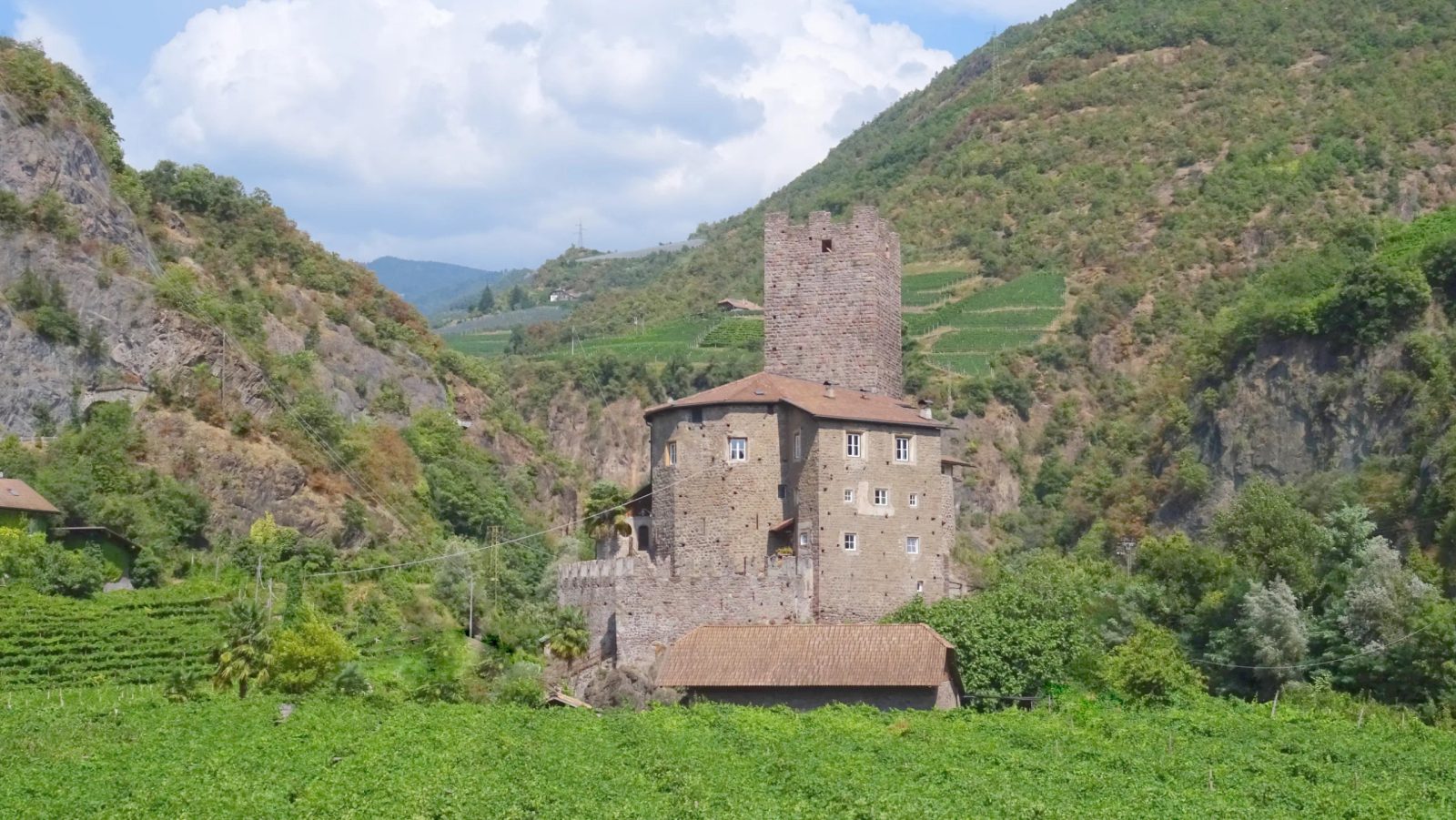
Ried Castle or Ried Fortress is a rather small castle without palace-like elements north of Bolzano at the entrance to the Sarntal in South Tyrol, Italy. Today, Ried Castle is an administrative curiosity. Although it is located on the orographically right side of the Talfer, it belongs to the locality of Sill, part of the municipality of Ritten, which otherwise lies exclusively to the left of the Talfer.
Location+
Behind the well-known Runkelstein Castle, the Sarntal widens into a small basin, after which it narrows again. The former water castle of Ried took advantage of this formerly strategically important basin. In the Middle Ages, its walls were surrounded by the waters of the Talfer; today, it flows less than twenty meters past the castle. Ried Castle is one of the few castle complexes that were never conquered.
History+
The complex was presumably built around 1200 and expanded in the mid-13th century with residential buildings, a zwinger, and a castle chapel. In 1225, the ministerialis Heinrich de Riade (Ried) appears. The family coat of arms of the Lords of Ried was a black rooster on a golden field.
Towards the end of the 13th century, the castle was owned by the noble free lords of Wangen. In 1307, the castle was sold to the wife of Duke Otto of Carinthia-Tyrol. Subsequently, the castle was issued as a Tyrolean-Habsburg administrative court to appointed court administrators; thus, in 1465, a Lenhart Ortwegker served as "pfleger ym Rit bey Botzin". From 1501, King Maximilian I used the castle as a customs station on the recently constructed Sarntal valley path; in 1509, the complex was owned by the Liechtensteiner family. In 1549, Christoph Khuepacher, councilor and court secretary to Emperor Maximilian II, bought the castle from Stephan Stoß. On October 1, 1558, he received permission to use the predicate "von und zu Ried" and an augmentation of his coat of arms with that of the extinct Lords of Ried. The family, partly elevated to the rank of baron, later called themselves von Kuepach zu Ried, Zimmerlehen und Haselburg. In the 19th century, the castle came into the possession of the Barons von Ingram, who had it restored and expanded in a palace-like manner. The multiple (cf. List of Rulers of Moldavia) Voivode of the Principality of Moldavia, Petre Şchiopul (also Peter the Lame), who had fled from the Turks, was assigned residence here by Vienna at that time. His tombstone is located in the Franciscan Monastery in Bolzano. The Bolzano trade fair procession of spring 1921, which triggered the Bolzano Bloody Sunday, was originally intended to lead to Ried Castle but was aborted due to fascist attacks. Today, the well-preserved complex is in private ownership and cannot be visited.
Take Mobile History with you
You are reading this text for free. Premium adds what matters on the road: descriptions read aloud, sites found through your camera, whole regions taken offline.
- Every description, including the ~17,700 Premium sites
- Audio guide: have descriptions read to you on location
- AR finder: see sites through your camera, with distance and bearing
- Unlimited saved sites
14 days free, then from €2.99 a month. Cancel anytime.
Source: Wikipedia · Licence: CC BY-SA 4.0 · Image: Foto: Jörg Heldt (Community)
This description is a machine translation of an excerpt from the linked Wikipedia article. The source text was written by its authors, the translation is by Mobile History; like the original it is licensed under CC BY-SA 4.0.
Location: 46.5205, 11.3613