To be privately owned
Riede Castle
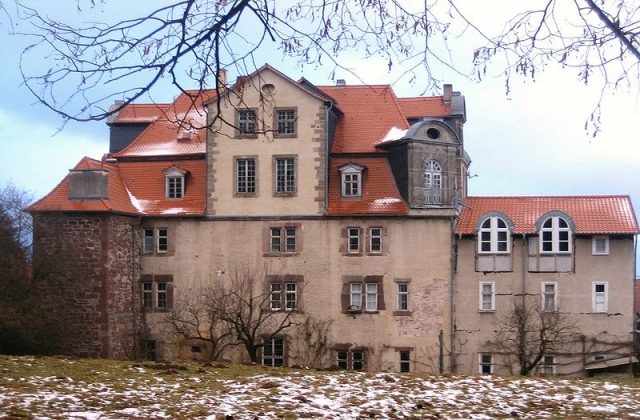
Riede Castle is a Renaissance building in Riede, a district of Bad Emstal in the North Hessian district of Kassel.
The first documented mention of the village of Riede dates back to 1074. The castle was built on the foundations of a farm belonging to the Augustinian monastery of Merxhausen. This original building fabric was verifiable through a Romanesque chapel until the 19th century.
In 1443, the first verifiable owner, Henne von Wehren, who held it as a fief from the Landgraves of Hesse, sold the property to the Hessian noble family of Meysenbug. In 1563, using extensive parts of the existing building, the castle was erected in the Weser Renaissance style, with a knight's hall at its center. The Renaissance cast iron plates in the bay window room, created according to the designs of the Hessian iron founder Philipp Soldan, date from 1574.
In 1674, a manor house, a simple hall building with half-timbered turrets, was added to the castle by Wolrad von Meysenbug. In the 17th century, a herb garden, which still exists today, was laid out. Commissioned by Leo von Meysenbug, the castle was rebuilt in the 17th and then again in the 18th century; in the process, the unity of the complex was lost. Around 1770, the castle complex was supplemented with an English garden by Heinrich von Meysenbug.
In 1810, the Meysenbug family died out with Heinrich von Meysenbug, and the fief reverted to the then sovereign, Jérôme Bonaparte, King of the Napoleonic Kingdom of Westphalia, who gifted it to his Grand Equerry, General Philippe François Maurice d’Albignac, appointed Count of Ried; however, he never personally saw Riede. After the restitution of the Electorate of Hesse-Kassel in 1813, Elector Wilhelm I gifted the castle to his son, Crown Prince Wilhelm II, who stayed there briefly with his mistress Emilie Ortlöpp.
In 1825, the von Buttlar family bought the castle, park, and farm buildings and kept them until their sale in 2007. In 1878, the Romanesque chapel had to make way for the extension of the south wing.
The historic knight's hall in the castle is now available as a wedding venue. In addition, the castle houses a small art gallery in some rooms, which shows temporary exhibitions.
Castle Park+
Heinrich von Meysenbug, the then owner of the castle, commissioned Johann Heinrich Müntz around 1770 to create an English landscape park. The natural forest park adjoins the castle on a slope in front of the Klauskopf and covers about 30 hectares. It has been supplemented several times over time.
The garden, in the early Romantic-sentimental style, was planted with numerous native and exotic trees and shrubs. The park included an obelisk from 1774, a tower ruin, a hermit's hut, a memorial stone, a stone with the inscription "All or nothing," and the "Hennerkapelle." The chapel served as the family burial place for the Buttlar family. The garden architectural structures were connected by winding paths. The design of the planting allowed views of the surrounding landscape. A baptismal font from 1564 is integrated into the park. Also typical of the early Romantic-sentimental style is that monuments and park architectures were imbued with themes of friendship, love, death, and sorrow. Work on the park was completed in 1800.
In 2001, the first garden monument preservation measures began in the park. The Heinrich von Meysenbug Path commemorates its spiritual creator. However, the park is no longer fully preserved, and only the planting, the obelisk, and the now developed tower on the Klauskopf remain as reminders of its existence.
Take Mobile History with you
You are reading this text for free. Premium adds what matters on the road: descriptions read aloud, sites found through your camera, whole regions taken offline.
- Every description, including the ~17,700 Premium sites
- Audio guide: have descriptions read to you on location
- AR finder: see sites through your camera, with distance and bearing
- Unlimited saved sites
14 days free, then from €2.99 a month. Cancel anytime.
Source: Wikipedia · Licence: CC BY-SA 4.0
This description draws on the facts documented in the linked Wikipedia article; Wikipedia content is licensed under CC BY-SA 4.0. Wording and editing: Mobile History.
Location: 51.2082, 9.2524