CastlePalenberg

Rimburg Castle (Palenberg)
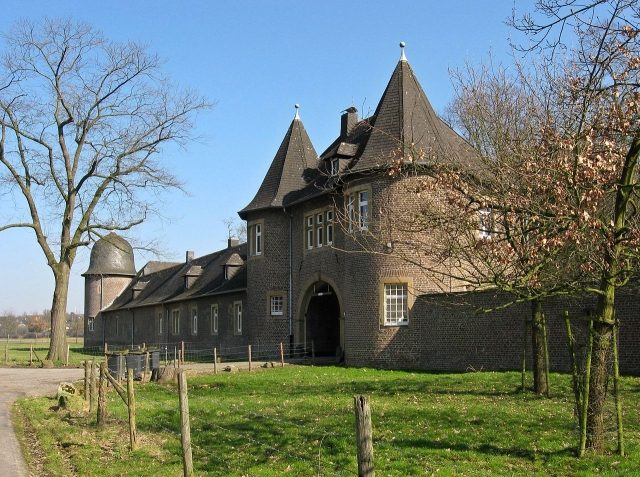
Rimburg Castle (Palenberg)

To be privately owned

Rimburg Castle is a moated castle located in the Wurm valley on the German-Dutch border near Übach-Palenberg. The village of Rimburg, a district of the municipality of Landgraaf, which is directly opposite the castle on the other side of the Wurm, belongs to the Netherlands, as the Wurm also forms the national border.

In Roman times, a military road, the Via Belgica, crossed the Wurm in the immediate vicinity of the castle complex. The crossing over the river was secured by a Roman outpost.

The first documented owner of Rimburg Castle for the year 1276 was a Lord of Mülrepas, Drost (Burgrave) of the Duke of Limburg. In the feud between the Duchies of Limburg and Brabant, the complex was partially destroyed by Duke John I of Brabant. The Lords of Mülrepas took the reconstruction of the castle, which probably took place around the turn of the 13th century, as an opportunity to further expand it to increase its defensive potential. The main castle was provided with four flanking towers and additionally received a strong outer ring of fortifications, which was manned with four towers. The towers were equipped with firing chambers and casemates, which were connected to the main castle by underground passages. The expansion measures resulted in an unusual defensive strength of the entire complex.

In 1323, the castle came into the possession of Gerard von Merode through marriage. The property remained in the possession of the Merode family until the 15th century. The next owner was the von Gronsfeld family. In 1498, Rimburg came into the possession of Johann I von Bronkhorst and was elevated to a free imperial lordship.

In 1543, Johann I von Bronckhorst sided with the German Emperor Charles V during the Jülich Feud against the Duke of Jülich. However, Johann I offered the castle to the Duke of Jülich as an open house. This resulted in the castle being occupied by soldiers of the Duke of Jülich, which it was. Rimburg was then besieged by imperial troops and partially destroyed.

In 1640, Jost Maximilian von Bronckhorst sold Rimburg to Baron Arnold von Boemer. During this time, Rimburg was frequently occupied by foreign troops, for example, it was conquered by French troops in 1673. The French intended to use the castle complex as a base after further expansion. Arnold von Boemer's widow, Catharina von Westerholt, asked the Governor of Maastricht to refrain from this plan and withdraw the troops. This request seems to have been successful, as Spanish troops followed the French soldiers as early as 1678. In 1726, Rimburg was in the possession of the Counts of Ligneville, the Count of Galen zu Ermelinghof, and the Baron von Westerholt. In 1782, Christoph von Ligneville was its owner, who passed it on to Count Josef Goncry in 1792. At the beginning of the 19th century, Eduard Joppen von Beegden first bought the castle, and in 1879, finally, a Mr. Weckbeker. Around 1900, it was owned by Johanna von Brauchitsch, née Weckbeker. Johann von Brauchitsch had the property provided with a baroque facade in 1899 according to designs by Professor Josef Kleesattel, had the outer bailey built, and carried out further alterations. In the Second World War, Rimburg Castle was integrated into the defensive positions on the western border and was therefore fiercely contested during the advance of the Allies into what is now German territory in 1944.

Buildings+

The moated castle is an extensive complex from the 12th to 14th and 19th centuries, consisting of the L-shaped outer bailey and the actual main castle. The outer and main castles are separated by a wide moat. The main castle was originally surrounded by a curtain wall. The first complex from the 12th to 13th centuries consisted of three wings grouped around an inner courtyard together with the keep. The medieval complex is largely still preserved, but has been altered, particularly by renovations in the 19th century and considerable war damage. The outer ring of fortifications was reinforced by casemates, which were located in front of the walls.

The castle, which is privately owned, is not accessible to the public.

Take Mobile History with you

You are reading this text for free. Premium adds what matters on the road: descriptions read aloud, sites found through your camera, whole regions taken offline.

  • Every description, including the ~17,700 Premium sites
  • Audio guide: have descriptions read to you on location
  • AR finder: see sites through your camera, with distance and bearing
  • Unlimited saved sites

14 days free, then from €2.99 a month. Cancel anytime.

Source: Wikipedia · Licence: CC BY-SA 4.0

This description draws on the facts documented in the linked Wikipedia article; Wikipedia content is licensed under CC BY-SA 4.0. Wording and editing: Mobile History.

Location: 50.9139, 6.0897