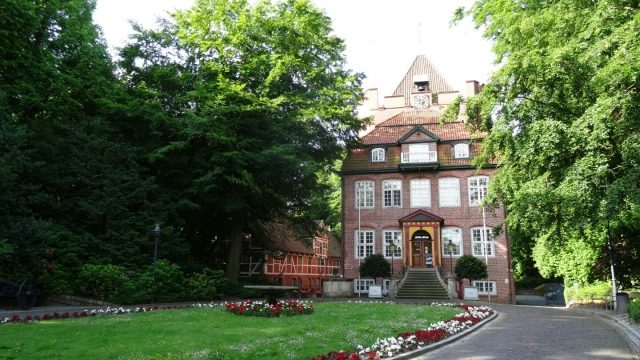
The Castle can be visited
Ritzebüttel Castle
Ritzebüttel Castle in Cuxhaven was the residence of the Hamburg bailiffs during the time Ritzebüttel belonged to Hamburg. The castle, parts of which date back to the 14th century, is one of the oldest preserved secular buildings of North German Brick Gothic in the region and is now open to visitors.
The castle is based on a fortress built around 1340 for the feudal lords of Saxe-Lauenburg. Its construction followed only 30 years after the erection of the externally very similar tower on the Hamburg island of Neuwerk. After disputes with the city of Hamburg and a subsequent siege by the Hanseatic city in 1393, the castle passed from the Lappes into Hamburg's possession on July 31, 1394. Since control of the Lower Elbe was easily possible from Ritzebüttel and the defensive complex also included larger estates, the location was a valuable asset for Hamburg. The city also gained access to a winter emergency port and could act more quickly against the North Sea pirates from here.
The bailiffs were mostly Hamburg senators, and included the writer and poet Barthold Heinrich Brockes as well as the advocate Amandus Augustus Abendroth. The bailiffs resided for over 500 years in the complex, which was transformed from a fortress into a castle. They were endowed with extensive powers, which were also reflected in the castle's impressive furnishings. Nevertheless, the office in Ritzebüttel was not particularly popular among the Hamburg bailiffs, as it meant fulfilling their duties deep in the province and almost three days' journey from the amenities of Hamburg. In 1864, justice and administration of the office were separated, and the Hamburg bailiffs lost much of their influence. Finally, in 1937, Cuxhaven was exchanged for Altona, Harburg-Wilhelmsburg, and Wandsbek with Prussia as part of the Greater Hamburg Act, and the castle definitively lost its political significance.
Until 1981, the building was used for various purposes. At that time, the castle was in poor condition and in urgent need of renovation. The renovation work, which was repeatedly delayed due to lack of funds, lasted until 1996. The castle was handed over to the public with a new usage concept and now houses, among other things, a restaurant, exhibition rooms, and a wedding room. All rooms can be visited. Various markets are also held on the castle grounds.
Buildings+
The Castle
The late medieval castle originally consisted of a mighty defensive and residential tower with a rectangular floor plan, surrounded by ramparts and moats, thus corresponding to the type of a tower castle. This tower still forms the core of the complex, built entirely of brick. During Hamburg's takeover, the defensive structures were reinforced, so that the walls were then extended to a thickness of three meters and the tower was raised to 21 meters, with the roof truss adding another nine meters. The tower, crowned by large battlements, has remained largely unchanged externally since its construction.
In the 17th century, a half-timbered extension was added to the front of the tower, which, with its three turrets and a large entrance gate, referenced the Hamburg city coat of arms. This portal building was removed again in the 18th century and replaced by the five-axis baroque extension that still exists today. The castle's defensive structures were largely demolished over the centuries and are now only visible as fragments in the castle garden.
The castle contains furnishings and architectural details from almost 600 years of art history. Inside the defensive tower, the original Gothic brick vault from the first construction phase can still be found. Also preserved, in addition to the ballrooms on the second and third floors, are the bailiffs' living quarters with furnishings from around 1900.
The Swiss House in the Castle Park
In 1847, the Swiss House was built as a tea house in the garden of Ritzebüttel Castle, commissioned by the then bailiff Sthamer. The style of this Swiss House can also be found in some tea and garden houses of other complexes of that time. The house is located in the middle of the park path that leads around the castle and the moat system. The later construction of an open-air stage directly next to the house further emphasized its importance, as both facilities were used together for a time.
The War Memorial
On February 21, 1932, former mayor Dr. Grube inaugurated a war memorial in the castle park of Ritzebüttel Castle. It was designed by the then city architect Carl Jung and serves to commemorate those who fell in the First World War. The monument is located on the grounds of the Krähenhof, which burned down in 1909 and was added to the castle garden area in 1913. Architecturally, it resembles the Kugelbake. The last structural changes were undertaken in 1980, when the sandstone honor plaques inside were replaced by metal plaques and an iron grate was installed.
Take Mobile History with you
You are reading this text for free. Premium adds what matters on the road: descriptions read aloud, sites found through your camera, whole regions taken offline.
- Every description, including the ~17,700 Premium sites
- Audio guide: have descriptions read to you on location
- AR finder: see sites through your camera, with distance and bearing
- Unlimited saved sites
14 days free, then from €2.99 a month. Cancel anytime.
Source: Wikipedia · Licence: CC BY-SA 4.0 · Image: Jörg Heldt
This description draws on the facts documented in the linked Wikipedia article; Wikipedia content is licensed under CC BY-SA 4.0. Wording and editing: Mobile History.
Location: 53.8571, 8.6984