Museum
Rodewisch Castle

The town of Rodewisch entered history with its first mention in 1411. The origin of the name is not yet fully clarified. However, a connection to "roden" (to clear) and "wisch" (meadow) (cleared meadow) is plausible.
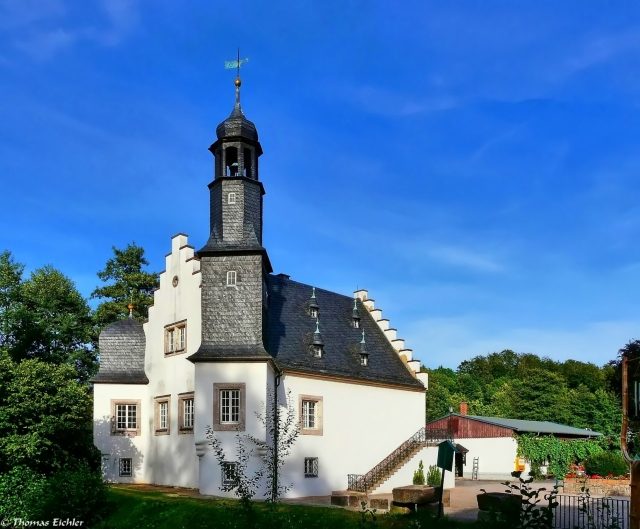
The historical and cultural center of the town has always been the so-called "Schlossinsel" (Castle Island). On it are three sights that have gained recognition beyond the town's borders: the archaeological reserve, the castle, and the museum housed in the manor house of the knight's estate.
The starting point of settlement around Rodewisch was the ancient castle, which originated around the turn of the 12th to the 13th century. From 1937 to 1939, employees of the Institute for Monument Preservation Dresden, under the direction of the later Saxon State Conservator and Professor Hans Nadler, uncovered and archaeologically investigated the remains of Burg Göltzsch, a medieval ring wall complex with the foundations of a so-called "fortified house" surrounded by a moat.
The excavations yielded a wealth of everyday objects from the 13th to 15th centuries. In addition to ceramics, glasses, weapon parts, jewelry, and toys were recovered. Bones and other waste thrown into the moat led to conclusions about the diet of the inhabitants. The finds are exhibited in the adjacent museum in the former manor house.
The complex originally consisted of a square residential tower, which already used water as an obstacle to approach. In the 14th century, space constraints forced the knights to abandon the residential tower and build a larger moated castle over it. The core consisted of a small castle courtyard with the "fortified house" and some residential buildings. A two-meter-high earthen wall enclosed the approximately 21 x 21 m complex, which could be reached via a drawbridge over the seven-meter-wide moat.
There is no reliable information about the original builders of the complex. Literary sources assume the Lords of Reuss, bailiffs of Plauen, as owners. At the beginning of the 16th century, the Lords von der Planitz, who were granted the noble predicate "Edler" in 1522, were named as owners. Through an inheritance division in 1602 by the brothers Günther, Georg Dietrich, and Christoph Friedrich Edle von der Planitz, the knight's estates Obergöltzsch and Untergöltzsch were created. The Niederauerbach outpost had already been split off earlier. Obergöltzsch was sold several times from the 17th century onwards: in 1661 to Joachim Friedrich von Beust, 100 years later to Friedrich August von Brandenstein, who in turn sold it in 1780 to the cloth merchant Johann Adam Frank, and shortly thereafter Obergöltzsch went to the bourgeois estate-owning family Adler, who managed the estate until the middle of the 19th century. Finally, it was a fortunate circumstance that the city of Rodewisch, which had already acquired part of the knight's estate in 1911, wanted to annex the estate's area to the city park and therefore initiated the archaeological excavations already described. The then young architect Hans Nadler found during his investigations that the oldest preserved building structure, the so-called "Schlösschen" (small castle), was a Renaissance building from the 16th century. This was all the more surprising as the first mention of a castle dated back to the 15th century. Hans Nadler suspected older building remains still underground and began a systematic search in an orchard in the north-west corner of the complex. In doing so, he came across the foundation wall of the former main castle, during the further excavation of which the sensational results came to light.
In addition to the quadrangle of the former moated castle, the Renaissance "Schlösschen" of the Edle von der Planitz, built at the beginning of the 16th century, also attracts attention. The "Schlösschen" was built as a residence, as the gentry no longer wanted to live in the old moated castle. It consists of a barrel-vaulted ground floor and two corner towers, which are round in the lower part and widen upwards into rectangular projecting bay windows. The courtyard-side turret is provided with an elaborate slate-clad spire. Since the "Schlösschen" was integrated into a barn at the beginning of the structural redesign of the Schlossinsel, the upper floor was missing. According to plans by Hans Nadler, an upper floor and a gable roof, framed by stepped gables, were added. The interior work was only carried out in the 1950s due to the outbreak of the war. A coffered ceiling, which formerly adorned the Niederrödern Castle, which had been approved for demolition, was also installed. The ceiling features so-called "Flasern", multi-colored printed wallpaper parts glued to the cassette fields. Star and sun motifs alternate within it. The green-tinted intermediate spaces are decorated with gilded cones. The banqueting hall of the Rodewisch "Schlösschen" is reached via an exposed staircase, whose wrought-iron railing comes from the blown-up Tiefenau Castle. The hall is used for concerts, weddings, festive events, and other purposes.
However, the "Schlösschen" was not used as a stately residence for long. The von Beust family, who had acquired the knight's estate in the mid-17th century, moved into the manor house in the southwest of the island, a simple two-story building with a gable roof. The museum established there houses valuable excavation finds and local history collections, offering visitors insights into the history of the town and the surrounding area. Access to the Schlossinsel is through a gatehouse with a half-timbered upper floor, which adjoins the manor house at a right angle.
The entire courtyard area is surrounded by an almost rectangular moat, fed by the Göltzsch. Originally, the knight's courtyard was built with barns and stables. However, these were demolished in 1938/39. The plans for new construction developed by Hans Nadler could no longer be carried out. However, they formed the basis for the establishment of today's municipal cultural center on the Schlossinsel. In addition to the museum, the "Schlösschen", and the foundations of the old moated castle Göltzsch, an island snack bar and an open-air stage were added.
Take Mobile History with you
You are reading this text for free. Premium adds what matters on the road: descriptions read aloud, sites found through your camera, whole regions taken offline.
- Every description, including the ~17,700 Premium sites
- Audio guide: have descriptions read to you on location
- AR finder: see sites through your camera, with distance and bearing
- Unlimited saved sites
14 days free, then from €2.99 a month. Cancel anytime.
Location: 50.5249, 12.4020