Apartments
Rösberg Castle

Old Castle and New Palace
Rösberg Castle was the seat of the oldest dynasts on the slopes of the foothills. In the history of the castle, destruction and reconstruction had followed one another. Thus, the old castle of the Neuenahr family, standing next to the church in the village center, was also in a devastated, ruinous state by the mid-17th century. Ferdinand von Weichs initially built a new manor house near the church, and Baron Ferdinand Joseph von Weichs decided to build a magnificent palace outside the village. The new building, constructed using materials from the old castle, was erected north of Rösberg and completed in 1731.
Description
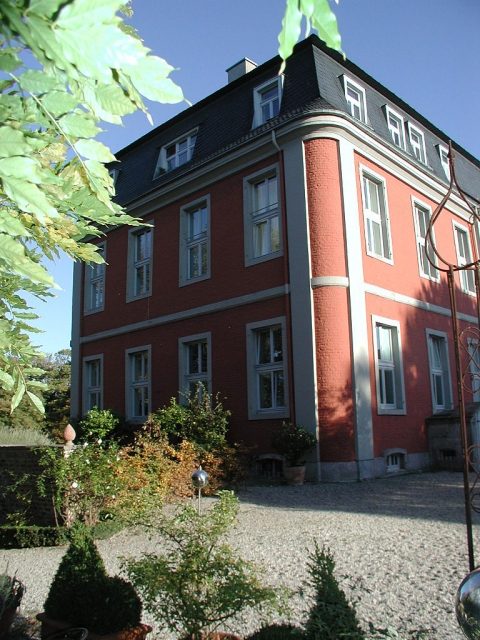
Rösberg Palace was now a complex with an exposed manor house, fronted by a wide terrace. It was flanked by symmetrically arranged outbuildings, which, like the manor house initially, had been built with two stories. They were structured by simple pilaster strips and, like the manor house, were adorned with broken roofs.
All buildings were constructed of brick masonry, with the manor house receiving its articulation from ashlar. Its corners were rounded, and simple pilaster strips as well as horizontally running bands structured the wall surfaces. The manor house received a loosening risalit on the courtyard side and a three-sided extension towards the terrace. The interior of the house had a large hall in the central axis, to the left of which an ascending grand staircase connected. It opened on the upper floor into a large hexagonal hall, which was repeated on the further floors. On the top floor was a library hall furnished with Louis-seize cabinets.
On the western front, crowned ashlar pillars had been erected, between which a mighty wrought-iron gate formed the main entrance to the complex. The wrought ironwork adorned the gate with the alliance coat of arms of the von Weichs and that of the von Velbrück zu Garath.
End of the Rösberg Dominion
With the occupation and incorporation of the Rhineland during the French period, the legal conditions in Rösberg, which now belonged to the canton of Brühl, changed. Although the castle lords retained their property, the feudal lordship with its other privileges was definitively lost. After the French rule, the von Weichs could again dispose of their representative estate without restriction. The manor house, initially built with two stories overlooking the Rhine Valley, was raised by one floor after a fire in 1833.
End of the von Weichs zu Rösberg
The castle lords are buried in the chapel next to the old cemetery. The Barons von Weichs were also buried there until 1859. Since then, the burial site has been in the old cemetery around the church.
The last of the Weichs was Maximilian Maria Joseph Karl Gabriel Lamoral Imperial Baron von und zu Weichs an der Glon (* November 12, 1881, in Dessau; † September 27, 1954, at Rösberg Palace).
Rösberg after World War II+
In World War II, the palace was destroyed down to its outer walls by English phosphorus bombs on the night of February 27, 1941. The furniture and many art treasures were lost. However, the palace could be rebuilt.
As heir to Baron von und zu Weichs, Prince zu Sayn-Wittgenstein sold the building complex in the 1990s, and after extensive restoration and conversion of the outbuildings, private condominiums were created.
Take Mobile History with you
You are reading this text for free. Premium adds what matters on the road: descriptions read aloud, sites found through your camera, whole regions taken offline.
- Every description, including the ~17,700 Premium sites
- Audio guide: have descriptions read to you on location
- AR finder: see sites through your camera, with distance and bearing
- Unlimited saved sites
14 days free, then from €2.99 a month. Cancel anytime.
Source: Wikipedia · Licence: CC BY-SA 4.0
This description draws on the facts documented in the linked Wikipedia article; Wikipedia content is licensed under CC BY-SA 4.0. Wording and editing: Mobile History.
Location: 50.7691, 6.9151