CastleRomrod

Romrod Castle

Romrod Castle

Hotel
Conference center


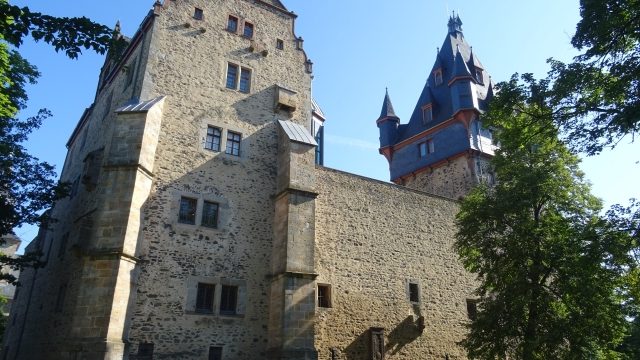
Romrod Castle is a castle complex in Romrod near Alsfeld in the Vogelsberg district in Hesse. The complex dates back to an older moated castle of the Lords of Romrod, which probably originated in the 12th century. Later, it fell to the Landgraves of Hesse-Darmstadt, who had the castle converted into a hunting lodge.

The original lowland castle was built in the valley between Antrift and Ocherbach. Not far away ran an old road, which was later called the Kurze Hessen. The moat surrounding the castle was filled in around 1830 and converted into a park.

The first documented mention of Romrod dates back to 1197, when a Ludwig von Rumerot appears as a witness to a transfer of property in a document of Fulda Monastery under Abbot Heinrich III von Kronberg. The ministerial family probably belonged to the followers of the Landgraves of Thuringia, but is also attested in the Fulda area.

Heinrich von Romrod built Herzberg Castle towards the end of the 13th century and pledged it as a fief to the Landgrave of Hesse. The family subsequently split into two lines, one of which named itself after the new castle of Herzfeld. The Romrod line died out in the male line around the middle of the 14th century, whereupon the heiress sold the castle to Landgraves Heinrich II and Otto. The castle was occupied by burgmannen and finally came into direct Hessian possession around 1400.

In the course of the Hessian partition of inheritance after the death of Philip the Magnanimous, Romrod Castle initially passed to Landgrave Ludwig IV of Hesse-Marburg. He had most of the castle buildings demolished between 1578 and 1587 due to dilapidation. The new buildings of this period essentially gave the castle its present appearance. After Ludwig's death in 1604, the castle fell to the Landgraviate of Hesse-Darmstadt. Until 1829, it served as an official residence. Subsequently, the castle was rebuilt again, mainly between 1878-85, and served the grand ducal family as a summer residence. For this purpose, the nearest train station, Zell-Romrod, received its own princely room for the reception of the "highest majesties".

In the property dispute between the People's State of Hesse and the last Grand Duke of Hesse and by Rhine, Ernst Ludwig, the castle was awarded to the former Grand Duke in the first agreement of 1919. In the second treaty of 1930, concluded due to the inflation of 1923, the castle fell to the former Grand Duke only for life and thus, one year after his death in 1938, to the People's State of Hesse. After the Second World War, it was used as accommodation for refugees until the 1970s. Subsequently, it stood empty for years and threatened to fall into disrepair until the German Foundation for Monument Protection acquired it in 1997. Today, the castle houses the Monument Academy and a hotel. Between 1996 and 2002, extensive archaeological excavations took place in the castle area.

Since early 2006, the castle has been home to the Forum Network Rural Area, offering an extensive program of events (including training and further education).

Complex+

Recent excavations have provided evidence of two castle complexes preceding the current castle complex. Since construction on the castle took place repeatedly over 800 years, only a few undisturbed layers were encountered. Previous statements on the building history were limited to observations of the existing building fabric, which is why the excavation revealed previously largely unknown aspects of the castle's history. For example, a wooden castle from the late 12th century, which was previously completely unknown, could be proven. Dendrochronological examinations of the wood found dated this construction phase to the period between 1170 and 1192. Several wooden buildings and sections of the courtyard area were identified. These may have been grouped in a ring around a no longer traceable wooden tower in place of the later keep. The largest proven building was located in the south of the castle courtyard west of the present Chancellery Tower. The walking level of the first castle complex was about 1.70 m lower than the current courtyard. The resulting moisture was combated with layers of wooden clubs, wickerwork, and birch twigs.

The Romanesque castle construction, which chronologically follows this wooden castle, was also little known. It was built in the 12th or 13th century. Presumably, the buildings of the castle were initially enclosed by a ring wall and successively replaced. A part of this wall was uncovered in the cellar of the main building. Large parts of the ring wall were only demolished with the attached outbuildings during the 19th-century renovations. The stone castle buildings also formed a perimeter development along the ring wall, which was grouped around the central keep. This could be proven centrally in the castle courtyard. It had a diameter of about 8 m with a wall thickness of 2.70 m. Inside there was a well or a cistern.

In this construction phase, the core castle occupied an almost circular area of about 1,500 m². To the north of the castle was the outer bailey, which is probably to be regarded as the nucleus of the town of Romrod. Today, a part of the outer wall of a Staufer residential tower on the northeast side is still preserved from this construction phase. It has corner quoins made of bossed ashlar, typical for this period, and two bifora windows.

Among the older buildings of the core castle is the so-called Chancellery Building with its striking high tower spire, a late Gothic residential tower, the upper floor of which consists of half-timbering. The four-story main building on the west side with a stair tower and the kitchen building in the north were built or significantly rebuilt by Eberhardt Baldewein during the renovation phase of 1586-88. In the immediate vicinity of the castle, several outbuildings of more recent origin are still preserved, such as the stable, gatehouse, hunter's house, bakehouse, brewery, and a slaughterhouse.

Take Mobile History with you

You are reading this text for free. Premium adds what matters on the road: descriptions read aloud, sites found through your camera, whole regions taken offline.

  • Every description, including the ~17,700 Premium sites
  • Audio guide: have descriptions read to you on location
  • AR finder: see sites through your camera, with distance and bearing
  • Unlimited saved sites

14 days free, then from €2.99 a month. Cancel anytime.

Source: Wikipedia · Licence: CC BY-SA 4.0 · Image: Jörg Heldt

This description draws on the facts documented in the linked Wikipedia article; Wikipedia content is licensed under CC BY-SA 4.0. Wording and editing: Mobile History.

Location: 50.7133, 9.2194