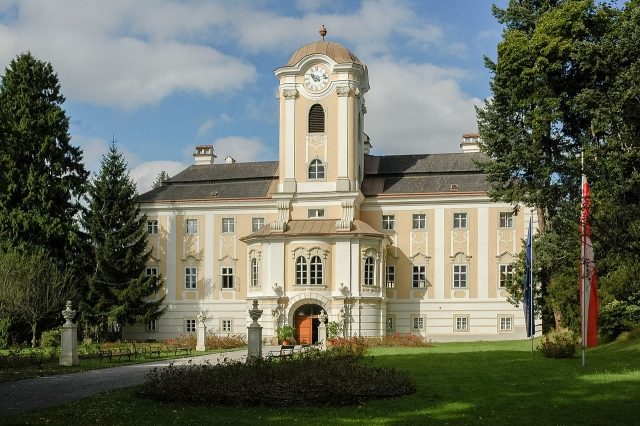
CastleZwettl-Rosenau

Rosenau Castle

Rosenau Castle

To be privately owned

Rosenau Castle is a castle in the village of Rosenau Castle, west of Zwettl in the Waldviertel (Lower Austria). It has been rebuilt and renovated several times over the years and has changed hands several times.

In 1593, the Lords of Greiß expanded an existing four-sided courtyard into a Renaissance castle.

From 1720 to 1803, Rosenau was owned by the Counts of Schallenberg. The first owner was Leopold Christoph Graf von Schallenberg, who bought the estate in 1720. He had the castle rebuilt according to the plans of Baroque master builder Joseph Munggenast and set up rooms there for a Masonic lodge. In addition, the almost completely preserved estate settlement was built during this period. The old people's home (hospital), the forester's house, the former farmstead, the ribbon weaving mill, the carriage house of the rectory, the elementary school and the parish church of the Holy Trinity bear witness to this manor. Josef Graf Schallenberg sold the castle in 1803.

It was acquired by Ernst Christoph Georg August Graf Hardenberg, Royal Hanoverian envoy in Vienna, whose nephew sold it in 1832 to the economist Baron Andreas von Stift.

In 1863, Creszentia Stummer, widow of the merchant Carl Stummer from Brno, became mistress of the castle, after the Stift heirs had sold the estate. Just five years later, the railway engineer Mathias von Schönerer acquired the castle and estate.

Georg Heinrich Ritter von Schönerer inherited the property in 1883 and managed the estate until his death in 1921. In 1907, he had Austria's only Bismarck Tower built north of the castle. For the well-being of the local population, he created numerous social and economic facilities on the estate and in the surrounding area. His daughters managed the inheritance until 1928.

In 1943, the Deutsche Ansiedlungsgesellschaft took over the castle. From 1943 to 1945, Baron Lazarini-Zobelsperg was lord of the castle.

After the end of the war, Soviet troops devastated the castle, followed by confiscation by the occupying power and USIA, and after the end of the occupation in 1955, its return to Baron Lazarini-Zobelsperg.

He sold the castle, which had become uneconomical due to the destruction, in 1964 to the Siedlungsgesellschaft des Landes Niederösterreich.

After considerable investments by the state, the castle hotel and restaurant were opened on September 26, 1974.

A year later, the Austrian Masonic Museum was opened in the castle. In the parish church, a ceiling fresco, said to have been designed by the painter Paul Troger, depicts the Adoration of the Holy Trinity.

Significance and Use of the Castle as a Masonic Museum+

Count Schallenberg was a high-ranking official at the court of Maria Theresia and came into close contact there with the Enlightenment and its intellectual child, Freemasonry. It was the social component of the Enlightenment movement that prompted him to develop his estate in Rosenau into an institution for the benefit of the simple people living and working as farmers in the manorial surroundings of the castle. He himself was a Freemason – as was Maria Theresia's husband, Francis Stephen of Lorraine – and set up a lodge in the castle, which served as a meeting place for brothers living in the neighborhood and passing through. It is very likely, though not fully provable, that the famous Freemason Wolfgang Amadeus Mozart stopped in Rosenau on his way from Vienna to Prague.

The castle, rebuilt in the 18th century, still stands out today for the works of the master builder Joseph Munggenast, the painters Paul Troger, Daniel Gran, and the "Welsch perspective painter" Rincolin, who is buried in Rosenau. The owners who followed Schallenberg's death in 1800 – including Georg Ritter von Schönerer, notorious for his anti-Semitic activities – no longer knew of the special significance of the castle as a Masonic place of activity. The symbolic paintings were covered and painted over.

It was not until 1972, when the castle and the estate settlement were to be saved from decay in a joint action by the surrounding communities and the Lower Austrian provincial government and renovated with public funds, that the Masonic symbols were discovered during the renovation work. On April 23, 1975, the Masonic Museum began its operations. Officials of the Lower Austrian provincial government had succeeded in persuading Austrian Freemasons to establish a museum. In its first year, more than 35,000 visitors were counted, a remarkable result for a museum far from the tourist beaten paths.

In addition to numerous loans from the Grand Lodge of Austria, exhibits from the German Masonic Museum in Bayreuth, from the Vienna Cathedral Workshop, and from the Lower Austrian State Museum are also shown. Most of the exhibitions were supervised by members of the Quatuor Coronati research lodge. They also succeeded in bringing objects from private collections and from the holdings of the English Grand Lodge into the museum.

Take Mobile History with you

You are reading this text for free. Premium adds what matters on the road: descriptions read aloud, sites found through your camera, whole regions taken offline.

  • Every description, including the ~17,700 Premium sites
  • Audio guide: have descriptions read to you on location
  • AR finder: see sites through your camera, with distance and bearing
  • Unlimited saved sites

14 days free, then from €2.99 a month. Cancel anytime.

Source: Wikipedia · Licence: CC BY-SA 4.0 · Image: http://commons.wikimedia.org/wiki/File:2005-09-19_Schloss_Rosenau.JPG

This description draws on the facts documented in the linked Wikipedia article; Wikipedia content is licensed under CC BY-SA 4.0. Wording and editing: Mobile History.

Location: 48.6011, 15.0636