Museum
Rothschönberg Castle

The activities of the Schönberg family in Saxony can be traced back over 700 years. During this time, the family developed into one of the most important and widespread noble families in the country, holding high offices in Saxon state service and administration. Caspar and Dietrich were Imperial Princes as Bishops of Meissen (1451-63, 1463-76). For almost two hundred years, starting in 1518, the Schönbergs provided the chief mining officials of the Ore Mountains in Freiberg.
The name "Sconenberg" first appeared in 1157 for free nobles and ministeriales in documents of the Bishops of Naumburg. The name "Sconenberg" can be traced back to a castle on the Saale northeast of Naumburg. A connection to the Schönbergs verifiable in the March of Meissen from 1254 onwards is presumed but not proven. The family's lineage is genealogically secured with Sifrid von Schönberg, who appears in documents of Altzella Monastery from 1282 to 1284.
The Meissen family of Schönberg can be traced back to ministeriales in the Thuringian Osterland. While they appeared only sporadically there in the 13th century, more and more bearers of this name were found in the March of Meissen. Over the centuries, the family acquired properties throughout Saxony. However, their main area of distribution was the Ore Mountains and the area around Meissen. The Schönbergs served the Wettin margraves and burgraves of Meissen and received estates as fiefs, some of which they owned until the land reform after 1945.
One of these possessions was the village of Schönberg - the official designation Rothschönberg was only introduced in 1838 - which was first mentioned in 1254 with Dietrich (or Tuto) von Schönberg. Rothschönberg is thus considered the ancestral seat of the Schönbergs in the Saxon region.
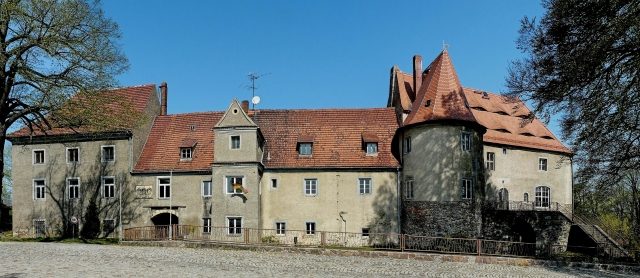
Of the former castle on a hill above the Triebisch valley, the angled southeast wing with the round bastion has been preserved. The oldest parts date from the 15th century. Also during this period (around 1500), the castle chapel, formerly freestanding in the northwestern part, was built. The late Gothic cross-rib vaults indicate this construction period. The chapel was used as a utility room between 1830 and 1870. After the conversion of the castle lords to the Catholic faith around 1870, the chapel had to be re-consecrated. Since then, it has been available for Catholic services.
The other parts of the building surrounding the courtyard were added to the oldest core in the 17th and 18th centuries. The south wing with the gate passage was built by Caspar Dietrich von Schönberg between 1651 and 1659. A beautiful sandstone relief with a coat of arms and the year 1659 marked the completion of the construction work. In 1738, Hans Dietrich von Schönberg supplemented the castle with the west wing. With the construction of the north wing in 1744, the Schönbergs finally completed the enclosed courtyard.
Below the castle complex, a spacious castle park with old trees spreads out. The complex, later transformed into a landscape park, was laid out by Burkhard von Schönberg in 1631. A linden avenue leads to the pavilion built in 1789. From the garden pavilion, there is an impressive view of the Triebisch valley.
Rothschönberg Castle was owned by the Schönberg family for almost 700 years. In 1945, the owners were dispossessed and expelled by the communists. The building parts were prepared for apartments and the municipal administration. The ancestral gallery and the library were destroyed or lost; ceiling and wall paintings were painted over; in the gentlemen's room and the dining room on the upper floor, the municipality set up a village shop. Until 1990, several apartments were still located in the buildings. Since then, the castle has been largely empty, although some rooms in the south wing are used for a local history exhibition.
Take Mobile History with you
You are reading this text for free. Premium adds what matters on the road: descriptions read aloud, sites found through your camera, whole regions taken offline.
- Every description, including the ~17,700 Premium sites
- Audio guide: have descriptions read to you on location
- AR finder: see sites through your camera, with distance and bearing
- Unlimited saved sites
14 days free, then from €2.99 a month. Cancel anytime.
Source: Wikipedia · Licence: CC BY-SA 4.0 · Image: Thomas Eichler
This description draws on the facts documented in the linked Wikipedia article; Wikipedia content is licensed under CC BY-SA 4.0. Wording and editing: Mobile History.
Location: 51.0660, 13.3918