To be privately owned
CastleSankt Georgen am Längsee-Rottenstein
Rottenstein Castle
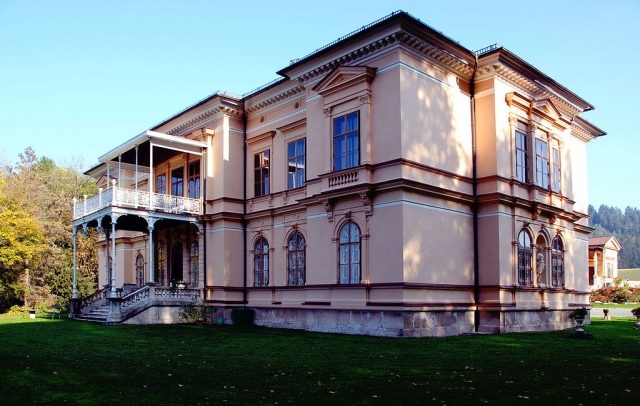
Rottenstein Castle is a castle complex built in the Historicist style, located about one kilometer on a hill east of St. Georgen am Längsee.
The original history of the estate is largely unknown, partly due to the many places named Rottenstein and partly due to the poor geographical attribution of old documents. The property was first mentioned without doubt in 1373, referring to an inherited farm of the Wucherer family at "Rotenstain pey sand Görgen". It is assumed that this later fell into disrepair. Only in 1580 is the property mentioned again without doubt in a document by Abbess Afra von Staudach of the convent of St. Georgen am Längsee.
The current Rottenstein Castle originates from a building that the well-known Carinthian iron industrialist and merchant Maximilian Thaddäus Graf von Egger had built towards the end of the 18th century as a widow's residence for his wife Gabriele Oktavia Maria Josepha, née Freiin von Pinelli. The Counts of Egger were probably the most famous merchant family in Carinthia and owned extensive properties throughout southeastern Austria, including several castles and estates, as well as hammer mills in Lippitzbach, Treibach, and Vordernberg in Styria, among others.
The castle remained in family ownership and passed by inheritance to Gustav Graf von Egger, the grandson of Maximilian Thaddäus. In 1868, Gustav Graf von Egger had an extensive English-style natural park built around the castle and its outbuildings, surrounded by a remarkable 1100-meter-long wall. On the stone pillars of the gate in the garden wall, the entrance to the castle park, stand cast-iron lions bearing coats of arms.
In 1870, Gustav Graf von Egger commissioned the Viennese architect Rudolf Bayer to build a country noble residence in the style of the time. The extensive alterations, an extremely solid interior design, and the construction of further outbuildings, including a private bathhouse, resulted in a unique, comprehensively composed work of art of Historicism in Carinthia.
In 1871, a private castle chapel was built in the middle of the extensive park and consecrated to St. Charles Borromeo. It contains a square central room structured with Ionic pilasters. Northwest of it in the castle park lies the specially built crypt chapel of the Egger and Gorton families, adorned with an imposing marble relief.
After the death of Count Gustav von Egger on June 11, 1884, his daughter Gustava Aloisia Gorton, née Countess von Egger, inherited the entire property. After her death on June 17, 1920, the castle passed by inheritance to her son Karl Gorton. He married the daughter of the well-known Field Marshal Lieutenant Ludwig Hülgerth there. Hülgerth died on August 13, 1934, on his son-in-law's estate and was also buried in the crypt chapel there. The castle remains to this day in the possession of the Gorton family, who still inhabit it.
Source: Wikipedia · Licence: CC BY-SA 4.0 · Image: http://commons.wikimedia.org/wiki/File:Sankt_Georgen_Laengsee_Rottenstein_Schloss_15102006_02.jpg
This description draws on the facts documented in the linked Wikipedia article; Wikipedia content is licensed under CC BY-SA 4.0. Wording and editing: Mobile History.
Location: 46.7843, 14.4437