The Castle can be visited
CastleRoudnice nad Labem (Raudnitz)
Roudnice Castle
More pictures
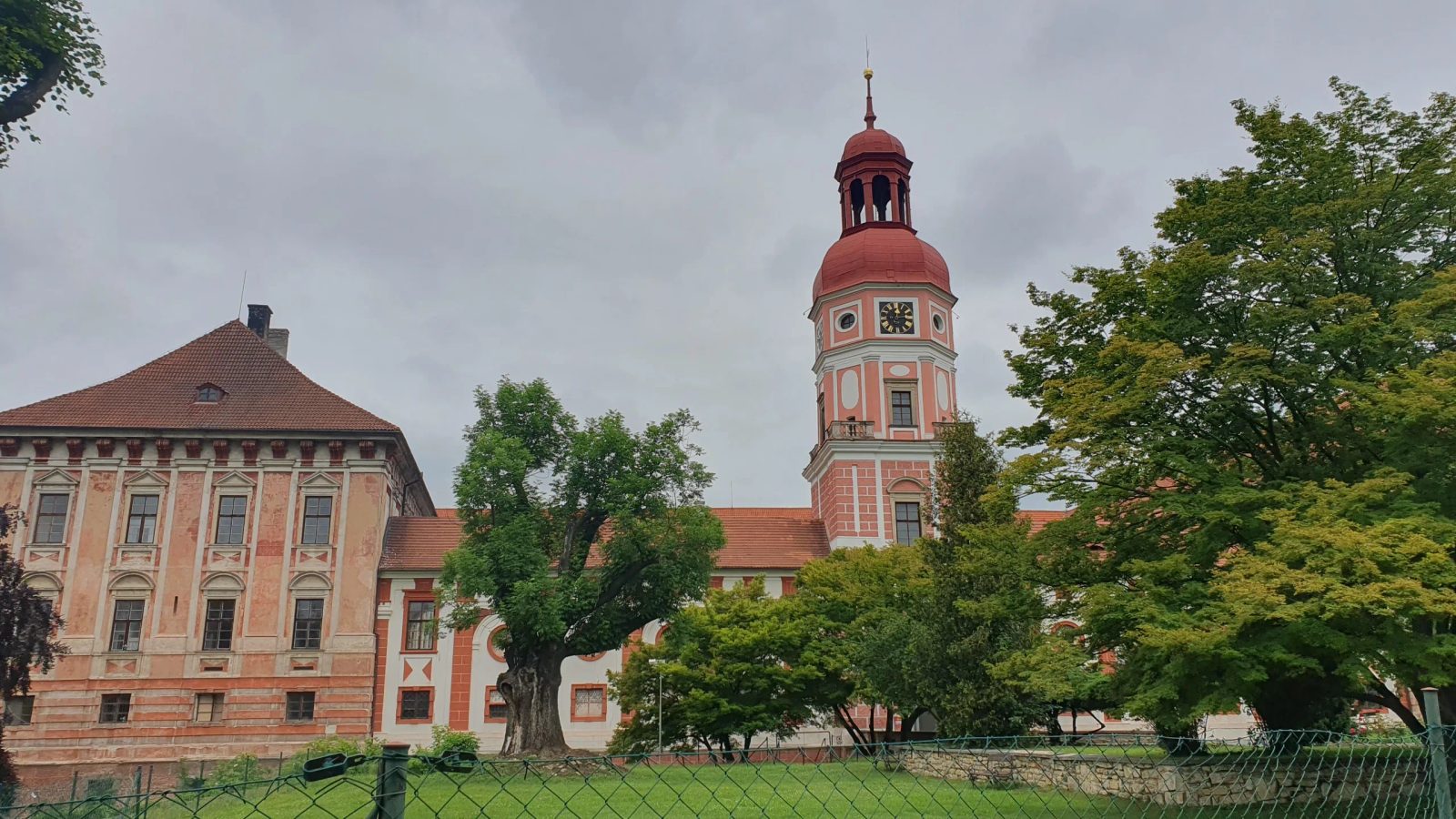
Roudnice Castle (German: Schloss Raudnitz) is located in the center of Roudnice nad Labem (Raudnitz an der Elbe) on a rocky outcrop above the Elbe River. It is owned by the Czech Lobkowicz family.
Location+
The castle is located in the center of the town and dominates the historic town center. The building is a three-winged structure in the shape of a horseshoe, whose open side is closed by a connecting wing to form a quadrangle. In the middle of this connecting building is the main entrance to the castle and a bell tower, which is topped with a lantern. It is one of the largest castles in the Czech Republic with a castle courtyard measuring 58 m × 54 m.
Episcopal Castle+
On the site of the later castle, a Romanesque castle had stood since the end of the 11th century, built by Prague Bishop Henry Bretislav III, who came from the Přemyslid ruling dynasty. It served as a summer residence for the Prague bishops and at the same time secured Elbe shipping and the trade route from Prague to Upper Lusatia. The castle had a rectangular shape of 39 m × 15 m and had seven bastions and defensive towers. The wall thickness at the base was about 1.9 m. Above a hall on the ground floor was the ballroom and in the southern area a building with a fortified gate. In 1333, Bishop John IV of Dražice founded an Augustinian canons' monastery below the castle, which was completed in 1360 by his successor, the first Archbishop of Prague, Arnošt of Pardubice, who often stayed at the castle. Bishop Tobias of Bechin fortified the castle. A castle chapel is documented for the year 1371. The reconstruction of the castle was completed in 1380. Its remains have been preserved in the foundations and cellars of the later built castle. During the Hussite Wars, the castle was spared from destruction in 1421 and 1425 because Bishop Konrad of Vechta had already turned to the Utraquists in 1421, accepted the Four Articles of Prague, and participated in the first Čáslav Diet. He hosted two Utraquist synods at Raudnitz Castle. In 1425, he retired to the episcopal castle in Raudnitz, where he died in 1431. In the same year, the Hussite captain Jan Smiřický of Smiřice acquired the castle, town, and lordship of Raudnitz as a fief and had further alterations made. Later it was owned by Zdenko of Sternberg. In 1467, the troops of King George of Poděbrady conquered the castle. In 1575, Raudnitz came to Wilhelm of Rosenberg, whose widow Polyxena of Pernstein married Count Adalbert Popel of Lobkowicz. Thus, in 1603, the castle came into the possession of the Lobkowicz family.
Baroque Raudnitz Castle+
The conversion to a Baroque castle took place under Wenzel Eusebius von Lobkowicz between 1652 and 1684 by the Italian architects Pietro Colombo, Francesco Caratti, Carl Orsolini, and Antonio della Porta. The completion in 1684 was under Ferdinand August von Lobkowitz (1655–1715). Access to the castle is via a double-flight staircase. The castle has more than 200 rooms, some with tiled stoves from the 18th and 19th centuries, a chapel, and a theater. The stucco work and frescoes were created by Francesco Marchetti, the frescoes in the castle chapel by Giacomo Tencalla (1644–1689/1692). Next to the castle are utility and administrative buildings, the castle garden, and a riding hall. The Lobkowicz Castle was furnished with valuable furniture. The museum contained an excellent collection of weapons, Delft faience and Italian faience, porcelain, silver, glass, religious objects, miniatures, and furniture, as well as numerous objects of applied art from Europe and the Far East. Famous was the Raudnitz collection of paintings by the noble families of Rosenberg, Pernstein, and Lobkowicz, as well as the collection of portraits by Spanish, Dutch, and Central European painters. There was also the Lobkowicz Library (about 100,000 volumes) with precious books and numerous manuscripts, including those of the humanist Bohuslaus Lobkowicz of Hassenstein, as well as the Lobkowicz Archive. The collections also housed musical instruments and manuscripts of important composers of the 18th and 19th centuries, such as Gluck, Mozart, and Beethoven, including the original of the 3rd Symphony, which he dedicated to his patron Franz Joseph Maximilian von Lobkowitz. Many of these works were performed by the Lobkowicz Castle Theater Orchestra.
Raudnitz Castle in the 20th Century+
After the dismemberment of the remaining Czechoslovakia in 1939, the Lobkowicz family emigrated to England. Count Maximilian von Lobkowicz (1888–1967) lived with his wife Gillian Somerville in London, where he served as ambassador for the Czechoslovak government-in-exile. Initially, the castle was used as a Wehrmacht barracks. From 1940, the National Socialists began converting the castle into an SS youth education home, destroying some rooms and built-in furniture in the process. During an air raid in the last days of the war, the west wing with the castle theater was severely damaged. After the war in 1945, Maximilian Lobkowicz returned to Raudnitz. He began repairing the destroyed parts of the castle. After the February coup in 1948, the Lobkowicz family was dispossessed, and the castle was nationalized. The art collections were removed from the castle and distributed to various collections and locations throughout the country; the most valuable art objects and the library went to the Prague National Museum. For the next five decades, the castle housed the military administration and the "Vít Nejedlý" Military Music School of the Czechoslovak Army. In 1965, the "Gallery of Modern Art Roudnice" was established in the castle's riding school. After the Velvet Revolution in 1989, Raudnitz Castle was restituted to the Lobkowicz family in the 1990s, who leased it to the Military Music School until the end of 2008. The rental income was used for the renovation of the buildings, especially the roofs and the bell tower. Since 2009, the renovation has continued. Since 2012, the castle has been open to the public for guided tours.
Take Mobile History with you
You are reading this text for free. Premium adds what matters on the road: descriptions read aloud, sites found through your camera, whole regions taken offline.
- Every description, including the ~17,700 Premium sites
- Audio guide: have descriptions read to you on location
- AR finder: see sites through your camera, with distance and bearing
- Unlimited saved sites
14 days free, then from €2.99 a month. Cancel anytime.
Source: Wikipedia · Licence: CC BY-SA 4.0 · Image: Foto: Jörg Heldt (Community)
This description is a machine translation of an excerpt from the linked Wikipedia article. The source text was written by its authors, the translation is by Mobile History; like the original it is licensed under CC BY-SA 4.0.
Location: 50.4247, 14.2616