Apartments
Rumpenheim Castle (Offenbach)

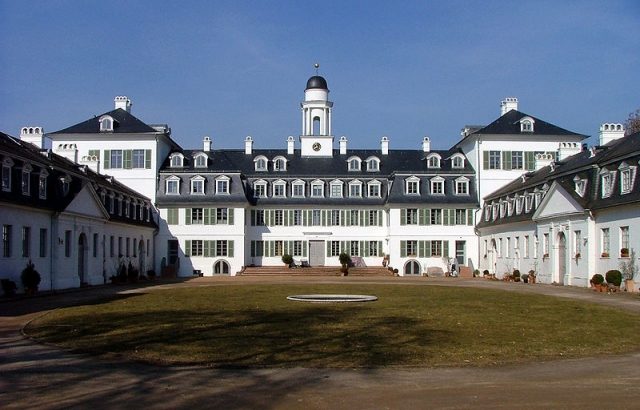
Rumpenheim Palace is a three-winged palace complex on the banks of the Main River in Offenbach. It is the landmark of the Offenbach district of Rumpenheim, which shares its name. The extensive Rumpenheim Palace Park adjoins the complex.
Origins+
The core of the present-day palace dates back to a manor house built by Johann Georg Seifert von Edelsheim, head of the government of the County of Hanau, starting in 1678. He had received the estate and village of Rumpenheim as a fief from Count Friedrich Casimir von Hanau in 1674, having earned great merit in the financial rehabilitation of the county. He purchased several plots of land on the Main River to add to what would become the palace grounds. The manor house later became the central building of the palace.
Hesse-Kassel Residence+
Ninety years later, in 1768 – the County of Hanau-Münzenberg, including Rumpenheim, had fallen to Hesse-Kassel after the death of the last Hanau Count Johann Reinhard III in 1736 – the von Edelsheim family sold their fief for 140,000 guilders to Prince Karl of Hesse-Kassel. He expanded the manor house into a princely country seat in 1771. His mother, Landgravine Maria, used the palace until her death in 1772 and furnished it accordingly. At the end of 1781, Karl sold the palace to his brother Friedrich. The latter expanded the palace into a three-winged complex between 1787 and 1788. In the early 19th century, the two corner pavilions on the Main side were added. Friedrich von Hesse-Kassel redesigned the park until 1839, a stable was added in 1840, and servants' quarters were built in the mid-19th century.
During the 19th century, personalities such as Austrian Emperor Franz Joseph, Russia's Tsar Alexander III, and Danish Kings Christian IX and Friedrich VII met at Rumpenheim Palace. In 1863, Prince Wilhelm of Schleswig-Holstein-Glücksburg was offered the Greek royal crown here, which he accepted.
Decline+
Some years after the Austro-Prussian War, which also led to the demise of the Electorate of Hesse, a settlement was reached between the formerly ruling house and Prussia, which awarded various castles from the former possessions to the private assets of the former Electorate, including Philippsruhe Palace near Hanau. The Rumpenheim line of the House of Hesse moved there, so Rumpenheim Palace stood empty for some time in the 1880s. After being used again for a period, it was finally abandoned as a residence in 1902 when Friedrichshof Palace in Kronberg came into the family from the inheritance of Empress Victoria, and the residence was moved there.
After the First World War, the palace became part of the assets of the Kurhessische Hausstiftung, predecessor of the Hessische Hausstiftung. During the Second World War, the central building of the palace was damaged by bombs in 1943, and the roof structure burned out. After the war, refugees were still housed there. However, subsequent lack of maintenance led to significant damage to the ruin from weather influences and arson. In 1965, the city of Offenbach acquired the palace and the palace park.
Revitalization+
In 1973, an architectural competition was held, the goal of which was the demolition of the ruin and a row of high-rise buildings at this location on the Main riverbank. This was prevented under pressure from a citizens' initiative. In the 1980s, initial safeguarding measures were taken, and the side wings of the palace were converted into apartments. The central building, by then heavily damaged, remained a ruin for a long time. Only since 2002 has the palace once again presented its historic exterior appearance. Inside, it now contains modern condominiums in the upscale price range. From 1999 to 2010, the palace and the palace park served as a backdrop for a medieval market in summer.
Palace Park+
The park maintenance plan, completed in 1995, aims to better develop the park, replace trees, and create new sightlines through suitable measures by 2022.
Take Mobile History with you
You are reading this text for free. Premium adds what matters on the road: descriptions read aloud, sites found through your camera, whole regions taken offline.
- Every description, including the ~17,700 Premium sites
- Audio guide: have descriptions read to you on location
- AR finder: see sites through your camera, with distance and bearing
- Unlimited saved sites
14 days free, then from €2.99 a month. Cancel anytime.
Source: Wikipedia · Licence: CC BY-SA 4.0
This description draws on the facts documented in the linked Wikipedia article; Wikipedia content is licensed under CC BY-SA 4.0. Wording and editing: Mobile History.
Location: 50.1331, 8.8016