CastleSachsenhagen

Sachsenhagen Castle

Sachsenhagen Castle

To be privately owned
Cultural Events


Sachsenhagen Water Castle is a former moated castle in Sachsenhagen, Lower Saxony. Duke Albrecht I of Saxony had it built around 1250 to secure his dominion and to colonize the Dülwald forest. Its current appearance results from the transformation of the water castle into a palace around 1600. When it came under the rule of the Landgraviate of Hesse-Kassel in 1665, the complex increasingly fell into disrepair. Today, the massive keep, an outbuilding, and the former official residence (Amtshaus) are still preserved.

The castle complex is located southeast of Sachsenhagen in the lowlands of the Sachsenhäger Aue, near its river. Here was an earlier river crossing of the Aue, on a north-south route connecting Hameln and Nienburg/Weser. The castle grounds, elevated by about 2.5 meters, consist of a plateau of about 100 x 100 meters. An elevated causeway leads to it from Sachsenhagen. Near the castle, there was a bailey of about 80x50 meters, whose buildings were dismantled over the centuries.

Architectural Description+

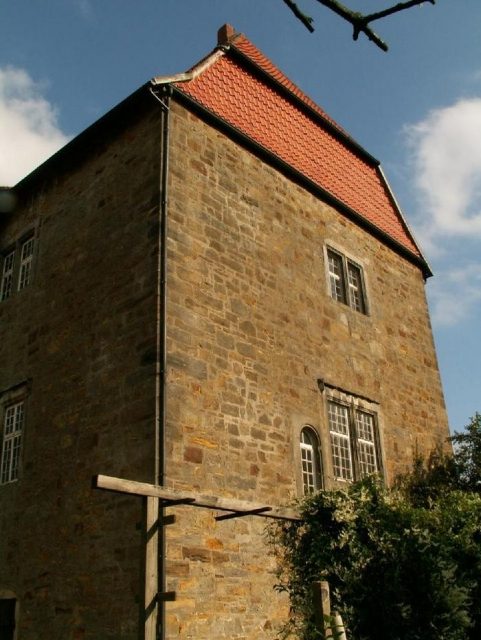
The current appearance results from the transformation of the water castle into a palace around 1600 by Count Ernst of Holstein-Schaumburg. The castle today consists of the keep, the former official residence, and an outbuilding. The three-story keep is a well-preserved, massive tower with walls three to four meters thick. It has a base area of 14 x 14 m and a height of 14 m. The facade features an oriel window and a latrine oriel on the top floor. The official residence originally had three stories and formerly had a passage leading to the tower. The remaining buildings of the palace, as well as the bailey, were dismantled over time. The former castle area is now used for allotments. The so-called Schlosswiese (palace meadow) on the grounds of the former bailey was transformed into a small park in 2012.

The water castle on the Sachsenhägener Aue was built by the Ascania Albrecht I, Duke of Saxony, to expand his dominion and to take possession of parts of the Dülwald. This was a continuous forest area between Bückeburg and Steinhuder Meer. The castle served as a base for clearing and colonization. After the construction of the castle, the settlement of Sachsenhagen developed opposite the Sachsenhäger Aue. Servants, such as castle men, day laborers, craftsmen, and also traders, settled there. As peasant citizens, they usually had a smaller agricultural and livestock economy.

When the Diocese of Minden claimed sovereign rights for the area around Sachsenhagen in 1253, a settlement was reached between the builder Duke Albrecht I and Bishop Wittekind I of Minden. The Duke had to surrender the castle and received half of it back as a fief. The Bishop placed his castle men in the castle, who had two episcopal castle manors. Around 1260–1297, Rembert II von Münchhausen and his sons were castle men and bailiffs. In 1391, the bailey was mentioned in the Lower Saxon City Book. In 1571, the castle was pledged by Count Otto IV of Holstein-Schaumburg to Hermann von Mengersen, the Drost of Rodenberg. In 1595, Count Ernst of Holstein-Schaumburg received Sachsenhagen Castle from his older half-brother Adolf XIV as compensation. He had the water castle converted into a residential palace. When Count Adolf XIV died in 1601, Count Ernst moved to Stadthagen to take over the government of the County of Schaumburg from the palace there.

When Sachsenhagen was destroyed by a major fire in 1619, the palace, located outside, remained unharmed.

Between 1622–1634, the palace was the residence of Count Hermann of Schauenburg and Holstein.

Towards the end of the 16th century, Sachsenhagen became the residence of non-reigning members of the comital house and finally a dower (until 1665). After that, the facilities fell into disrepair, of which around 1750 only the official residence and the keep, a residential tower used during sieges in the Middle Ages, remained.

After the division of the County of Schaumburg in 1665, the palace came under the rule of the Landgraviate of Hesse-Kassel.

North opposite the castle was the agricultural domain, which largely determined economic life in Sachsenhagen. In 1877, the domain was auctioned by the municipality of Sachsenhagen, and the land was sold to citizens; the buildings were rented out. After a fire, the buildings fell into disrepair and were partially demolished.

In 1923, a youth hostel was set up in the upper hall of the keep. In the 1930s, the League of German Girls used the premises. In the 1960s, they served as a practice room for school sports purposes.

The former official residence has been in private ownership since 1969 and is used for residential purposes, as is the outbuilding. Cultural events of the Sachsenhagen-Auhagen local history association currently (2011) take place in the still unrenovated keep.

Archaeological Investigations

During the construction of a park on the Schlosswiese, the former bailey grounds, in 2012, small-scale archaeological investigations were carried out during construction work. These were made possible by the excavation of soil for utility trenches, which served as soundings for the municipal archaeology of the Schaumburger Landschaft. The ground interventions took place on and at the edge of the elevated areas of both the main and outer bailey. They provided insights into the structure of the two castle mounds. In their peripheral areas, the original ground level was about 1.5 meters lower than today. For the main castle, the soil accumulation amounts to about four meters. Under a humus layer of about half a meter, ceramic remains from ovens, as well as from vessels and fragments of roof tiles of the "Monk and Nun" type, were found in the cultural layers of the soil. The ceramics could be dated to the 12th to 16th centuries. During a small-scale excavation of the subsoil next to the keep, archaeologists discovered the 1.6-meter thick enclosing wall of the castle. In sounding cuts on the dam-like elevated access road to the castle, accumulated soil layers from the 16th century were found in the subsoil, containing earlier household waste. Among these were animal bones and fragments of ceramic vessels and glasses.

Take Mobile History with you

You are reading this text for free. Premium adds what matters on the road: descriptions read aloud, sites found through your camera, whole regions taken offline.

  • Every description, including the ~17,700 Premium sites
  • Audio guide: have descriptions read to you on location
  • AR finder: see sites through your camera, with distance and bearing
  • Unlimited saved sites

14 days free, then from €2.99 a month. Cancel anytime.

Location: 52.3940, 9.2656