Local government
Saint Aubin Castle

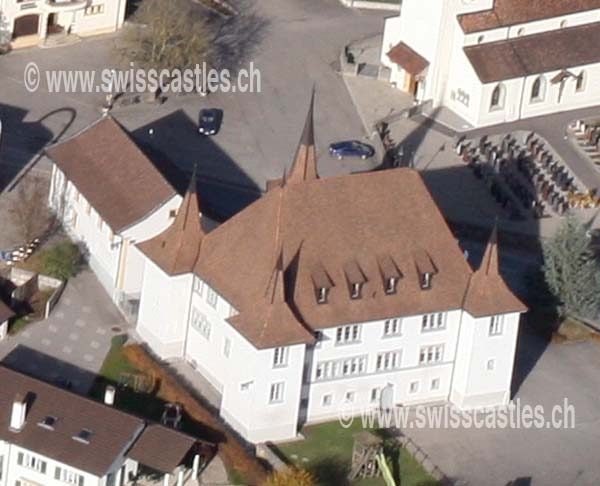
Louis Vallier, lord since 1627, constructed St-Aubin Castle. His father, Jacques Vallier, who died in Solothurn in 1623, had already built a castle, identical to Cressier-le-Landeron, of which he was also the lord. Louis built St-Aubin Castle in 1631 using his father's plans. The general dimensions, internal organization, and framework are almost identical to the "Neuchâtel" model. The framework was built with timber from Solothurn. Fred. Brülhart quotes in his work: "the extensive castle of Louis Vallier still stands, but unfortunately the four towers that adorned the corners have been mutilated."
Since that date, the castle remained the residence of the lords, but mostly empty by the latter, as they preferred to live in their original city. Then, Francois Vallier, who only had daughters, sold the lordship in 1691 to Their Excellencies of Fribourg for the sum of 30,500 Ecus. The castle, the farm, and all seigniorial rights to tithes, oven, mill, hunting and fishing areas, benches, jurisdiction, and justice were mentioned in the deed of sale. St-Aubin thus became a bailiwick. The bailiffs were usually appointed for 5 years and were, of course, members of a patrician family from Fribourg.
For the citizens of St-Aubin, the happy times of the lords in a distant residence thus ended: the bailiffs took possession of the castle and consequently directed the life of the community. Under the regime of the Swiss Republic, imposed by Napoleon I since 1798, the municipality of St-Aubin tried to become a district capital. This remained unsuccessful. At this time, however, the castle was declared a national asset.
In 1849, the municipality of Fribourg, to settle a mortgage, took possession of the castle by investiture from the heirs of a certain Antoine Collaud, who had bought it a few years earlier. Barely two years later, on May 5, 1851, the municipality of St-Aubin bought it back from Fribourg for the sum of 14,565 francs to establish its schools there. Since then, this building, a symbol of our village, has survived the twentieth century with the aim of ensuring the education of all young students of St-Aubin in its center. This noble task ended in 1998.
Today
With the renovation of the premises, the old names of the rooms also disappeared; thus, the "Water Room," the "Music Room," or "Gagnaux's old apartment" no longer existed. With new uses, new names were also given to the various rooms. This commemorates the lords and bailiffs who animated the history of our castle.
Lower Floor
The Angleis Room. In 1443, the Duke of Savoy made St-Aubin an independent lordship and appointed Antoine of Angleis as lord. This room corresponds to the old "Music Room" and does not yet have its defined use.
The Oncieux Room. In 1498, when Antoine Angleis died without sons, the lordship returned to his wife's nephew, Philippe of Oncieux. This family ruled over St-Aubin until 1606. The Oncieux Room occupies the "Water Room" and does not yet have a specific purpose.
The small cellar is intended for small receptions of approximately fifteen people.
Upper Floor
This floor is reserved for communal affairs with the Council Room, the municipal administration, and the Commissions Room.
1st Floor
The Bailiffs' Room. In 1691, Francois Vallier, who had no son, sold the lordship to the State of Fribourg. St-Aubin became a bailiwick, and until 1798, the castle served as the residence of the bailiffs. This room was formerly occupied by a classroom and will henceforth be used by singing and music societies.
The Jacques Antoine Collaud Room. In 1803, Jacques Antoine Collaud bought the castle during the sale of national assets by the Swiss Republic. His children tried to reduce maintenance costs and decapitated the four towers, lowering them to roof level. This room is assigned to the municipal library.
The Baroque Room bears the name of the staircase, built in the mid-18th century, which stands out. This glazed room has not yet been assigned a specific purpose.
The Louis Vallier Room. In 1606, the lordship of St-Aubin was publicly auctioned because the creditors of the Oncieux family could not be paid. Thus, it passed to Jacques Vallier, advisor of Solothurn. His son Louis, lord of St-Aubin since 1627, had the castle built in 1631 after the model of Cressier-le-Landeron, which also belonged to the family. This room under a magnificent framework can be used for more than 200 people. Equipped with state-of-the-art technology, the Louis Vallier Room offers the ideal infrastructure for large meetings or conferences as well as for theater troupes.
The municipal council decided to set up a committee for the administration of the castle, whose objective is to benefit from these new rooms and especially to revive this old residence of the bailiffs.
Take Mobile History with you
You are reading this text for free. Premium adds what matters on the road: descriptions read aloud, sites found through your camera, whole regions taken offline.
- Every description, including the ~17,700 Premium sites
- Audio guide: have descriptions read to you on location
- AR finder: see sites through your camera, with distance and bearing
- Unlimited saved sites
14 days free, then from €2.99 a month. Cancel anytime.
Source: Wikipedia · Licence: CC BY-SA 4.0
This description draws on the facts documented in the linked Wikipedia article; Wikipedia content is licensed under CC BY-SA 4.0. Wording and editing: Mobile History.
Location: 46.8895, 6.9802