To be privately owned
Salaberg Castle
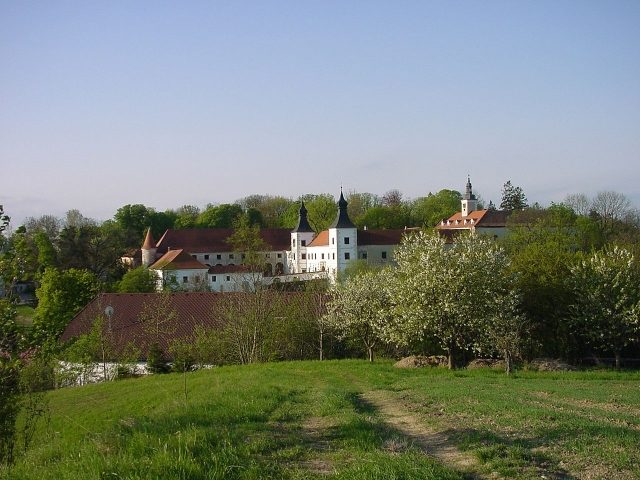
Salaberg Castle rises in the southwest of the Lower Austrian town of Haag. The architectural image of the castle is determined by three adjoining courtyards, and the silhouette of the building by the two towers of the middle courtyard and the clock tower of the arcaded courtyard.
Foundation Period
The first known mention of the castle, which was then still a fortress, is found in a document from 1282. In 1530, the merchant Niclas Kölnbeck from Steyr acquired the fortress. The Kölnbeck family expanded the fortress into a Renaissance castle. The creation of the arcaded courtyard dates back to this period. In 1618, the castle was sold to the Salburg family of counts, direct ancestors of the current owner Christian Freiherr von Mylius. Georg Siegmund Graf Salburg and his son Franz Ferdinand Graf Salburg, whose remarkable military career led him to Lieutenant Field Marshal, were the most important builders of Salaberg. They gave the castle the appearance it still has today.
Extensions
Around 1640, the now middle courtyard was created by adding three two-story wings to the already existing castle in the eastern part. This courtyard is flanked at the corners by two protruding, almost square towers. Around 1700, starting with the construction of the castle chapel, the outer courtyard was erected, which is essentially a farmyard. These castle extensions of the 17th and early 18th centuries are art-historically interesting because, in contrast to the Renaissance part, not only the architecture but also artistically valuable interior furnishings and the garden have been preserved.
Under Franz Ferdinand Graf Salburg, the Venetian ballroom of the castle was also created. The appearance of this ballroom is determined by the strongly plastic stucco, the opulent painting decorations, and the magnificent marble works. These marble works, the Lion of St. Mark in the left center of the hall, the portrait frieze in the cornice zone, the full-figure paintings, and the vivid ceiling frescoes fascinate every visitor.
Renovations
The war times in the 20th century, but especially the military and civilian quartering caused by the occupation period, left enormous damage to the buildings and artworks. Due to the unfavorable times, targeted restoration measures could only begin in the 1970s. These have been and are being continued with increased intensity by the current owner together with the Federal Monuments Office and the Cultural Department of Lower Austria.
In 1999, after four years of renovation work, the bathhouse was completed with the help of the Messerschmitt Foundation and the Federal Monuments Office and can be publicly visited from the year 2000 via the Haag Wildlife Park. The bathing facility of Salaberg deserves to be considered a special rarity and can certainly be compared with the Badenburg in the park of Nymphenburg Palace in Munich or with the Marble Bath in Kassel Palace.
The castle itself is currently not publicly accessible. However, the Venetian ballroom can be rented for private events. The castle chapel, restored since 1998, is also available for masses (e.g., smaller wedding masses).
Take Mobile History with you
You are reading this text for free. Premium adds what matters on the road: descriptions read aloud, sites found through your camera, whole regions taken offline.
- Every description, including the ~17,700 Premium sites
- Audio guide: have descriptions read to you on location
- AR finder: see sites through your camera, with distance and bearing
- Unlimited saved sites
14 days free, then from €2.99 a month. Cancel anytime.
Source: Wikipedia · Licence: CC BY-SA 4.0 · Image: http://commons.wikimedia.org/wiki/File:Salaberg_von_haag_gegen_sueden.JPG
This description draws on the facts documented in the linked Wikipedia article; Wikipedia content is licensed under CC BY-SA 4.0. Wording and editing: Mobile History.
Location: 48.1014, 14.5578