To be privately owned
Salis Castle (Bondo)

Built 1766–76 according to plans by the Milanese architect Francesco Croce for the Grisons envoy Count Hieronymus von Salis-Soglio, married to Countess Mary Fane from the house of the Earl of Westmoreland; exterior restoration 1997–98. Still inhabited today by an English branch of the von Salis family.
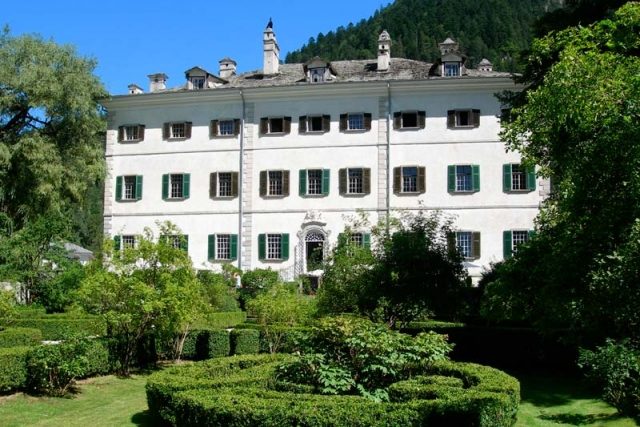
Broad building, divided by ashlar pilasters into three sections of three axes each, with two main floors, a mezzanine, and a basement, low hipped roof with three dormer windows on the garden side. In the central axis of both facades are portals with profiled granite surrounds, volute gables, and coat of arms cartouches.
On the west side, a geometric garden with a fountain in the center, laid out simultaneously with the building (restoration 1991–98); symmetrical grand staircase with intermediate landings.
The elaborate staircase is located in the middle of the courtyard side, externally recognizable by the transversely oval skylights on the main floors; simple staircases with baluster railings, opened to the narrow longitudinal corridors by pillars and round arches. Tectonic spatial arrangement: the reception rooms in the middle (three axes), the living rooms on the sides (two axes), and single-axis corner cabinets.
The sparse Rococo stucco work by the Comasque Domenico Spinelli is mixed with early Louis XVI motifs such as Ionic pilasters, garlands, trophies, draperies, etc. In the "Japanese Cabinet," painted chinoiseries; two rooms with local Swiss pine paneling; panelling, fabric wallpapers. In the dining room, a manganese-painted dome stove from around 1770 by Johan Jakob Kuhn, in a bedroom, a stuccoed dome stove with three eagles; a fireplace surround from Chiavenna (?) from the first half of the 17th century with the Pestalozzi coat of arms. Well-coordinated furniture.
Numerous portraits, notably that of Lady Rachel Fane, Countess of Bath (died 1680), attributed to Anthonis van Dyck (1599–1641); a Sappho painting and a self-portrait by the Chur painter Angelika Kauffmann (1741–1807), two girls' heads by Jean Baptiste Greuze (1725–1805), and a Saint Catherine, perhaps by Bernardino Luini (1475–1533).
Take Mobile History with you
You are reading this text for free. Premium adds what matters on the road: descriptions read aloud, sites found through your camera, whole regions taken offline.
- Every description, including the ~17,700 Premium sites
- Audio guide: have descriptions read to you on location
- AR finder: see sites through your camera, with distance and bearing
- Unlimited saved sites
14 days free, then from €2.99 a month. Cancel anytime.
Source: Wikipedia · Licence: CC BY-SA 4.0
This description draws on the facts documented in the linked Wikipedia article; Wikipedia content is licensed under CC BY-SA 4.0. Wording and editing: Mobile History.
Location: 46.3355, 9.5538