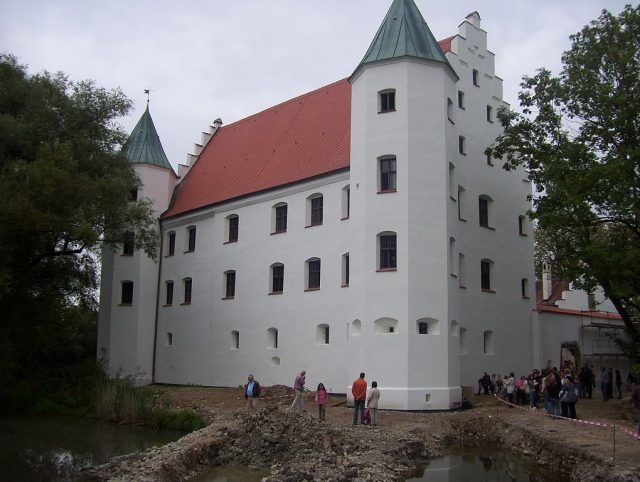
CastleSchambach

Schambach Castle

Schambach Castle

To be privately owned

Schloss Schambach is an old moated castle between Plattling and Straubing and has always been the landmark of the village of Schambach in the municipality of Straßkirchen.

Since the property is located in the ancient settlement landscape of the Gäuboden, there are suspicions that there might have been a Roman predecessor building. Around 800, a castle in Schambach is mentioned for the first time; this could have been a wooden manor house. The exact location of this building can unfortunately no longer be determined.

The castle itself was built in the Middle Ages using brick construction. It is built in the Old Gothic style on oak posts and was already surrounded by a moat, which, however, was much larger than it is today. A drawbridge denied intruders access. To the west, two hexagonal towers stood firm, and at the eastern entrance was a watchtower, which was demolished as early as 1318 and replaced by an extension. At the main entrance to the castle is a small tower with a spiral staircase. On the east side, two side entrances with flying buttresses rest on stone columns. Originally, the ground floor housed the stables and the upper floor contained the Fronfeste (manorial rooms).

Around 1550, the castle was converted into a two-wing complex using old components. This happened under the Trenbach family, who were the owners until the Thirty Years' War. Then it briefly came to the St. Emmeram Abbey in Regensburg, later returning to private hands. The last major renovation took place in the early Renaissance with the installation of arcades. Since then, the castle has remained largely unchanged.

Since the lords of the Hofmark could exercise lower jurisdiction, they also had the right to imprison and sentence wrongdoers, but not to judge their life and limb. However, they apparently did so, because years ago several knives and skeletons were found in the northwest castle tower. So there were secret executions of inconvenient contemporaries in Schambach Castle. They disappeared forever in the hunger or knife tower. There was an underground passage connection to the nearby Moosdorf Castle (distance approx. 4 km). An investigation has confirmed this assumption, but the passage is no longer passable.

In 1813, the castle, with significant land ownership, came into the hands of Count Franz Gabriel von Bray, who had settled in Irlbach in 1811, through auction for the price of 90,000 guilders. He saved this magnificent monument from decay. Schambach thus temporarily came under Irlbach jurisdiction. In 1961, Adalbert Freiherr von Poschinger-Bray offered the inherited castle in Schambach for sale. The district of Straubing initially sought to acquire it with the intention of establishing a rural museum there. But then, in 1962, Baroness Elisabeth von Oefele from Munich bought the castle property. With the involvement of the State Office for Monument Preservation, the new owner initiated a thorough renovation of the proud building. The lowering of the groundwater caused massive damage to the pile foundation, further damage to the roof structure pressed on the arcades, leading to deformations that forced emergency securing. The outdoor facilities were redesigned with a surrounding moat and a wooden bridge (formerly a drawbridge) as access. The restaurant operated in the castle square was demolished. Inside the magnificent building, a castle chapel was newly furnished.

Take Mobile History with you

You are reading this text for free. Premium adds what matters on the road: descriptions read aloud, sites found through your camera, whole regions taken offline.

  • Every description, including the ~17,700 Premium sites
  • Audio guide: have descriptions read to you on location
  • AR finder: see sites through your camera, with distance and bearing
  • Unlimited saved sites

14 days free, then from €2.99 a month. Cancel anytime.

Source: Wikipedia · Licence: CC BY-SA 4.0

This description draws on the facts documented in the linked Wikipedia article; Wikipedia content is licensed under CC BY-SA 4.0. Wording and editing: Mobile History.

Location: 48.8521, 12.6867