Cultural center
Schieder Castle

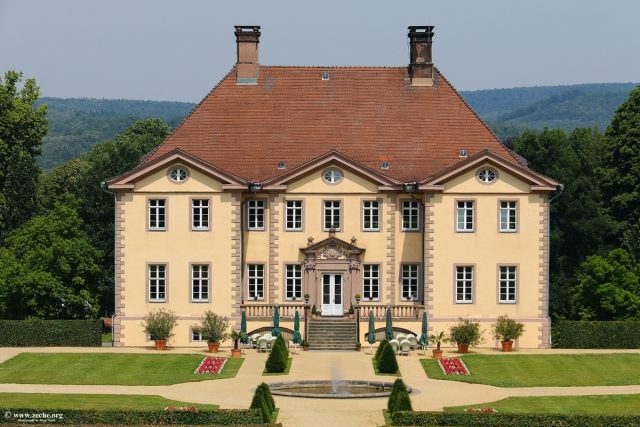
Schieder Castle in Schieder, North Rhine-Westphalia, was built at the beginning of the 18th century. It was owned by collateral lines of the House of Lippe until it reverted to the princely house in 1789. Until 1918, it served as a summer residence.
The area around Schieder was largely desolate in the 15th century. Only a glassworks existed at the end of the century. This, along with the Schieder Mark, came into the possession of the Augustinian monastery in Blomberg. The monastery developed the property into an estate, which in 1553, during the Reformation, came into the possession of the Counts of Lippe. From 1621, the property formed part of the territory of the collateral line Lippe-Brake. Count Rudolph zur Lippe-Brake had the castle and garden built from 1703. With the extinction of the Lippe-Brake line, the castle and property reverted to Schaumburg-Lippe in 1773. The counts had the Baroque garden extended.
In 1789, the castle returned to the princely house of Lippe-Detmold. It served as the summer residence of the princely house until the November Revolution of 1918. The park was opened to the public in 1914.
After the revolution, the castle and park became the property of the Free State of Lippe. From 1922 to 1968, the castle was used by the Reichsbahn and later the Bundesbahn as a children's home. In 1963, the park, and in 1968, the castle, became the property of the city of Schieder-Schwalenberg. The castle houses the Haus des Gastes (Guest House), the adult education center, a music school, and the city library. The so-called Kornhaus (granary), dating back to the 16th century, is now located in the open-air museum in Detmold.
Buildings+
The architect of the castle was Joseph Falck, who came from Tyrol. He had previously worked on the new construction of Corvey Abbey. The simple building with a high hip roof and flat triangular gables follows the style of Dutch Classicism, a variant of Baroque common in Westphalia at the time. Immediately next to the actual castle, the bakehouse and brewery with the castle chapel were built between 1705 and 1708. This building was also referred to as the Kavaliershaus (Cavalier's House). Later it was called the Palais. Falck also built a bridge over the Emmer, which is no longer preserved. Only in 1832 were a stable and a coach house built. The Prince's or Tea House also dates from the first half of the 19th century. Between two other identical buildings, which formed the conclusion of the garden extended during the time of Leopold II, the northern gate used to be located. The two buildings served as a gardener's house and a greenhouse; the latter was therefore also called the Blumenhaus (Flower House). Later, this served as a residential house. The recently renovated Blumenhaus was the Monument of the Month in Westphalia-Lippe in October 2010.
Garden+
A garden was laid out in the Baroque style between 1701 and 1706. This consisted of the parterre, a flat garden area with a central fountain basin in front of the castle, a canal, and three terraces with stairs and cascades in the central axis. In 1705, a lime tree avenue was also planted. This avenue consisted of 260 trees and crossed the Emmer River. In 1832 and 1865, the garden was redesigned. Since 2006, the Baroque state in the south of the park has been reconstructed and opened in 2009.
Take Mobile History with you
You are reading this text for free. Premium adds what matters on the road: descriptions read aloud, sites found through your camera, whole regions taken offline.
- Every description, including the ~17,700 Premium sites
- Audio guide: have descriptions read to you on location
- AR finder: see sites through your camera, with distance and bearing
- Unlimited saved sites
14 days free, then from €2.99 a month. Cancel anytime.
Source: Wikipedia · Licence: CC BY-SA 4.0 · Image: www.zeche.org
This description draws on the facts documented in the linked Wikipedia article; Wikipedia content is licensed under CC BY-SA 4.0. Wording and editing: Mobile History.
Location: 51.9150, 9.1501