To sit empty
Schieritz Castle

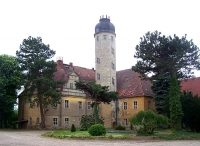
Schieritz Castle is a Renaissance castle in Schieritz in the Ketzerbach valley, six kilometers west of Lommatzsch and seven kilometers northwest of Meißen in the Free State of Saxony.
Meaning of the Name
The place name is generally attributed to a Sorbian field name and is of Old Slavic origin (approx. 6th/7th century). It means "width". Due to sound shifts that may have occurred over time, Schieritz can also mean "apron" or "skirt". An apron protected against injuries when working as a stonemason or miner. In a figurative sense, the lords of Schieritz were thus protected by their castle as if with an apron, to ward off harm.
Location
The Ketzerbach valley, widening towards the Elbe, leads into the Elbe near Zehren. On the Eckhardsberg, which borders the area, there was a vineyard until 1945. Kaolins are found in the Kirschberg. Schieritz is only one kilometer away from Zehren, which is of the same age. In 1003, Bolesław Chrobry Wielki destroyed Glomuci, the central sanctuary of the Wends settled here, from this location.
Building Description
Castle
The castle has a prominent hip roof, towering high above the Ketzerbach valley, which was extended with dormer windows featuring Renaissance gables. The main part, the former manor house, consists of a cellar and two upper floors. The ashlar sandstone construction of the tower portal dates from the building period around 1555. The utility building, built in the second half of the 19th century, has cross-vaulted ceilings. The directly adjacent south wing housed the brandy distillery, and there is a column there, just as in the former kitchen there are two more columns in Tuscan order. The plinth plate is octagonal and transitions to the 67 cm thick cylindrical shaft, a weak torus, and a slightly projecting plate, on which the vault rests directly. The round-arched access door from the courtyard bears the coat of arms of the von Schleinitz and Sundthausen families and the year 1556 as a keystone in the jamb. The chapel of the castle was on the second floor of the south wing. The southeastern part was the former administrator's apartment and dates from the 16th century. The 42.6 m high tower was reconstructed in 1882 and 1919. In the 1970s, the lantern became dilapidated, and during a storm on December 31, 1977, it was severely damaged. In 1987, it had to be secured by mountaineers, but in 1993, it was completely dismantled. The window jambs are consistently without the profiles typical of the Renaissance and possibly date from a window enlargement in the 17th century. The widely visible ornamental gables are possibly also a work of the historicizing spirit of the time and date from the 19th century. At the northwestern entrance, sandstone posts for the gate were found, bearing the royal Saxon coat of arms and a monogram P.G.H.S., referring to Prince Georg, Duke of Saxony, who owned the castle between 1862 and 1869.
Schieritz Estate
Behind the towering castle lies the estate, accessible via a gently rising ridge. The jurisdiction of the old-established estate covered eight villages: Kaisitz, Kleinkagen, Obermuschütz, Seylitz, Zscheylitz, Zehren with Keilbusch, Ickowitz, and part of Klappendorf, and belonged to the Meißen district. The manor had the patronage of church and parish offices and the school of the village of Zehren, and awarded six scholarships at the Meissen State School St. Afra. On April 1, 1923, the 153-hectare manor of Schieritz was merged with the municipality of Schieritz. The large barn in the northeast of the courtyard, whose rear was accessible via a bridge, dated from 1600 and was extended in the 19th century, but was destroyed by a major fire in 1971.
Castle Mill
The mill site is already marked in the Ur-Oeder (1589–1602), but is probably much older. Originally, the mill was built as a wood and saw mill, later mainly used as a grain mill and for electricity generation for Schieritz Castle and the community as a hydropower plant. From 1905 to 1917, the installed spiral turbine supplied 5 kW of electrical power for the entire village, manor, brewery, forge, and inn. The mill wheel, with a diameter of 3.9 m and a width of 2.25 m, is driven by the Ketzerbach.
History
Motte-and-bailey castle Dragonerberg
The medieval motte-and-bailey castle Schieritz with its section wall, as well as outer bailey and associated section wall, all encompassed by a ditch, is not identical in location and position with the possible predecessor building of Schieritz Castle, and its dating by experts to 1200-1250 is also unconfirmed, solely because the existing and assignable documents only begin from 1260. It is certain that the use of the motte-and-bailey castle ended at the beginning of the 13th century.
Predecessor building of Dominus Conradus
In 1902, during paving work at the altar of the Seußlitz church, a sandstone slab was found with the image of a knight, still wearing the Roman attire of the 13th century and holding an undivided shield with three five-petaled roses in his left hand. This coat of arms was identical to the form of the Schleinitz coat of arms, preserved on a document of Peter von Schleinitz from December 12, 1350, by which he sold money and grain rents in Alt-Lommatzsch to the Poor Clares monastery of Seußlitz. Accordingly, Dominus Conradus (the rest of the stone was broken off), buried in September 1288 at the holiest place of the monastery confirmed by the Pope in 1255, was a de Slinicz. Schieritz is a place with a very old history and belonged to the numerous border fortresses on the Elbe. Otto Eduard Schmidt therefore already hypothesized in 1906 that Konrad von Schleinitz zu Seußlitz must have had a similar relationship to the Poor Clares monastery of Seußlitz in the easternmost part of the Lommatzsch district as his relatives in the westernmost part had to the St. Afra monastery in Meißen. Konrad von Schleinitz was possibly enfeoffed with the Burgward Zehren, mentioned in 1003, whose military use as a Burgward, however, certainly ended at the beginning of the 13th century. A possible relationship of Dominus Conradus de Slinicz to a predecessor building (the successor to the Dragonerberg fortification) on the militarily more important route through the valley from the rough ford to Lommatzsch, the current location of Schieritz Castle, is logical, but unconfirmed by documents or archaeology.
von Gorenzk (1349–1361)
In 1360, a Ulrich von Gorenzk, referred to as dicti de Schyricz, and his wife Agnes with their five sons are mentioned as owners of the manor.
von Schleinitz (1416–1441)
In 1416, a knight Hannes von Slinicz zu Schiricz is mentioned.
Rosenhain (1411–1457)
The von Rosenhain (also von Rosenberg) family originated from Upper Lusatia.
von Miltitz (1457–1460)
In 1476, Georg von Miltitz made a pilgrimage to Jerusalem with Duke Albrecht and Heinrich von Starschedel.
von Rechenberg (1460–1490)
From 1460, the Lords of Rechenberg resided here.
von Sahlhausen (1409–1513)
In 1480, a Friedrich von Sahlhausen is mentioned as owner († 1480 Meißen). His son was Johann VI. von Saalhausen.
von Arras (1513–1549)
Dittrich von Arras came from Thuringia.
von Schleinitz (1549–1841)
The von Schleinitz family is an ancient Saxon noble family and was first documented in 1255. The family's property complexes extended into northern Bohemia. In 1549, George von Schleinitz zu Seerhausen bought the Schieritz manor and built the west wing. His successor Hannß von Schleinitz had the castle visible today built between 1556 and 1601, possibly on the foundations of a predecessor building. The enormous depth of the cellar vaults under the old part supports this. Hannß von Schleinitz was married to Maria von Sunthausen. In 1841, the last Schleinitz, the Royal Prussian Chief Forest Master Georg von Schleinitz, sold the castle. With him, the Schleinitz family died out.
Kunert (1841–1862)
The castle owner Christian F. Kunert, a poor journeyman soap boiler from Liebenwerda, had traveled to Odessa and successfully founded his own soap factory there. He returned wealthy to his homeland and lived as a rich castle lord in Saxony until his death.
Prince Georg of Saxony (1862–1868)
von Kiel (1868–1891)
From 1868 to 1891, Fedor von Kiel was the owner of the castle.
Günther (1891–1945)
From 1891, Dr. phil. Emil Franz Günther was the owner of the complex. He cultivated lily-of-the-valley near the castle. He died in 1944 and was buried in Schieritz. The city of Dresden possessed a cultural-historical museum, the Saxon Post Room, created between 1929 and 1932 as a result of the 8th annual exhibition "Travel and Hiking". The museum was set up in the Reichspostdirektion Am See. Due to increasingly heavy air raids, this museum was relocated to Schleinitz Castle. On June 6, 1945, Kurt Schreiber, an employee commissioned by the Oberpostdirektion, found that several Russian companies with a commander had taken up quarters in the castle. On July 12, 1945, the wife of the Schieritz post administrator informed the Oberpostdirektion Dresden about the withdrawal of the Russian military. On July 19, 1945, Dresden archivist Karl Jäger reported: The castle was uninhabited and completely plundered, the files in wild disarray. The employees of the Oberpostdirektion who then arrived found destruction and devastation of the entire castle inventory, that the historical models of postal vehicles from the former museum served as toys for the children in the village, that pictures lay scattered in burnt-out stables, mixed with household furnishings and torn clothing items. Thus, not only the objects of the former postal museum but also the paintings and antique books of the state library, which had been relocated from the picture gallery to Schieritz, were senselessly destroyed and plundered by Soviet troops, but also by locals. However, not all art treasures fell into foreign hands. Dresden librarian Helmut Deckert found the following in 1946: Of a valuable manuscript, I found remnants impaled on a nail as toilet paper in the toilet; others lay torn, soiled, or with torn bindings. Occupying soldiers had stuffed historical maps into their beds for padding.
Children's Holiday Camp (1945–1953)
After the looting and withdrawal of the Soviet military, displaced persons from Silesia, East Prussia, and the Sudetenland moved into the castle. It was then used as a GDR children's holiday camp "Philipp Müller" by the Meißen Cable Works.
LPG - Meißen University (1953–1992)
At the beginning of the 1950s, the agriculture of the former GDR lacked thousands of trained specialists. The cause was the expulsion and ideological criminalization of leading agricultural entrepreneurs through politically motivated expropriation: "Junker land in peasant hands - now we eradicate the weeds." All leading agricultural enterprises in the entire Soviet occupation zone that owned 100 hectares or more of land were expropriated, and the owners, and thus the most important knowledge bearers of agricultural contexts, were criminalized, persecuted, or driven out of the country. The SED party leadership therefore tried to close this gap by establishing cadre training centers. Thus, in September 1953, the district school for LPG was established in Schieritz Castle, which was taken over by the LPG - Meißen University in 1956. The castle became a dormitory for distance learning students of the university. On December 11, 1990, the Free State of Saxony decided to dissolve the university and commissioned the TU Dresden to carry out the liquidation of the university by September 30, 1992. The rector succeeded in arranging a regulation for the still studying graduates, which provided them with a diploma certificate from the TU Dresden instead of a diploma from the LPG University after passing their degree.
from 1991
Due to its affiliation with the university and the Unification Treaty, the Free State of Saxony was the owner of the castle. The property was managed by the Saxon Property and Building Authority Radeberg, directly subordinate to the Saxon Ministry of Finance. All efforts by the Ministry of Finance, since the first tender in June 1993, to auction the castle for one Mark with the condition of renovation, failed. By 2000, the required renovation costs amounted to 1.5 million Marks. On August 13, 2002, after heavy rainfall, fifteen meters of the retaining wall and eighteen cubic meters of the slope from the castle area to the bypass road of federal highway 5 broke away. In the 2005 internet auction, an Austrian, Hannes Graf from Vienna, became the new owner for 71,000 Euros. His concept of establishing a sanatorium for obese children in the castle failed due to the financing of the project. In 2008, due to his own payment problems, the owner pledged the castle to a Japanese architectural firm under Arata Matsumura in Leipzig and then disappeared without a trace. The architectural firm was involved in the project developments of the venture and later claimed that Hannes Graf was still the owner, as he had since paid his debts. The financing requirement had already risen to 2 million Euros by 2008. As the reason for the increased costs, which ultimately led to the failure of every project, the architectural firm cited primarily the inadequate development in the water and wastewater sector of the affected properties. Due to all missing emergency securing measures, the monument was left to decay.
Take Mobile History with you
You are reading this text for free. Premium adds what matters on the road: descriptions read aloud, sites found through your camera, whole regions taken offline.
- Every description, including the ~17,700 Premium sites
- Audio guide: have descriptions read to you on location
- AR finder: see sites through your camera, with distance and bearing
- Unlimited saved sites
14 days free, then from €2.99 a month. Cancel anytime.
Source: Wikipedia · Licence: CC BY-SA 4.0
This description draws on the facts documented in the linked Wikipedia article; Wikipedia content is licensed under CC BY-SA 4.0. Wording and editing: Mobile History.
Location: 51.1976, 13.3932