Cultural facilitie
Schleinitz Castle
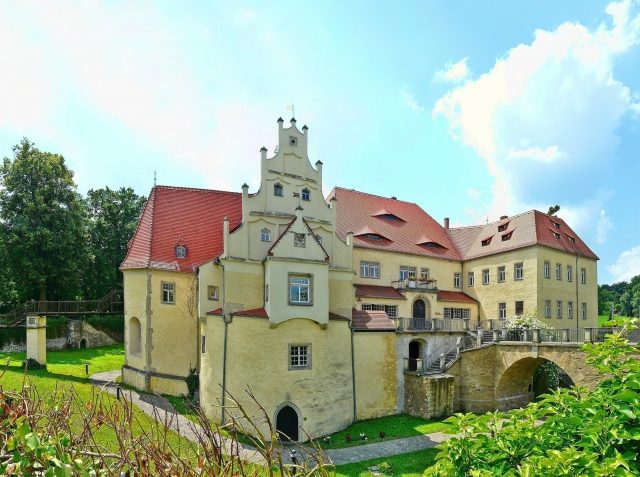
Schleinitz Castle is a late Gothic former moated castle in Renaissance style in the Ketzerbach valley, 4.5 km south of Lommatzsch and 13 km west of Meißen, and until 1945 was one of the largest manorial estates in Saxony by area.
Architectural Description+
The late Gothic building was erected at the end of the 15th and beginning of the 16th century in place of a possible moated castle with two projecting round towers. The bottom of the moat visible today was at least three meters deeper at that time, as the pond behind it, connected by a dam, still had a depth of four meters in 1923. The two towers still visible in the moat area are connected by a defensive wall. Between the two towers is the inner courtyard, remnants of the former Zwinger (outer bailey). The late Gothic architectural concept never envisioned flooding and using the surrounding moat as a water moat, but rather already pursued the castle concept, no longer exclusively militarily oriented, as set by the new construction of Albrechtsburg Meißen, focusing instead on the architectural representation of the manorial estate's power. Of the original Gothic design, only the left wing with the so-called cellar, which forms the actual ground floor at today's moat level, remains today. It is the former house chapel with a net vault. Its choir is closed on three sides of the octagon. In the axis of the chapel are two windows with curtain arches and strong overlaps of the profiles, which place the Schleinitz master builder in historical proximity to Arnold von Westfalen. Until the Reformation, this stately chapel was served by a special altarist; the pastor from Leuben had to preach here, or the school teacher from Leuben had to serve as organist, to provide the lord, his family, and subordinates with divine service and the office of communion at the lord's request. The wall cabinet carved into the stone in the chapel shows the year 1518 and probably dates from the time of the predecessor building of the castle visible today. The upper floor of the left tower, in which the circular shape of the tower's lower floor was abandoned, also dates from the same period as the chapel. Above the cellar, probably as a result of a fire, a delicate arched hall was built as the current ground floor in the second half of the sixteenth century, and above that, two more upper floors, which are divided into an almost square central building and a right wing, forming the architectural complement to the Gothic left wing in Renaissance style. Otherwise, the entire building is kept simple. The often-described Gothic gable in front of the saddle roof already shows the transition to the curved volute gable often used in the Renaissance. Two original latrine bay windows have been preserved on the north facade. The right tower is still used as a kitchen. Since 1781, a stone bridge has led over the former moat, and two side staircases lead down into the moat on both sides of the castle. In 1905, extensive renovations were carried out under the Dresden architect Hans Gerlach. Thus, the large two-story hall was built in the central building, which had to replace an original late Gothic spiral staircase. Above the central building, the so-called Dresden Room with a painted wooden ceiling in dark gray, brown, and yellow ornaments commemorates this renovation period of 1905.
Orangery
The garden house, which was built as an orangery and stood opposite in an extensive French park, is an elongated building of simple design. On the ground floor there were large openings to the south, and on the upper floor was the famous Schleinitz library with over 3000 volumes by Dietrich von Bose from 1690, which was cared for by the Saxon historian Johann Friedrich Ursinus, (* August 15, 1735 in Meißen, † January 9, 1796), pastor from Beicha. The valuable book collection included a Bible by Hans Lufft from 1561 from Wittenberg and a handwritten letter by Nikolaus Selnecker. The building is now used exclusively for residential purposes. The remains of the theater, still sighted by Cornelius Gurlitt in 1923, are no longer traceable.
Lucas Cranach the Elder's Paradise
When Otto Eduard Schmidt entered the castle and garden house, which had been abandoned for years, during his excursions through Electoral Saxony in 1904, he recognized an original painting by Lucas Cranach the Elder in the art collection of the former owner von Bose, among other things by the winged serpent. Cranach depicted Paradise as the Garden of Eden with a multitude of animals living peacefully together. The painting thus existed in two original versions, one of which is still part of the Vienna art collection. Both are identical except for the accentuation of the events and further show, in individual Protestant-influenced interpretation scenes, the creation of Adam by God, the Fall, and the Expulsion. In 1928, the owner, Baron Stephan von Friesen, gave this painting to the Dresden Picture Gallery for restoration, as the panel had suffered from flaking paint and was consequently not intact. The gallery director responsible there, Hans Posse, immediately recognized the value of this hitherto unknown Cranach and sought to acquire the painting for the Dresden Picture Gallery. After further negotiations, Baron Stephan von Friesen sold the painting to the Dresden Picture Gallery in 1928 for 15,000 Marks, where it was immediately presented in the permanent exhibition. This painting, like other art objects, was then looted by the Soviets in 1945, then returned, and has been presented in the permanent exhibition from 1958 to today.
Schleinitz Estate
Immediately to the northeast, facing the castle, is the former 280-hectare estate, connected to the castle, an ensemble of farm buildings with former barns, malt houses, bakeries, and stables, which are now used as apartments. In 186 hectares of fields, 21 hectares of meadows, 65 hectares of forest, and 8 hectares of ponds belonged to the estate. A stone immured in the court building dates parts of the complex to 1558. Traditional rural use no longer takes place in the sparsely populated locality. In the old granary of the manor, a museum for rural customs was established by the Förderverein (support association), which with sixty ABM (job creation measure) workers was temporarily the largest local employer around 2000, in which tools and implements from peasant household, field, and livestock farming are displayed as museum exhibits. Furthermore, demonstration workshops for shoemakers, saddlers, and blacksmiths can be seen. The court building, most recently renovated in the axis of the castle, which was originally built in the 16th century as a cellar house solely for the purpose of storage, served by its name in the 18th century as the local official and judicial seat for the hereditary and superior court matters of the Schleinitz manorial estate. The octagonal roof turret with clock, lantern, and pear-shaped dome located on it dates from later construction periods.
In Schleinitz, a manorial seat was first documented in 1231, a knight's seat in 1443, and an old-established knight's estate in 1551. The lordship exercised hereditary and superior jurisdiction. In 1696, Schleinitz belonged to the jurisdiction of the Meißen office.
von Schleinitz (1255 – 1594)
The von Schleinitz family is Saxon ancient nobility and was first documented in 1255. The family's property complexes extended as far as northern Bohemia.
Coat of Arms
The coat of arms depicts three roses in a split shield and bears a red buffalo horn on the right and a silver one on the left.
von Loß (1594 – 1664)
The noble family von Loß belonged to the power elite of Saxony. Christoph von Loß (* 1574, † 1620) was, through the inheritance of Abraham von Schleinitz on the eve of the Thirty Years' War, a Protestant lord of Schleinitz Castle and the diplomatic counterpart to his brother Joachim von Loß at Pillnitz Castle, who was known as the "evil Loß". Privy Councillor Christoph von Loß was married to Maria von Schleinitz and had significant influence on the politics of the Saxon court under King Christian II.
von Bose (1664 – 1773)
From the Imperial Treasurer Joachim Christian von Bose, the inheritance passed to his son, Joachim Dietrich von Bose of Schleinitz, Petzschwitz, Graupzig, Gödelitz, Seegeritz, and Burkersdorf. Dietrich von Bose was a Knight of the Order of St. John, Electoral Chamberlain, and Inspector of the Princely School of St. Afra in Meißen. Reports of so-called hunting encampments from the years 1727 to 1736 are preserved from him.
von Zehmen (1773 – 1906)
In 1773, Friedrich von Zehmen of Stauchitz inherited Schleinitz Castle and manor from his uncle, Privy Councillor Carl Gottlob von Bose. From then on, Schleinitz Castle, along with Petzschwitz, Gödelitz, and Graupzig, formed a single property complex. Friedrich von Zehmen (1733-1812) attended the Franziskaneum in Meißen, studied law at the Alma mater Lipsiensis and at the Salana in Jena. He eventually became a Saxon court and justice councillor. After a drought year in 1789, there was a poor harvest in 1790. In addition, there was the unequal legal situation of the farmers compared to the feudal hereditary courts, which led to the Saxon Peasants' Uprising in the Lommatzscher Pflege in 1790. Lord Friedrich von Zehmen noted that justice was now at an end, as it was being enforced by the subjects with beatings and violence. In his distress, he had forty men from the artillery stationed in Lommatzsch commanded to Schleinitz. But on August 22, 1790, the peasants snatched the rifles from the soldiers, broke the saber of the commanding Lieutenant Bach, and, with the captured officer in their midst, armed with scythes, pitchforks, and flails, marched to Schleinitz Castle. There, the court administrator Kohl, appointed by von Zehmen, was so severely mistreated that he died of his injuries on August 23 in Meißen. On the stone bridge of the castle, the lord was forced to sign a declaration renouncing all corvée services and grain rents. After the events of 1790, he sold the Schleinitz manor to his younger brother. His descendant Ludwig Gottfried von Zehmen-Schleinitz wrote several scientific reports on pomology. His son Hans-Dietrich v.Z. inherited his father's estates, Schleinitz, etc., but mostly lived in London and died there on February 20, 1906. Since he had no children, his sister Marie Susanna von Zehmen, married to Dr. Heinrich Freiherr von Friesen, inherited the estates, including Schleinitz.
von Friesen (1906 – 1945)
In 1906, Dr. Heinrich Freiherr von Friesen-Rötha inherited the castle. Of his three sons who went to World War I in 1914, only lawyer Freiherr Stephan von Friesen survived. His two brothers Hans-Dietrich and Georg Friesen were buried under the linden trees of the rampart walk. Stephan von Friesen fell in Russia on the Eastern Front, his son Georg Dietrich Freiherr von Friesen (* 1923) was severely wounded in Ukraine in 1944 but survived. His mother, the widow Marie-Josephe von Friesen, was the last civilian owner of Schleinitz Castle until 1945. Due to a warning from the mayor of Meißen, the family managed to flee to Siebeneichen near Meißen before the impending deportation by the Soviets. Afterwards, Georg's sister, Marie-Luise Sahrer von Sahr von Schönberg, managed to return to Schleinitz in October and observe how the castle was plundered by the Russians. The Dresden cultural assets stored in the castle during the war, including "Dragoner vases," were, however, misused in the village for pickling cucumbers, whereby they were all destroyed without exception. Only one of them was saved in a severely damaged state, reconstructed, and can be seen today in Moritzburg Castle. From Siebeneichen, the mother fled on a coal train to Haidenburg, her children followed later.
After 1945
After the war, displaced persons were quartered in the castle and an LPG (agricultural production cooperative) was established. From the sixties onwards, the von Friesen family maintained contact with those who remained in their homeland, visited them often, but always had to expect state repression due to the existing district ban. The owners received back only forty paintings and two cupboards from their entire property. A complete return of the stolen property or compensation for the injustice did not occur.
In 1990, the LPG dissolved and the run-down castle stood empty. Therefore, on February 13, 1992, a support association, Förderverein Schloß Schleinitz e. V., was founded. As start-up capital, the support association received 200,000 DM from the Munich Dussmann Foundation. The association began to gradually renovate the castle and received further EU funding from the Leader II funding program, establishing a cultural, educational, and meeting center for the Lommatzscher Pflege region. In 1998, a restaurant GmbH was founded with 50,000 DM share capital for the operation of a three-star hotel with 19 hotel beds and 60 restaurant seats. The castle chapel was used for weddings and a wedding suite was set up. Currently, event manager Nicole Suba operates the Hotel Schloss Schleinitz. It is also available for conferences, wedding and Christmas parties, and other events.
Take Mobile History with you
You are reading this text for free. Premium adds what matters on the road: descriptions read aloud, sites found through your camera, whole regions taken offline.
- Every description, including the ~17,700 Premium sites
- Audio guide: have descriptions read to you on location
- AR finder: see sites through your camera, with distance and bearing
- Unlimited saved sites
14 days free, then from €2.99 a month. Cancel anytime.
Source: Wikipedia · Licence: CC BY-SA 4.0 · Image: Thomas Eichler
This description draws on the facts documented in the linked Wikipedia article; Wikipedia content is licensed under CC BY-SA 4.0. Wording and editing: Mobile History.
Location: 51.1633, 13.2725