Hotel
Schlemmin Castle

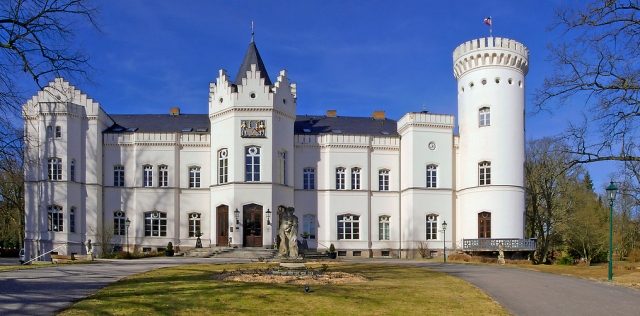
Schlemmin Castle is a manor house in Schlemmin in the district of Vorpommern-Rügen. Built in the Neo-Gothic style, the building was erected in the mid-19th century according to designs by Eduard Knoblauch for Wilhelm Ulrich von Thun.
As early as 1320, Heinrich von Thun was hereditary resident in Schlemmin as a councilor to Prince Wizlaw III of Rügen. The von Thun family, probably immigrants from Lower Saxony, built a castle in Schlemmin in the 14th century, which was rebuilt several times in the following centuries. A wall thickness of 1.8 meters and the presence of a moat and castle dungeon are documented.
In 1838, Major General Wilhelm Ulrich von Thun, serving in Prussian military, inherited the feudal estate of Schlemmin, among other properties. He had his estates allodified and expanded his landholdings by purchasing surrounding lands. Since the family's old castle was no longer usable, the construction of a suitable new manor house became necessary. Wilhelm Ulrich von Thun commissioned the Berlin architect and building councilor Eduard Knoblauch for this purpose. According to Knoblauch's design and under his supervision, Schlemmin Castle was built from 1846 to 1850 by local craftsmen. In addition to the castle, the farmyard, the farm laborers' cottages, the schoolhouse, the church, and other buildings in the village were also renovated. In 1853, King Friedrich Wilhelm IV visited Schlemmin and stayed overnight at the castle. After the death of Lieutenant General Wilhelm Ulrich von Thun in 1862, a Fideikommiss (entailed estate) was established for the Schlemmin estates.
Through marriage, the property passed to Count Bolko zu Stolberg-Wernigerode and finally belonged to the Counts zu Solms-Rödelheim, who had leased the estate, until its expropriation in 1945. In the 1930s and 1940s, the castle stood empty until a military hospital was established there in 1943. From 1944, refugees were also accommodated here. After World War II, 160 displaced persons were housed in the castle. During GDR times, a Konsum (cooperative store) and a school were set up there. From 1970, Schlemmin Castle served as a guesthouse for the LPG (agricultural cooperative) of Trinwillershagen.
After the reunification, Schlemmin Castle was initially owned by the municipality of Schlemmin. After unsuccessful management by a Berlin-based corporate group, it was administered by the TLG from 1992. In 1999, Schlemmin Castle was bought by a private investor who, after a fundamental renovation, established a hotel in the castle.
Layout+
The Neo-Gothic plastered building, with four halls and 45 rooms, contains many elements of castle architecture. These include the battlements on the castle and on the round tower. The risalits feature stepped gables. The central risalit of the main facade bears a pointed spire. Towards the village, the castle is surrounded by a moat, over which a bridge leads. The substructure of the tower and the waterside retaining wall of the elevated forecourt are made of smoothed granite blocks.
On both sides of the driveways are two single-story outbuildings, which, like the castle, were built in the Neo-Gothic style. The southern one is inhabited, the northern one is a ruin.
The landscape park, covering over 20 hectares, was already laid out in the 18th century as a Baroque park. Even then, the old beech and oak stands were included in the design, which was transformed into an English landscape park in the 19th century. From the village, two winter lime avenues, enclosing a wide lawn, lead to a square in front of the moat. Here there is a pump with a Neo-Gothic decorated metal casing. Another lime avenue, about 200 meters long, runs from there to the southern edge of the park. There is a memorial for those who died in the military hospital. Dendrologically interesting trees and shrubs in the park are marked with signs. The park is publicly accessible.
Take Mobile History with you
You are reading this text for free. Premium adds what matters on the road: descriptions read aloud, sites found through your camera, whole regions taken offline.
- Every description, including the ~17,700 Premium sites
- Audio guide: have descriptions read to you on location
- AR finder: see sites through your camera, with distance and bearing
- Unlimited saved sites
14 days free, then from €2.99 a month. Cancel anytime.
Source: Wikipedia · Licence: CC BY-SA 4.0
This description draws on the facts documented in the linked Wikipedia article; Wikipedia content is licensed under CC BY-SA 4.0. Wording and editing: Mobile History.
Location: 54.2225, 12.6792