CastleKruckow-Schmarsow

Schmarsow Castle
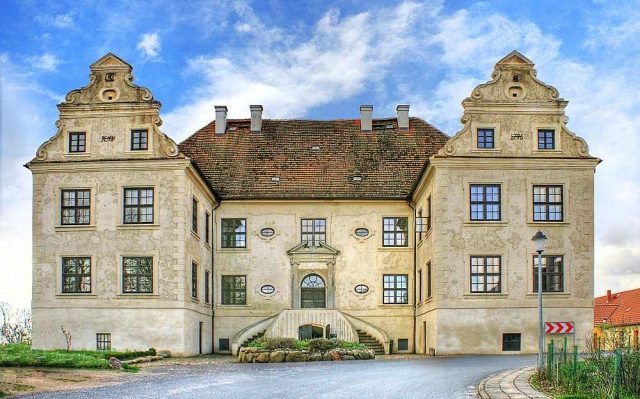
Schmarsow Castle

Apartments for Holiday

Schloss Schmarsow is a manor house in the eponymous district of Schmarsow in the municipality of Kruckow in the Vorpommern-Greifswald district. The three-winged building, used for residential and administrative purposes as well as cultural events during GDR times, is one of the oldest manor houses in the area and a significant cultural monument of Vorpommern. Today, concerts are regularly held in the ballroom, and holiday apartments and function rooms can be rented.

The village of Schmarsow, first mentioned in 1249, was a knightly fief of the von Maltzahn family. It belonged to the possessions of Osten Castle, located very close by on the Tollense, which remained in the joint possession of the Osten-Kummerow and Sarow lines of the von Maltzahn family until the end of the 16th century. In 1599, Schmarsow, along with parts of the villages of Pensin, Kruckow, Pritzenow, Kartlow, Plötz, and Roidin, belonged to the Vanselow estate complex. There was already an estate in the village at this time, but it is unknown whether it was on the site of the later erected manor house. After various ownership disputes within the von Maltzahn family and with external interested parties, including the Duke of Courland and Baroness von Mardefelt, Philipp Joachim von Parsenow acquired all of the Osten estates, including Schmarsow, between 1674 and 1695.

The manor house was built by Philipp Joachim von Parsenow at the end of the 17th century on the site of a previous building. Building material for this was also taken from Osten Castle, which was destroyed in the Thirty Years' War.

In 1796, Otto Bogislav von Parsenow had the building restored. After the extinction of the Parsenows in the 19th century, several lines of the Maltzahn family laid claim to the inheritance to regain the old feudal rights. The decades-long process was only concluded in 1844. Schmarsow went to the Kummerow line. However, as the animosity between the parties to the lawsuit continued to smolder for about 20 years, Schmarsow, along with Osten and the Borgwall outwork, was finally sold in 1855 to Woldemar von Heyden-Cartlow, who resided in neighboring Kartlow. The von Heyden-Cartlow family remained in possession of Schmarsow until the expropriation in 1945. Already in 1865, the Schmarsow estate was leased to Ludwig Freiherr von Maltzahn of Vanselow. The administrator appointed by the von Heydens lived in the castle, but they also accommodated their guests here. Until 1938, there was a dairy in the cellar rooms.

After the end of the Second World War, the manor house came into the possession of the municipality of Schmarsow, which used it for residential purposes, for the municipal administration, a youth club, cultural events, and also as a consumer sales outlet. During this time, the building was placed under monument protection. In 2000, the municipality sold the building. Extensive renovations took place. The village road, which had been routed directly past the manor house through the former estate since the 1950s, was relieved by a bypass road completed in 2006.

Building+

If one approaches Schmarsow from Kruckow, the sight of the two gables of the side wings of the two-story manor house, adorned with volutes, dominates the appearance of the village. The gables bear the inscriptions "RENOV" and "1796", which refer to the year 1796, when the manor house underwent renovation or restoration. Dendrological investigations have shown that the assumption that the side wings were only added in 1796 is incorrect. Both the roof truss and the wooden beam ceilings of the side wings, as well as those of the main building, were dated to 1698. A two-armed, semicircular open staircase leads to the portal of the central main wing. The portal itself is framed in the manner of an aedicule with a broken pediment and pilasters. Otherwise, the plastered facades (shell limestone) with their square windows are only sparsely structured.

During the renovation of the castle from 2001, fragments of wall paintings, plank and terracotta floors, and wall hangings were found. The "black kitchen" installed on the ground floor in 1796 can be visited by guests.

In 1930, a buried well was discovered under the cellar floor. This contained, among other things, human bones, swords, and weapons. A bricked-up entrance was found in the well wall. However, popular traditions that speak of an underground passage between Schloss Schmarsow and Osten Castle on the Tollense are to be classified as a legend due to the geological conditions.

Take Mobile History with you

You are reading this text for free. Premium adds what matters on the road: descriptions read aloud, sites found through your camera, whole regions taken offline.

  • Every description, including the ~17,700 Premium sites
  • Audio guide: have descriptions read to you on location
  • AR finder: see sites through your camera, with distance and bearing
  • Unlimited saved sites

14 days free, then from €2.99 a month. Cancel anytime.

Source: Wikipedia · Licence: CC BY-SA 4.0 · Image: http://www.werner-conrad.de/schloss-schmarsow.html

This description draws on the facts documented in the linked Wikipedia article; Wikipedia content is licensed under CC BY-SA 4.0. Wording and editing: Mobile History.

Location: 53.8757, 13.2136