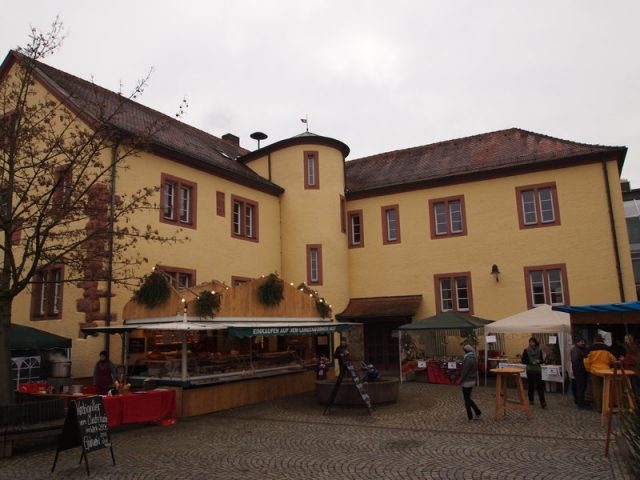
Town Hall
Schöllkrippen Castle

During the Staufer period, Schöllkrippen Castle served as a supply base for the Gelnhausen Imperial Palace; hence the reports of a hunting lodge of Emperor Frederick Barbarossa. With the displacement of the Rieneckers from the Kahlgrund, Mainz took over this place from 1325, developed it into a forest estate, and enfeoffed various noble families with it. On the northern corner tower, the coat of arms of Elector and Archbishop Theodor (Dietrich) von Erbach with his 3 stars and the Mainz wheel is still well preserved.
During his reign from 1443 to 1459, most of the current building was erected, and the castle chapel was built at the same time. The castle, the Sackhäuser with their tithe barns, the chapel, and the old Geipel building at the end of Marktstraße formed the core of a Mainz administration in the Northwest Spessart after 1450. From here, the Laubmeister administered the forests in this area of the Mainz Spessart.
The castle at that time must be imagined as a moated castle within a garden and park area, where the chapel with its cemetery also stood, and the lime tree was the only tree remaining, which was felled on November 26, 1999. Around 1480, the then influential Geipel family was enfeoffed with the Schöllkrippen forest estate, and the forest master over the entire Mainz Spessart was Heinz Geipel, who also had Rothenbuch Castle built after 1480 as the new central administrative seat over the Spessart forest.
Around 1530, a Dr. Dieter von Lauter was a councilor of Kurmainz, owner of the castle and, of course, of the castle field and the castle meadows. The castle housed the hunter's court and, especially under Lord von Lauter, the Centgericht (district court). The large coat of arms panel on the north gable has the following text: "erected by the C (Cent) judge Johann von Lauter on May 5, 1544". Below it is the coat of arms of Johann von Lauter.
At that time, it was a central point in the Cent before the Spessart, especially for settling disputes and legal issues of the northwestern Mainz Spessart. A Gothic Christopher relief, which can still be admired today in the castle's inner courtyard, dates from this period. Afterwards, the castle was the widow's residence of the widely branched Lauter family and around 1600 repeatedly the official seat of a Kurmainz bailiff, as a seal from 1667 confirms. Part of this 'Ampts' seal is today part of the municipal coat of arms. In 1693, the nobleman Heinrich Gros was murdered in the castle courtyard and his body was later found in the dungeon. Until the second half of the 18th century, this Schöllkrippen official castle was in the northwestern area of the Cent before the Spessart, and only from 1782, when the office was moved to Kaltenberg, did the castle and its properties pass into private ownership.
The Elector of Mainz gave it to his cathedral singer von Hauxladen as his own. Later, the industrialist Karl Berk (owner of the Großkahl glassworks and the Reuschberg) acquired it. Around 1830, it was owned by the merchant Ehinger from Frankfurt, and then Count von Schönberg-Erbach acquired it, who sold the building to the Kingdom of Bavaria around 1858.
During the territorial reform of 1858, the royal district court of Rothenbuch was dissolved, and the new district court of Schöllkrippen was formed from half of the municipalities of the royal district court of Alzenau. Bavaria thoroughly renovated the buildings at that time, had a gendarmerie station with a prison built next door, and had the surrounding walls erected. The castle was then the administrative and judicial center for the inhabitants of the municipalities between Breunsberg and Heinrichsthal, Huckelheim and Rottenberg. After the separation of administration and jurisdiction on November 10, 1862, in Bavaria, the administration was moved to Alzenau, and a district court with a land registry office was established in Schöllkrippen Castle. This district court was in operation until 1945.
After World War II, a Red Cross home for returning soldiers was housed there, and in 1952, the market town of Schöllkrippen acquired this old building from the Free State of Bavaria as its town hall.
Take Mobile History with you
You are reading this text for free. Premium adds what matters on the road: descriptions read aloud, sites found through your camera, whole regions taken offline.
- Every description, including the ~17,700 Premium sites
- Audio guide: have descriptions read to you on location
- AR finder: see sites through your camera, with distance and bearing
- Unlimited saved sites
14 days free, then from €2.99 a month. Cancel anytime.
Source: Wikipedia · Licence: CC BY-SA 4.0 · Image: http://www.wehrbauten.de/thread.php?threadid=928
This description draws on the facts documented in the linked Wikipedia article; Wikipedia content is licensed under CC BY-SA 4.0. Wording and editing: Mobile History.
Location: 50.0848, 9.2464