CastleSchöningen

Schöningen Castle

Schöningen Castle

Hotel

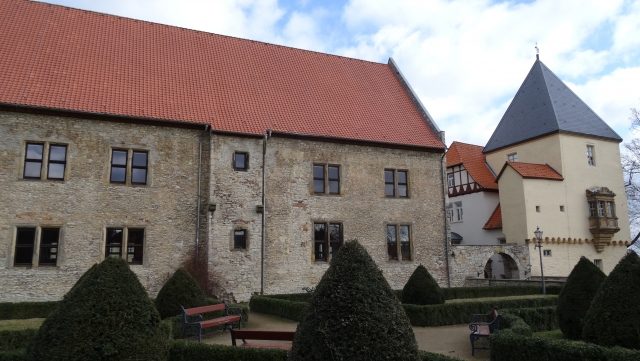
Schöningen Castle is a former hunting lodge built by Welf Duke Magnus I in Schöningen in the Helmstedt district. It was also intended as a border fortress to the territories of the bishops of Halberstadt and Magdeburg.

The castle complex was one of the most magnificent buildings near the Elm. It often served as accommodation for the Welf dukes and their retinue during driven hunts. During one hunt, they are said to have entered the Elm with 3000 beaters. In 1733, the castle saw a particularly high-ranking guest: The Prussian Crown Prince Frederick – later King Frederick the Great – stayed there overnight on his journey to his wedding with Elisabeth Christine of Brunswick-Wolfenbüttel-Bevern at Salzdahlum Castle.

Duke Magnus I of Brunswick-Lüneburg founded Schöningen Castle around 1350 as a hunting seat and border fortress, which was damaged in 1542 during the Schmalkaldic War, when the Schmalkaldic League waged a religious war against Duke Henry the Younger. In the early 16th century, the complex was converted and redesigned into a castle and served as a widow's residence for three Brunswick duchesses, Sophia Jagiellonica (Sophie Jagiello), Elisabeth of Denmark, and Anna Sophia of Brandenburg, until the 17th century. At the same time, Schöningen became an administrative seat. The three women had a great influence on the development of the castle. When Duchess Sophie, sister of the Polish King Sigismund II, lived in the castle from 1568 to 1575 after the death of her husband Henry II, she had a pleasure garden laid out, which no longer exists today. Elisabeth, the sister of Christian IV of Denmark and mother of the "Mad Christian" of Halberstadt, lived there from 1613 to 1626. She completely redesigned the palas in the Renaissance style and had the west and north wings newly built. Duchess Anna Sophie, born Princess of Brandenburg, who used Schöningen Castle from 1628 to 1659, ruled almost independently here. The establishment of a Latin school at the city market goes back to her.

In 1661, Duke August had the complex de-fortified and the armory demolished. From 1679 to 1683, Anna-Sophie, the second daughter of Duke Anton Ulrich of Brunswick, married to Margrave Karl Gustav of Baden-Durlach, lived in the castle. Previously, her sister Katharina of Brandenburg had used the complex as a residence before she died there in August 1644. On January 25, 1681, Schöningen Castle was the site of the marriage of Elisabeth Eleonore of Brunswick-Wolfenbüttel and Duke Bernhard I of Saxe-Meiningen.

Since 1815, when the administrative seat of Schöningen was moved to Helmstedt, the castle had been downgraded to a domain. Subsequently, the palas and outbuildings fell into disrepair. It was not until 1970 that agricultural operations on the site ceased. In that year, the state of Lower Saxony sold the buildings to private individuals. The city of Schöningen initially acquired only the surrounding open space. Between 1978 and 1983, it then bought three wings of the castle quadrangle, including the completely dilapidated palas and the district court garden south of the castle. Subsequently, restorations took place. Work began with the stables and their conversion into a youth center. This was followed by the establishment of an information center of the "Kuratorium Unteilbares Deutschland" for reunification. After the city acquired the former tenant's house of the castle domain from 1911, this building was also restored from 1985 simultaneously with the palas and the gardener's house. The city handed over the restored castle to the public in 1996, before the restoration of the Baroque garden followed from 1997 to 1998, and the restoration of the guardhouse until 2000. In addition to the facilities mentioned above, a hotel-restaurant is also located there today.

Brief Description+

The complex built by Duke Magnus of Brunswick-Lüneburg was heavily altered by conversions in the 16th and 17th centuries and later redesigns for agricultural use. Nevertheless, the floor plan of the late medieval complex is still discernible today. Remains of the old palas are preserved in the substructure of the castle. The east wing of the four-wing complex is flanked at its corners by two square towers with tent roofs. The southern one has a side length of about seven meters with a wall thickness of about two meters. In the south wing is the former castle chapel with ribbed vaulting. The castle park bordering the castle buildings was redesigned until 1991, just as the symmetrical garden south of the castle dates from the 1990s.

Take Mobile History with you

You are reading this text for free. Premium adds what matters on the road: descriptions read aloud, sites found through your camera, whole regions taken offline.

  • Every description, including the ~17,700 Premium sites
  • Audio guide: have descriptions read to you on location
  • AR finder: see sites through your camera, with distance and bearing
  • Unlimited saved sites

14 days free, then from €2.99 a month. Cancel anytime.

Location: 52.1406, 10.9651