Uninhabited
Schönwölkau Castle

Near the old trading and fair city of Leipzig, there are a number of castles and manor houses. The repeatedly redesigned Schönwölkau Castle also joins the list of these valuable architectural objects. Nevertheless, it leads a desolate existence and faces an uncertain future.
The history of the Baroque Schönwölkau Castle, off Federal Highway 2 between Leipzig and Bad Düben, dates back to the middle of the 15th century. Originally, a knight's estate stood on the site of the present castle, which the Lords of Spiegel received as a fief in 1464. In 1533, the von Schönfeldt family is documented as owners.
After its destruction in the Thirty Years' War, the knight's estate remained unused for a long time. Finally, in 1659, the Electorate of Saxony's chamberlain, cavalry captain, and provincial governor in Bautzen, Christoph Vitzthum von Eckstädt, acquired the property from Johann Gottfried von Schönfeldt and had a new manor house built on the site of the old destroyed knight's estate. However, the construction was not without complications: Duke Christian of Saxony-Merseburg opposed the construction of a spacious four-wing complex, which had a fortress-like character, and filed a complaint with Elector Johann Georg II on February 10, 1673. The imposed building ban was, however, soon withdrawn.
The Counts Vitzthum von Eckstädt descended from an old Thuringian noble family, already attested in Apolda in 1123. The Vitzthums were originally representatives of the Archbishops of Mainz in Erfurt. In the 13th century, the Vitzthum von Eckstädt line separated and settled in Saxony. Friedrich Vitzthum von Eckstädt, in particular, made a brilliant career as a skilled courtier and diplomat in Dresden and Warsaw. He owned several residences, but Wölkau Castle, for which the name "Schönwölkau" had become established in the 18th century, was his most important symbol of dominion.
It is therefore not surprising that Friedrich Vitzthum von Eckstädt, who was elevated to the rank of Imperial Count in 1711, had extensive alterations carried out in elaborate high Baroque forms at the beginning of the 18th century.
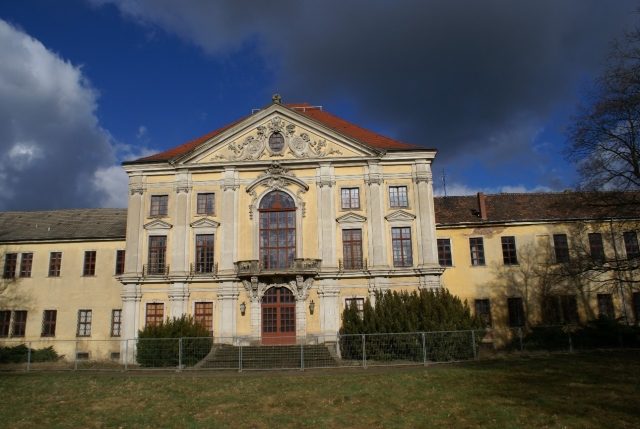
The spacious four-winged castle with its square floor plan consists of a magnificent three-story central section, which clearly stands out from the more modest side wings. Striking on the south wing are the superimposed Ionic pilasters that form the window axes. A balcony with a stone balustrade creates a pleasing appearance. The triangular gable with an oval window contains the coats of arms of the Count and his wife Rahel Charlotte von Hoym.
South of the castle, an extensive and charming park in an originally strictly geometric style with partly very old trees adjoins. Through three large main avenues and two arcades, it offered a scenic connection to the castle. The park was laid out by the then castle owner Friedrich Vitzthum von Eckstädt (1675-1726), a chamberlain of Augustus the Strong. However, the current appearance of the complex is more like that of a landscape park, which impresses primarily with long lime avenues and beautiful old trees.
In 1945, the owners were dispossessed and expelled by the communists.
Unfortunately, the present state of the castle is desolate. Used for residential purposes in the GDR and mostly kept secret due to the intended lignite mining, the castle was sold in 1997 to an investor who wanted to establish a cultural center in its rooms. Nevertheless, little has happened in recent years. Apart from occasional events in the large hall as well as rare concerts and Gellert evenings - the poet Christian Fürchtegott Gellert was a frequent guest - the castle is hardly used and is visibly decaying. It remains to be seen how the new owners will position themselves in the future. One can only hope that the castle, which is in need of renovation, will be spared the fate of further decay or even final demolition.
Take Mobile History with you
You are reading this text for free. Premium adds what matters on the road: descriptions read aloud, sites found through your camera, whole regions taken offline.
- Every description, including the ~17,700 Premium sites
- Audio guide: have descriptions read to you on location
- AR finder: see sites through your camera, with distance and bearing
- Unlimited saved sites
14 days free, then from €2.99 a month. Cancel anytime.
Source: Wikipedia · Licence: CC BY-SA 4.0 · Image: Roland Neubert, Halle (Saale)
This description draws on the facts documented in the linked Wikipedia article; Wikipedia content is licensed under CC BY-SA 4.0. Wording and editing: Mobile History.
Location: 51.4967, 12.4950