CastleSchorndorf

Schorndorf Castle

Schorndorf Castle

Tax Office

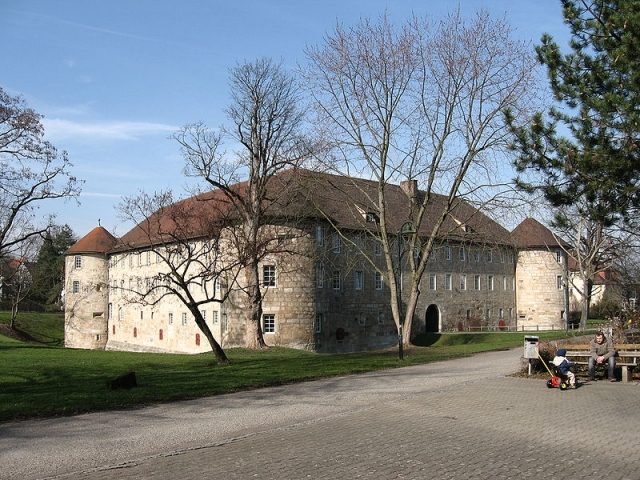
The Schorndorf Castle Palace is the remnant of an elaborate Renaissance fortress and stands on the edge of Schorndorf's old town.

The Castle Palace is located southeast of Schorndorf's old town. It is surrounded by a green area, the castle garden. West of the castle is the Archivplatz with the old hospital and the city archive; further east is the park at Stadthallensee with the former Villa Arnold, which now houses the adult education center. To the southeast are the Feuersee and the Heilig-Geist-Kirche. Directly opposite stands the Hunting Lodge.

Under Duke Ulrich (1495–1550), Schorndorf Castle was probably built from 1538 on the site of an older moated castle. It was intended to serve as a state fortress alongside the fortifications of Hohenneuffen, Hohenurach, Hohenasperg, Hohentwiel, and the city fortresses of Schorndorf and Kirchheim (Teck). In the 16th century, Schorndorf was the strongest city fortress in the entire duchy. The castle was a cornerstone of the elaborately constructed city fortress and survived all storms, including the fire of 1634, which otherwise claimed almost the entire city.

The castle had a permanent garrison and also contained some princely chambers, which could be the origin of the name "Burgschloss" (Castle Palace).

In the 19th century, various alterations were made to the Castle Palace; for example, it briefly served as a barracks from 1801 to 1804. Around 1834, a prison and various official residences were also installed.

The moat surrounding the castle was partially filled in 1837 and later completely; in 1976, the moat was excavated again, and the basement floor was re-exposed. Today, various authorities, such as the district court, are housed in the fortress.

Structure and Special Features+

The castle consists of a trapezoidal four-winged complex with mighty round towers at the corners. The small rectangular inner courtyard of the simple Renaissance building is constructed of half-timbering. Worth seeing are the inscriptions and elaborately designed coats of arms on the towers and above the two entrances to the castle courtyard; a cast bay window adorns the main portal.

Historical Controversy+

Due to the ambivalent appearance of the castle, the transition from a fortress to a palace, which is partly based on the very light and fragile half-timbered inner courtyard, some historians critically view or completely reject its original function as part of the fortress. Edeltraud Geiger argues that the Castle Palace was originally a citadel, whose outer fronts initially only had loopholes.

According to Wolfgang Morlok, the head of the Schorndorf City Museum, the interior of the castle was "far too vulnerable" for fortificatory functions. From this, he concludes that despite its current bulky appearance, the Castle Palace was not part of the defense systems from the beginning. This thesis is supported by the fortress plan of 1730, as it does not include the castle.

Hunting Lodge+

The Hunting Lodge, located opposite the main entrance of the Castle Palace, was built in 1555 by Duke Christoph. It was formerly also referred to as the New Palace.

Later, the chief bailiff lived here, and from 1755, the financial officer had his seat in the New Palace.

From 1810, it served as a hunting lodge for King Friedrich, who enjoyed hunting in the surrounding forests. From 1817, the forestry office was housed here; today, it is the seat of the tax office.

Take Mobile History with you

You are reading this text for free. Premium adds what matters on the road: descriptions read aloud, sites found through your camera, whole regions taken offline.

  • Every description, including the ~17,700 Premium sites
  • Audio guide: have descriptions read to you on location
  • AR finder: see sites through your camera, with distance and bearing
  • Unlimited saved sites

14 days free, then from €2.99 a month. Cancel anytime.

Source: Wikipedia · Licence: CC BY-SA 4.0

This description draws on the facts documented in the linked Wikipedia article; Wikipedia content is licensed under CC BY-SA 4.0. Wording and editing: Mobile History.

Location: 48.8043, 9.5301