CastleSchwaig bei Nürnberg

Schwaig Castle
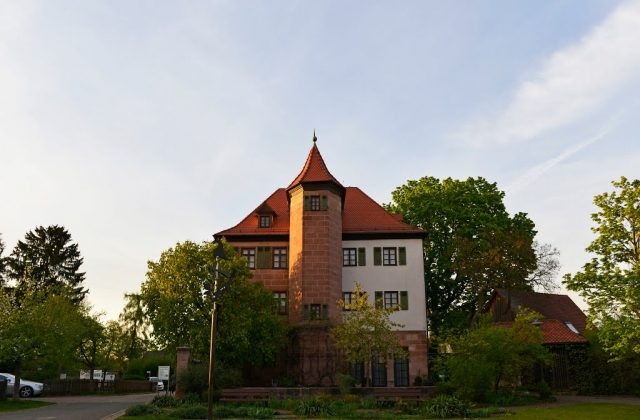
Schwaig Castle

Cultural Events

A manor house was also built in Schwaig in the 16th century on an old beekeeping estate in the Imperial Forest. The exploration of the landscape around Nuremberg, which the Council of the Imperial City had ordered before the outbreak of the Landshut War of Succession in 1504, did not yet identify a manor house in the village of Schwaig. Nuremberg's chronicler Johannes Müllner reported somewhat vaguely in the early 17th century that the estate had belonged to the lord of the manor "in olden times" and then to the Ebner family, before it passed to the Nuremberg citizen Hanns Dietz. In March 1545, the Imperial City demonstrably approved an extension of the already existing manor house for him. The builder, who wanted to set up a stable on the ground floor, was to be allowed to "make a room above it," perhaps at the level of the first attic floor. However, the building was only to be extended upwards: an expansion of the footprint was forbidden, as was the heating of further rooms.

In 1557, Paulus Lengenfelder was the owner of the manor house, which does not appear in any Nuremberg damage lists from 1553 and therefore probably survived the Second Margrave War largely unscathed. He was followed by his daughter, who married a Jorg Schultheiß. In 1559, the latter had to undertake to make structural changes to the "seat or manor house" in Schwaig only with the consent of the Nuremberg Council and to sell it to a farmer approved by the Council in the event of sale. Schultheiß, however, sold the seat as early as 1563 to Endres Melfuhrer. He was followed in 1576/77 by Marx Kötzer and in 1580 by Joachim and Susanna Weyermann. With the marriage of the Weyermann daughter, Hans Christoph Gugel inherited the property around 1589. The apparently still quite modest manor house was then considerably "dilapidated" and also "uncomfortable" to live in, so Gugel planned a renovation in 1590. This was also to involve the demolition of two larger bay windows and three dormers and their replacement by four turrets at the corners, and the construction of a new privy to the east.

Hans Christoph Gugel and his son-in-law Johann Christoph Hardesheim (1575–1620) were followed at the beginning of the Thirty Years' War by Paulus Ayrer, who had married Hardesheim's widow. In 1626, he had an outbuilding erected, which was to accommodate a cattle stable and a bakery oven. A little later, Ayrer then sold to Ludwig Dietherr von Anwanden (1588–1632). Probably around 1632/34, the manor house fell victim to the fury of war. The later owners, Ludwig's son Johann Georg Dietherr (1625–1700) and his brother-in-law Jacob Fetzer (both had married daughters of Johann Christoph Hardesheim), reported in 1666 that their estate had been "for the most part ruined" in the war and subsequently repaired within their modest means. Presumably, the restoration had been rather provisional, because in 1667 a major repair was to begin, for which up to 170 tree trunks of timber were requested from the Imperial Forest. The next major renovation took place under the Dietherr family in 1708, which this time brought with it the expansion of the footprint that had been denied in 1545. This renovation is likely to have significantly shaped the current appearance of the manor house.

Johann Christoph Dietherr, Johann Georg's son, died in 1709 as the last of his line. The inheritance rights lay with the daughters, and after an agreement, Sabina Dorothea finally took over the Schwaig seat with her marriage to Christoph Jacob Waldstromer in 1727. The couple had the farm buildings renewed in 1731. In 1747, the west gable of the manor house as well as parts of the two half-timbered upper floors and the stair tower were dilapidated due to moisture damage. The craftsmen solved the problem by replacing the beams and cladding the western half-timbered facade with flat tiles (beaver tail tiles). Already in 1752, the disadvantages of this action became apparent: larger parts of the half-timbering had completely rotted due to the cladding, so Christoph Jacob Waldstromer decided to replace the first and second upper floors here with solid outer walls. During these years, the interior was probably also modernized, as evidenced by the still preserved Rococo stucco ceilings.

Under Christoph Wilhelm Waldstromer, who had inherited the Schwaig seat in 1766, further extensive renovation measures followed from 1799 onwards. Not only were defects in the fixed furnishings of the manor house remedied, but also in the stables, in the barn, at the Voit and gardener's house, and at three other rented houses owned by the lordship.

Christoph Wilhelm, who had served as the last Nuremberg Imperial Schultheiß from 1804 to 1806, died in 1810 and left the Schwaig property to his son Carl Alexander Waldstromer, who was entered into the Bavarian nobility register in 1814. With his son Christoph Carl Alexander, one of the oldest Nuremberg families died out forever in 1844. Schwaig Castle passed into bourgeois hands and was long owned by the Riegel family. The three-story solid building with the stair tower attached to the south came into the possession of the Protestant church community in 1952, which set up a church hall in the ground floor hall. In 1972, the municipality of Schwaig took over the property, which was first rented out, then renovated around 1992 and set up for cultural purposes.

Take Mobile History with you

You are reading this text for free. Premium adds what matters on the road: descriptions read aloud, sites found through your camera, whole regions taken offline.

  • Every description, including the ~17,700 Premium sites
  • Audio guide: have descriptions read to you on location
  • AR finder: see sites through your camera, with distance and bearing
  • Unlimited saved sites

14 days free, then from €2.99 a month. Cancel anytime.

Source: Wikipedia · Licence: CC BY-SA 4.0 · Image: Jürgen Grösel

This description draws on the facts documented in the linked Wikipedia article; Wikipedia content is licensed under CC BY-SA 4.0. Wording and editing: Mobile History.

Location: 49.4732, 11.1974